Wednesday, November 07, 2007

The real challenge of cutting emissions

In late September President Bush hosted a meeting of the world's largest 16 greenhouse gas emitting countries in late September. The CEI, for their Cooler Heads Digest (sign up on the left-hand bar), obtained the slides from a Power Point presentation that the White House Council on Environment Quality (CEQ) Chairman Jim Connaughton gave at that meeting. Apparently the Chinese and other developing country delegates were shocked - they were right to be. This data shows, in simple terms, just how painful the emissions curbs, Kyoto-plus, agenda would have to be for both developed and developing world.

Essentially, emissions under the Business As Usual scenario that so many global warming policies are hell-bent on preventing goes something like this:


Emissions nearly quadruple by 2095 with nearly all the growth in developing countries. Bear in mind that business as usual expects that the kind of efficiency gains we've been making so far continue - that's why the developed world is already forecast to stall emissions growth despite continuing economic growth.

That sets up a massive challenge for global warming policy that wants to cut emissions to 50 per cent of their levels now. In order to reach that 50 per cent target we would need to make a 15 gigatons of carbon per year cut to get the 2050 levels back down to the level we're at now. We would then need to make another 11 gigaton cut to reach the 50 per cent target. If you're after 60 per cent, as the British Government is, 80 per cent, as the Quality of Life policy group is, or the even stronger target the Lib Dems are aiming at things only get worse.

Cutting a gigaton of waste off what will already be vastly more efficient economies takes some doing. To get an idea of just what cutting a gigaton of carbon means see this table:


Once again, that's on top of expected "business as usual" efficiency gains. Doing any of these 26 times is utterly impractical without incomes taking a serious hit.

Perhaps you think that the developed world should be shouldering most of the work. You're prepared to see our income taking a kicking but don't want to deny the opportunity to develop to poor countries.

Even if you were to miraculously cut developed world emissions to zero, complete de-carbonisation, the developing countries would still need to cut their emissions by 9.5 gigatones, 46 per cent. Growth in poor countries will mean that the rich world just can't do all the work in cutting emissions. If your cut in developed world emissions is more realistic, two-thirds for example, then the developed countries would need to make a 74 per cent cut.

Without some kind of miracle technology you can only reduce emissions sufficiently by radically slashing incomes. There is just no way that the Chinese, or any other other big emitters, will possibly accept this. Cutting their long-term expected income in half, or more, is just not an option at all.

What does this mean for Britain? We already knew that our emissions weren't particularly important to global emissions growth. The UK just doesn't emit that much. Instead of actually changing anything by our actions we were supposed to be "leading". Showing others how it is done. That's pretty irrelevant now. Even if you were to, as some would like to, have the EU put massive trade sanctions on any country that doesn't sign up to our green agenda they're still not going to pay half of their long-term income for the right to trade with us. They certainly won't be shamed into it by Britain's selfless willingness to decimate its manufacturing sector.

Our response to the threat of climate change has to be based on the three sets of measures those of us on the free-market right have been advocating for some time now:

1) Technology - cutting emissions to the level Al Gore, Zac Goldsmith or even Chris Huhne would like isn't impossible. It just requires a miracle. Fortunately science has a history of providing what, to previous generations, would have seemed miracles. There are economical steps we can take that don't screw over our economy and might make such a miracle, or just an incremental technology that reduces our emissions a bit, more likely. Prizes for technological discovery, an alternative to patents that was very successful in encouraging important developments during the Industrial Revolution, are a good candidate that Jim Manzi proposed in a recent National Review article.

2) Adaptation - we can make sure our flood defences are in order, our crops will respond well to the new seasons and take other steps to prepare for the challenges of a warmer world. We can help poor countries do the same. This needn't be particularly expensive and we should avoid doing too much while we don't know precisely what we'll be adapting to but adaptation is clearly a central response to climate change under any sensible programme.

3) Resilience - Manzi put it well: "Wealth and technology are raw materials for options". The most important thing to do in order to be able to withstand an ecological crisis is make sure you're rich to start off with. Rich countries are so much better able to withstand the harms of global warming. If we screw up our economy in a vain attempt to avert climate change future generations will not thanks us.

Tuesday, November 06, 2007

Liberaltarian conspiracy

A lot of right-wingers are very curious about Liberal Conspiracy. All our favourite lefties and many of our favourite ideological curiosities are there.

I think the contradiction that will make it difficult to maintain is that some (I'm thinking Chris Dillow and Gracchi in particular) think "left-liberal" means a libertarian who isn't particularly content with some of the right-libertarian movement's underlying philosophy. Others clearly mean it to be more like an American liberaltarian: Basically a classic statist left-winger with a particular concern for civil liberties. Neither position is illegitimate but they lead to very different practical politics. The ultra-Hayekian viewpoint Dillow advocates, for example, would imply a very small state which is a project a liberaltarian will, at best, spend their time poking holes in.

Now, while I have to write up a long Coasean post and finally tangle with Chris on the economic efficiency of firms (and write more about Rawls) the only real policy difference I can see between him and the very right-wing is immigration. Even there you'll find plenty of pro-immigration libertarians - far more than anti-statist lefties I think. Over at Liberal Conspiracy, by contrast, writers are already writing that "why social and environmental justice are worth spending a lot of society’s money on" is self-evident which suggests statism is likely to rear its head sooner rather than later.

There are important reasons why libertarians and conservatives tend to find themselves in alliance. I detailed them in an article for TCS that I'm still very proud of.

Still, disagreement and controversy on a group blog isn't necessarily a problem. That's generally what drives the Corner's most interesting moments.

I'm not sure what interaction Liberal Conspiracy wants with right-wingers. At first I thought it must want to be a showcase for the best talent the left-wing blogosphere has to offer. Sort of like Comment is Free was originally intended to be. That intention is suggested by the ConservativeHome-like online magazine format and the fact that it has clearly been "marketed" pretty widely. If that is the intention then it could become a great place to go and find all my favourite left-wing bloggers to debate with. The site would want to attract right-wing comment so that the new ideas it purports to promote can be battle-hardened before heading out into the real world.

Unfortunately, one of its very first posts manages a combination of superficiality and self-righteousness that has utterly put me off the whole project. Apparently what Zohra really wants is to escape the real world with all those unpleasant and self-evidently wrong people who disagree - who she never discusses in any tone but utter disdainful incomprehension. She might get what she wants. Ideas and arguments there aren't going to get scrutiny from the Right if we have to wade through such empty-headed sanctimony to get to them.

I've nothing against a forum to discuss ideas among the like-minded. Sometimes you do want to get off arguments about principles. I doubt you'll get that from Liberal Conspiracy though. The Hayekian left is too different to the politics of "social and environmental justice". Also, I'd suggest that if you look at the output of Demos, the IPPR and the other left-wing think tanks and compare it to an organisation like the TaxPayers' Alliance the left needs to do less talking to itself not more - the editor of Prospect expressed the same opinion at their Think Tank Awards this year. Of course that will require Zohra to get over his/herself.

Update: So far the two substantive posts are why we should force students to stay at school longer and why we should ban smoking in public places. It appears the site is less a liberal conspiracy and more a conspiracy to steal the word liberal from its rightful owners.

Monday, November 05, 2007

Jonathan Evans' brilliant speech on MI5 and the terrorist threat

This (via Ben Brogan) is an absolutely superb speech. Well worth reading in full as the press have, very understandably, focussed on the number of potential terrorists and the news that 15 year olds are being enlisted by the terrorist movement. While those are the most sensational and novel claims in the speech this is the most analytically section important in my opinion:

"But before we look at the violent manifestation of that threat in the UK, we need to remember where this comes from. The violence directed against us is the product of a much wider extremist ideology, whose basic tenets are inimical to the tolerance and liberty which form the basis of our democracy. So although the most visible manifestations of this problem are the attacks and attempted attacks we have suffered in recent years, the root of the problem is ideological.

Why? Because the ideology underlying Al Qaida and other violent groups is extreme. It does not accept the legitimacy of other viewpoints. It is intolerant, and it believes in a form of government which is explicitly anti-democratic. And the more that this ideology spreads in our communities, the harder it will be to maintain the kind of society that the vast majority of us wish to live in."


As he describes there is little reason to view 9/11 or any subsequent event at the beginning of this challenge to our way of life and its end is not in sight. It is an attack on our values by those who hate them.

Dershowitz gets censored

This essay is absolutely shocking. Both the account of what's going on in the Oxford Union and the fact that it has been censored. I find the idea that a Harvard Professor of Law's original articles was really beyond the journalistic pale a little far-fetched.

Hutton is not the King

Will Hutton is such a shoddy thinker. His latest piece is little more than blanket assertion about what the best thing to do "obviously" is:

"What should have happened, of course, is that when the Bank of England found that it could not find a secret buyer for Northern Rock in the summer, it should have done what it did in the 1974 secondary banking crisis. It should have taken Northern Rock into the Bank of England's ownership."


He then does nothing to establish quite why this is so obvious. Having the Bank of England take control of a bank and then sell it is a bloody big deal with plenty of transaction costs and a huge signal to the market of weaknesses in the system. He discusses none of the potential problems with his little scheme.

He also doesn't even mention Mervyn King's (someone not only more expert on this matter but also more influential - there's no excuse) alternate explanation of why intervention was so costly. Mike Denham gives some details of King's account and a more conventional view of what went wrong with Northern Rock. For Hutton to write his article without even mentioning this is the height of rhetorical laziness.

The Left's narrative on globalisation

There is a deep perversity to the Left's criticism of global multi-national capitalism that is terribly frustrating.

First, they hold companies operating in the Third World to an unrealistically high standard.

If anything happens in a developed country, from Colombia to Chad, that would look out of place in Crawley they cry foul. I once spoke against a motion at the LSE Student's Union that was going to condemn the entire Coca Cola company because some of its staff in Colombia had murdered trade unionists. While I'm no fan of murdering trade unionists I had to point out that with the sky-high murder rate in Colombia and the sheer scale and breadth of Coca-Cola's global operation this event didn't necessarily signify a systemic problem.

What the lefties miss is what it means to ensure, in the developing world, that factories are as safe, company's dealings are as above board and working conditions are as pleasant as in the West:

It is more difficult, as local staff will be used to the working standards of their own country - often corrupt or unsafe, that's a major reason why the country is poor in the first place. Local staff are essential in most industries and it is utterly unrealistic to expect multi-nationals to maintain perfect control over them. Multi-nationals can change that over time but it can't happen all at once.

It is also fundamentally less sensible. There's no reason why workers in these factories should not accept working conditions worse than those in the West (but still usually better than work outside the multi-nationals) in return for an ability to compete with more productive workers.

I'm not saying that firms should do as they wish and never face criticism for shabby behaviour in poor countries. We should ensure they do what they can. The problem is that more often than not the criticism completely loses perspective and makes investing in poor countries a fools game. If firms take a PR hammering every time anything goes wrong in a Third World factory or if they are forced to provide standards of pay and working conditions that the poor country's productivity cannot afford then they will simply invest elsewhere. While wages in poor countries are low with weak protection of property rights they are often a risky place to invest anyway. The anti-globalisation movement can succeed in stopping multi-nationals investing in poor countries.

When they do that three things happen.

1) Without the capital, technology and exposure to Western business methods that the multi-nationals bring the poor countries stay poorer, longer. With the divide in international incomes closing more slowly the Left complains ever more fiercely about exploitation and inequality.

2) Poor countries have to work still harder to attract international capital that will invest far less in the developing world once the Left has made investing there almost a guarantee of a PR disaster. Working harder to attract that capital means both making investment a better deal and more reliable by going further than rich countries to establish their capital-friendly credentials. This looks, to the Left, like an unfair inequality so they write fierce denunciations of the unfairness of making poor countries adopt more radical pro-capital policies than ourselves. Actually that is just the only way poor and unstable countries can now attract vital capital whether they decide to do it themselves or are forced to by international institutions charged with not wasting donor countries' money.

3) Western capitalism gets criticised for not engaging with Africa. As if they'd get any credit if they did.

It's deeply ridiculous.

Sunday, November 04, 2007

More on the morality of capitalism

Both Ian at Imagined Community and Gracchi have offered up interesting responses to my morality of capitalism post. Here are my attempts at a response, first to Ian:

"Gracchi points us to a well-made argument from our newest colleague in Blogpower Matt Sinclair suggesting that capitalism actually promotes less selfishness than other ways of organising society, but I wonder if it is too abstract. He argues, for example, that "In a capitalist system my well being depends upon anticipating and satisfying the needs of others." Could it be the case that much actual commercial activity is devoted to persuading people they have needs they were previously unaware of that, just coincidentally, Acme corporation can meet with their new product."


This critique of capitalism, that it manufactures demand through advertising, has a lot of intuitive force to it. Marketing told me I had a drastic need for an iPod whose lack I never rued before. However, I think it oversimplifies the process of advertising somewhat.

I'll use the example of the Phillips Wake-up Light that I recently purchased as an example. I saw the advert on the tube before buying it. Before that I had no inclination to buy a wake-up light as a substitute for my alarm clock. I did have trouble getting up. However, I had accepted the unpleasantness of my mornings as a constant and gave it little thought. It was a part of life. Therefore, I was unaware of the need for an alarm clock with the wake-up light's particular method.

What the advertising did was suggest that things could be different and I bought that message. It was less about manufacturing a need and more about making me aware of a need by showing that the need was not simply one more cross I would have to bear. I suspect that this is often the function of advertising. The advertising tells us that we have a need because it convinces us that a part of our life we had given up on as unimprovable is actually highly malleable.

This works for other, more status oriented products as well. We long to improve our status but give up on the idea that clothes can do it for us. We are convinced otherwise. This perception isn't false, people are shallow and clothes can improve your social standing. The shallowness is in ourselves and not our advertising. Some of the earliest human tools found by archaeologists were vastly oversized axes that were clearly unusable but functioned as status symbols.

I'm a little unsure about Ian's next two paragraphs.

"Also, does it risk under-estimating the complexity and potential incompatibility of the recipient's needs?"


Sometimes peoples needs are complex. That's why capitalism's rewards are so much better at encouraging people to take care of each other than the social rewards of gifts and charity that they often develop out of. The price system provides information about which products are really valued and which are valued most.

Ian then talks about the potential of firms to abuse the contracting process. I'm not sure of the particular relevance to this discussion but I'd suggest two common responses:

1) When contracting is particularly difficult a common response is to internalise that work within the corporation. A classic example is research and development. It is hard to specify price and requirement for research and development contracts thanks to the uncertainty that is inherent to research work. That is why research and development has so often been done within the firm or bought in after the fact by purchasing small and innovative firms.

2) Reputation does matter. Even if there are only a couple of firms in the market a duopoly can still be highly competitive. Monopolies are rarer than people think. They tend to exist in either geographical or very small product niches. Even then the monopoly is only pernicious if others cannot enter the market. If others can enter the market an inefficient company will need to stay on top of their game to avoid new competition. True, unshakeable, monopolies are particularly rare without some form of state intervention.

"In fact, surely the tendency to remove restrictions on managed capitalism in the name of the free market has had a significant impact on social breakdown - traditional industries have collapsed, whilst only mcjobs have replaced them."


With so much welfare dependency so often set alongside a need for immigrants to fill jobs I don't think the problem is a decline in economic opportunity. Some communities have suffered with economic change, that will happen under any system as tastes and technologies move. However, the decline has gone too far in too many places where economic opportunity is abundant for economic pressures to explain social decline. I think Dalrymple's peerless essay "The Frivolity of Evil" captures the true cause of social decline far better.

Gracchi's contribution is more esoteric. I think this is the crucial paragraph:

"This is a fascinating film- and there is much more to it than just what I have written- as ever there are interesting things to think about here which I haven't touched on from sex to alcoholism and the nature of addiction. But central to it all I think is this perception of the corrosive influence of capitalism upon our habits, that living in an other regarding society can turn us all into fraudsters and destroy our closest relationships as we seek that popularity known as profit. The point is extreme and in its extremity wrong- not all employment is geekdom. But the point that capitalism undermines true sympathy is an accurate one- and the issue that that points to in morality is a central problem that we live with constantly. This is neither a Randian individualistic manifesto (we are looking for real sympathy and not to abolish sympathy) nor is it a particularly positive manifesto (these problems may be endemic). What it does though is offer a corrective to the too easy view that if an action is other regarding, it is sympathetic. Gresham and the director and actors suggest it isn't."


Gracchi's argument is a funny one as he isn't really arguing for anything. He doesn't claim a moral superiority for any other doctrine (I claim some credit for the proviso he inserts that he isn't really a Randian). In fact, I'm almost concerned that Gracchi has come to conflate any human flaw with some deformity of capitalism. In any political state of affairs our very best instincts can be turned to evil: Love can turn to jealousy. The ambition that drove the most sublime of art also brings us the evil of Macbeth.

Does the desire to be of value to others, engendered by a capitalist system that makes our fortunes contingent upon the fortunes of others, lose its quality because in some it becomes a desire to fool people? Capitalism offers no particular favours to the trickster and will often punish them brutally (losing a reputation for honesty is usually very expensive) if they are found out. I'm not naive enough to think this will always be sufficient but neither am I expecting utopia.

This is clearly a domain for private morality that must be sustained by values and traditions. While I would still disagree with it Gracchi's film may be a better case for the necessity of combining Christian morality with capitalism than for an inherent immorality in the capitalist system.

Saturday, November 03, 2007

Pakistan in trouble

I've been saying for a while that Pakistan is among the most important foreign countries to Britain's interests. With a large Pakistani population here as immigrants and our troops in Afghanistan in danger from militants crossing the Pakistani border we are uniquely exposed to that country's problems. For that reason the dramatic news today that the government has declared a state of emergency, the chief justice has been dismissed, the head of their Supreme Court Bar Association arrested, Benazir Bhutto's return from a personal visit to Dubai cancelled and the media placed firmly under military control should be concerning us all.

I'll post more later today or tomorrow morning if I have any particular thoughts about how this might turn out or what it means in the medium to long term. At the moment it seems very uncertain how it will all play out.

Thoughtful blogging: how and why?

Sunny at Pickled Politics laments that the "elites" in academic, think tank, corporate research (I think that's what he means by analysts) and NGO circles don't get involved in blogging. As my day job is as a policy analyst for a pressure group and I blog both at the TaxPayers' Alliance website and here on more esoteric subjects I'm pretty well qualified to write on this subject.

I first have to take issue with his factual premise. On the right alone there are the Adam Smith Institute (probably the best developed), Civitas, the TaxPayers' Alliance and the Social Affairs Unit blogs. Others don't but, all in all, I'd say that over half of right-wing think tanks have blogs. My impression is that the left blogs somewhat less but there are still plenty of left-wing think tank blogs. That all these organisations are so keen to get involved in blogging suggests to me that the problem isn't, as Sunny suggests, some fear that bloggers will find them out. By putting their research out into the mainstream media they place it in the bloggers' firing line anyway.

So, most of these organisations do blog. What they don't do is interact with the blogosphere much. They can certainly work harder to make their blogs more involving with richer and more varied content. However, I suspect that the real difficulty has something to do with the rapid reaction/gossip focus in the blogosphere that Gracchi discusses. There are relatively few blogs demonstrating the depth of thought of, for an example you might not have heard of, The American Scene in the States. Our blogs are dominated by people expressing their immediate reaction to something they saw in the news. This doesn't take a lot of research, thinking or specialist knowledge to do well so the policy sphere loses its comparative advantage and becomes one more, often rather tame thanks to the need to avoid embarassing the institution, voice in the crowd.

This is not really something I'm inclined to get too worked up about. Blogs are written in people's spare time and the time and attention required for analytical work is a scarce resource. Getting too dissapointed that the product of amateurs writing with very limited time and largely for their own amusement isn't producing Dostoyevsky just seems unrealistic. In the States there is an interesting debate going on about whether Greg Mankiw, an economist with a serious academic reputation who does blog, can sustain that effort and whether he should.

First Dani Rodrik suggested that the best writers are the ones with the highest opportunity costs to their time blogging:

"So if economists with high opportunity costs of time start to get out, shall we have a lemons problem on our hands? Will eventually the only prolific bloggers remain the ones that are not worth reading?"


Blogging has very low entry costs but relatively low rewards relative to other ways someone with novel and interesting perspectives to share can express themselves. Iain Dale advised that the blogs further down his rankings needed to work on increasing their readership. If I write a report that gets covered in the Sun or makes the front-page of the Metro I reckon it will, in number of readers, achieve more than even the biggest blog can in months if not years. Look at the media coverage that the capital projects report got, if I'm interested in readership why should I bother blogging?

Perhaps we blog for irrational reasons, Nicholas Carr suggests some:

"But what's left out of all these economic equations is the ego-gratification that comes from being a popular blogger. Because blogging is such a personal pursuit, with strong and immediate ego-rewards, it can be irrationally seductive, particularly to highly competitive overachievers. The hazard - and this applies as well to disciplines beyond economics - is that extraordinarily talented individuals may end up, like lab mice drinking sugar water, spending more time blogging than they should, even though their comparative advantage is smaller in blogging than it is elsewhere. Distorted by noneconomic but nonetheless powerful rewards, the idea market would become less efficient than it should be, and we'd all suffer as a result. The real danger, in other words, may not be that the "lemons" - the "tolerable bloggers" - will take over as the mainstays of the blogosphere but that they won't."


Seth Finkelstein suggests some more reasons why people will over-blog in the comments:

"1) The lottery-like nature of the success argument.

Lotteries have negative expected value. This is very obvious. But people don't make good expected-value calculations overall (the ones that do, don't play lotteries!). This is apparent in the common evangelism marketing represented by the part about "actively demonstrating one's skillset for an interested public". There are very few winners in that game. But an unlimited number of aspirants can be induced to buy a (losing) blog-ticket in hopes of becoming one of the lucky few.

2) The objects-in-mirror-are-smaller-than-they-appear

It's really easy to think that your blog is far more influential that it is. A niche celebrity will attract enough of an audience to seem impressive, even though objectively, it's likely not. But still, you can readily get the impression it's more effective than rationally justified.

3) Random reinforcement

The occasional high-attention hit is great for misleading the blogger that they matter."


I only mention all this to illustrate how uncertain it is that analytical thinkers should get actively involved in the blogosphere. Perhaps those who do so now are essentially acting irrationally. Neither Gracchi nor Sunny ask the simple question, why should someone with interesting and novel things to say use the blogosphere as a medium? What is in it for them?

I'd suggest a few answers:

1) Anonymity - some people can only write on a broad range of topics with the cloak of anonymity or risk endangering their careers.

2) A place for ideas that are interesting but not worth the greater effort of preparing them for publication in another medium with greater rewards but higher standards. The blogosphere provides a small but significant reward for the presentation of ideas that aren't yet ready, are of interest to too small a niche or are not sufficiently novel for the big time.

3) A testing ground for incomplete ideas and arguments. If you have ideas that you are unsure of then dicussion in the blogosphere can either confirm that they are interesting and stand up to scrutiny or can reveal where more thinking/research is needed.

1) is significant but pretty constant. I think 2) is the reason most think tanks blog now. 3) probably has the most potential to encourage intellectually significant blogging. What is interesting about 3) is that it relies very heavily on a network. Blogs are most valuable when you are interacting with other bloggers who can challenge you and provide social rewards for your most interesting efforts in exactly the same way that a phone is most valuable when there are plenty of other people to call.

That might explain why it is difficult to get an analytical blogosphere going. I reckon lots of smart people start blogging and don't find it rewarding because they don't get into a community whose praise and criticism can make it worthwhile. That community is what those of us who want to see a more thoughtful blogosphere should all try to build.

Friday, November 02, 2007

Blogpower

I have now been approved and am a member of Blogpower (check out the links on the right). I like the group and only certain practical considerations have prevented me joining sooner. There are two things I think it does better than any other online community I've seen:

1) It creates a space for a reasoned dialogue between people who disagree. Too many bloggers are terribly concerned for rules and netiquette but miss the more important need to be respectful and friendly; to build a sense of community that makes everyone confident to venture their opinions and good-natured when they disagree.

2) It exemplifies the incredible connections that can form on the Internet. The sheer diversity of Blogpower, the range of backgrounds and experiences brought together, is amazing. You never know where you're going to find your audience and normally our social circle is so restricted. The Internet can offer us a way out of those narrow bounds and I see so many examples of Blogpower doing so. Wonderful.

Thursday, November 01, 2007

Libertarians and Monarchy

Devil's Kitchen and Peter Risdon are having a debate about the monarchy. First, can and should a libertarian be a monarchist? Second, should we adopt DK's particular plan for giving the monarchy 'hard' power within our constitution again?

I should qualify that I am not a libertarian so am writing about a doctrine not my own. While I still have relatively liberal views on many touchstone social issues, and always come up as a strict libertarian on the silly ideological tests, I am philosophically conservative. However, I still have a feel for libertarian thinking from my student days, I should be okay.

I find myself forced to write in abstention on this idea. Libertarians should be fundamentally unimpressed by the very question of how we choose our leaders.

Peter's notion that democracy is preferable because rights flow from the people is less than libertarian. People are the only ones who have rights in libertarian thinking but they have no rights over other people, whether they are alone or part of a group of a million. Libertarianism is at root sceptical of democracy and libertarians have often been at the front of opposition to its excesses. While I am not going to pretend that Ron Paul has the power to pronounce what libertarians should believe it is not a coincidence that he has been so hawkish on the constitution, itself a compromise with democracy. While, historically, limiting the power of the monarch has been essential to liberty that does not mean that, right now, monarchs contribute to the progress of illiberalism.

In the end, I don't see a libertarian answer to how we should be governed except "less". I think a Hayekian would prefer a decentralised democracy as it best brings in dispersed knowledge but Hayekians and libertarians are not, despite there being plenty of overlap, the same group.

So, I don't think there is a more or less libertarian form of government. Is DK's idea a good one anyway?

My own understanding of what makes the British monarchy so great is that it provides a figurehead for our law and tradition who is above politics. The only guard to real, crushing tyranny in Britain, or any country with or without a constitution, is that British people would find it morally and aesthetically repulsive. Constitutional 'rules' only help if people rally around them. Otherwise a majority or a disproportionately powerful minority will just break the rules.

Unfortunately a liberty-loving population is hard to maintain. A host of things from state dependency to terrorism to foreign attack to economic stagnation threaten it. You need the population of your liberal state to be both capable of living without state support and want to. You need to be able to provide credible security. Producing a decent society where people respect each other's freedoms, person and property is about as hard a policy challenge as they come. Getting it right is really rare and the system is under huge strain in the UK for a host of reasons. The monarchy is a powerful symbol of tradition and law that people rally round and that is not contaminated by distrust of politics. In troubled times getting rid of that would be quite a risk.

That's why I dislike the Devil's proposal to have the monarch veto bills that threaten a constitution and be dethroned if the people, through a referendum, decide that they have failed in that duty. By making the monarch one more wielder of temporal power he also makes them part of the political process. There's no way someone whose decisions we will debate over and can dethrone if we don't like their constitutional judgement can remain above politics. We will lose our monarchy and gain a sort of deformed supreme court. That is not an idea I could support.

Wednesday, October 31, 2007

Public service oddities

Following on from my discussions of some curiosities I found in the NHS here are some more tales of public sector eccentricity.

NHS Trusts like to get creative


South London and Maudsley NHS Foundation Trust has an online art gallery on its website. I'm not quite sure why. This is the most subversive picture I've found so far. I'm not sure whether this is your tax pound at work or whether it is funded in some other way.


If you'd like another example of NHS Trusts getting artsy look to the Princess Alexandra Hospital NHS Trust. They have a flash intro to their website. Inspired.

The Tote used to be owned by noone

The Tote has a statutory monopoly on pool betting on horses races since it was created by a 1928 Act of Parliament. When Labour went to privatise it they found that they had to nationalise it first. Until that happened, with royal assent in 2004, it had no owner.

The Tote was a living and breathing company with employees and profits but wasn't owned by the state, society, any individual or other organisation. It gave its profits to horse racing related charities but was really its own creature.

I see the light

This is the first time I'm working through winter having left the irregular student schedule behind. I finally get just how strange it is to be leaving work when it is already dark. Stepping out at six to seven in the evening and finding that it is night time is very strange and a little disconcerting.

I'm fortunate enough to work in a bright office with plenty of windows and it is still light when I walk in to work at eight. As such, I haven't had the experience, that I've heard some people describe, of going the entire day without seeing natural light.

I'm fortunate in another way. I'm not much of a mornings person but at the end of last week I bought this:


It's brilliant. Slowly lights up over half an hour and then wakes you up with a gentle sound at the end.

I bought it on Friday and it has now been 'road'-tested. First, how good is it at waking you up?

So far I've used it for three work days. For one I was very tired and it got me out of bed quickly and into work without too much grouchiness. Today I was a bit tired but basically fine and I got up easily. Yesterday I was very rested and I almost bounded to work. It really does make getting up in the morning much easier.

Second, are you sharper on waking up?

I had the alarm wake me up on Saturday morning to do an interview at 8am on slopping out in Scottish prisons with Talk 107. A relatively challenging radio interview if you want to do it well without sounding simple or unpleasant and risky when you've just woken up. It went really well. I didn't have any morning grogginess and was on top form.

It's pretty expensive but this is an unflashy but genuinely useful gadget. I'd highly recommend it.

Tuesday, October 30, 2007

"... and scientists predict that by 2050 there will be 32.9 scare stories for every person in Britain"

This, by Johann Hari, is unpleasant tripe:


"Back in 2001, I wondered out loud – and in print – if it would take "an environmental 9/11" to finally break the corporate brake that is holding up all action on global warming in America. Since then, New Orleans has drowned, the South-east has dried up so severely the city of Atlanta is nearly out of water, and the skies over California have been turned red by the worst wildfires since records began.


More than a thousand people have died, and more than $70bn worth of property has been destroyed. Seeing Americans huddled together in refugee camps is something that no longer shocks us on the nightly news. Yet still the political debate in the US remains stuck far short of the drastic cuts in carbon emissions we need now if we are to stop this Weather of Mass Destruction.


The science is clear: these apocalyptic weather-events are unlikely to be freak one-offs. While it's hard to link any single hurricane or vast fire to global warming, Katrina and California's wildfires fit into the wider warming pattern of increasingly freaky weather predicted by climatologists as the world gets warmer."

DK points out that patterns of both rainfall and hurricanes have been pretty good over the last few years. Rainfall was poor last year but that was an exception rather than fitting some rule while hurricanes are actually at a historic low.


All this is highly persuasive and clearly Hari is playing at The Day After Tomorrow inspired doom-mongering in the Al Gore style rather than actually attempting to tell an honest story about American political discourse. However, the sheer strength of the data supporting DK's position worries me. It is setting up a very low base.

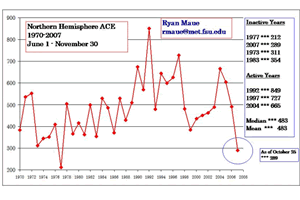
So far the pattern of hurricanes has been this:

If the frequency of hurricanes has nothing to do with climate change then, as far as I and other lay observers are concerned, it is a pretty random pattern. God may not play dice but as we don't know the factors driving hurricanes let us assume they're random. It isn't an assumption I'd recommend doing anything serious with but it will work for the purposes of this post. That makes it entirely possible that over the next few years the pattern will be:


The number of hurricanes could go up more, it could go up less, it could continue to fall. However, looking at the graph like that it is pretty clear that there is no reason to blame global warming. It would still look like a pretty random process.


However, I don't think that will stop some people claiming it as evidence for global warming. I think they'll present the pattern (not necessarily graphically) as:


They'll probably do this by saying something like: "the number of hurricanes has doubled in the last three years". Worse, someone - probably Dr. Someone - will do this:


The light-grey line is a projection and it pretty quickly leaves the historical range. An economist will be found to turn this into a prediction that the associated costs will be some astronomical portion of world product. A new scare story will have been born. Some lonely voices will point out that the trend described is misleading but they won't be able to make much of a difference.

Maybe I'm being too cynical but when a man can get a Nobel Prize for his documentary the same weak it is judged, in court, to have fatal flaws something has probably gone very wrong with the debate itself. What particularly angers me is that it might well be Johann Hari himself deploying the new 'increase in the number of hurricanes' as part of his rhetorical case. If he can get away with falsehoods now what is to stop him getting away with mere misleading statements in future?

What is even more infuriating is that I can see this coming but there's nothing that can be done about it. All we can do is hope that there are still bloggers around to point out the deceit and that someone is listening to them.

Monday, October 29, 2007

Bullets

It's been frustrating me for ages that with my template bullets weren't showing up. It just looked like I was quoting someone else. Fortunately, Blogger's Help function absolutely rocks and it answered my question in no time at all. Now I have bullets and only feel slightly foolish for leaving it this long. Huzzah!

The NHS keeping busy

I've wondered a few times whether it would be a serious service to the British political debate if someone were to plot out the different NHS institutions and how they interact with each other. It's a real jungle out there.

Take a look at the institution for five minutes and you quickly realise how utterly absurd it is to hope that such an unwieldy and byzantine structure, both centralised and out of control, can deliver a modern healthcare system. The politicians in charge don't have a clue and, for all the excellent people in the health service, the professionals get ground down by the system. All we can do is advocate real reform and, until that happens, enjoy the sheer strangeness of it all. Here are some things about the NHS that have been amusing me recently.

The Chief Executive of Christie Hospital NHS Foundation Trust has a podcast

Inspiring. I haven't watched through the archive yet. I'm not sure whether I should be pleased that they're trying new things or horrified that they're spending their time producing these little promo videos which I'm almost sure no one will be watching.


Chesterfield Royal Hospital NHS Foundation Trust are using Mr. Eugenides as a model for their promotional material


He looks scared.

This may not seem notable but all the other pictures in hospital accounts are so posed its nice to see this one so poorly composed. A document that looks professional generally reflects well on the organisation producing it. Unfortunately, many public bodies take that principle a little far and have clearly put more time and money into their annual reports than is sensible. The Public Accounts Committee is, naturally, the role model they should be looking to emulate.

Quango titles are special

Here are some favourites of mine, all from the Department of Health, which is only surpassed by the Home Office for number of quangos:

  • United Kingdom Xenotransplantation Interim Regulatory Authority. Despite its title suggesting it is a stop-gap solution this body has been in place since at least 1998.
  • National Radiological Protection Board. Lead-lined presumably. This was phased out in 2005 so either its been merged with some other organisation with much moving of desks or we're all in serious radiological danger.
  • Advisory Committee on Borderline Substances. This sounds too silly for words.
  • Advisory Committee on Hepatitis. Filling the role that used to be filled by the sober best friend before society went to the dogs.
  • Advisory Committee on Clinical Excellence Awards. Hard to parody.

Sunday, October 28, 2007

Big numbers

Some numbers are so stupidly large it's hard to get your head around them. I don't mean obvious ones like how large the universe is. I mean everyday, politically important facts. An interesting challenge is how you make the figures meaningful. A classic example is to put an amount of spending, waste or taxation in £ per household.

Sometimes you can be more adventurous. As of the 30th of September 2006 our little nation employed 554,000 civil servants. That's a staggering number. How can you make it meaningful?

All you can do is look for the right comparison. That means that there is nearly a civil servant for every hundred people in the UK. That our army of civil servants is now larger than the army that Napoleon used to invade Russia (at that point the largest army ever assembled in European history). Herodotus estimated that the construction of the Great Pyramid of Giza required 100,000 workers for 20 years. Blair could have had civil servants build him two in his years as Prime Minister with plenty of time to spare. When you put it like that you start to realise how ludicrously large the bureaucracy is.
"Sure it's hard work, but the pension's still great."

When this doesn't work statistics can be quite hard to absorb. Mike Denham has looked into evidence recently submitted to parliament on immigration trends. The numbers are incredible. Talk of a need for integration might even be missing the point. If these predictions come to pass what we're going to have to do would seem more analogous to the building of a new nation, similar to the process the United States went through.

I'm still not entirely sure I've got my head around the numbers. That shows how useful the little mental tricks like the ones I've demonstrated above are.

Saturday, October 27, 2007

MessageSpace is Annoying

I don't think I'm the only one who finds Message Space Ads infuriating.

Absolute rule number one of producing a usable content-rich website, except for in certain corporate cases, is that you should never play sounds without your user requesting them. This is particularly true for websites, like blogs, that people read late at night or while at work when they don't want sound suddenly blaring out of their speakers. If I'm checking the blogs for relevant stories in the morning I don't need Charlie Falconer's opinions on a ban on lies or an imitation of 24 being played to a quiet office.

It's particularly frustrating because the sound often doesn't play immediately and when I am browsing I tend to switch between tabs at a blinding rate. I'm left flicking through the different sites I have open looking for the ad so that I can shut it up.

This isn't in the interests of advertisers for two reasons:
  1. I usually stop the sound by stopping the advert playing so do not see their message.
  2. If I do see the ad it will be after it has annoyed me which is an association most advertisers don't want me to be making.
If someone associated with MessageSpace reads this then please adopt the practice of the advertising agencies that place ads on newspaper websites - make it possible to turn on the sound but by default have it off. That way I'll watch more of the ads and will often turn the sound on out of curiosity if the ad is good. Your advertisers will thank you.

Friday, October 26, 2007

Gracchi on the demise of the Union

Brilliant post by Gracchi on devolution and the Union. He sets out how the "uncomplete and incomprehensible" structure set up by the "ad hoc opportunists of Millbank" could lead to the Union's ruin. Scottish politics becomes ever more militantly anti-English as leaders seek to differentiate themselves and offer a narrative to their new nation. He doesn't mention the other side of this, the English feel steadily more aggrieved and will prove unwilling to pay bribes to keep the Scots onside.

This post comes about as close as Gracchi gets to real anger. His rage is well placed. Inspired leadership could bring about a renaissance for the Union yet but it now seems probable to me that it will not make its 400th anniversary. Those ministers responsible might well be dead when the United Kingdom passes into history but they will still bear a shame with only a few dismal historical parallels. They will have destroyed one of history's great nations.

It is almost unfashionable to really love the Union these days. Most English men and women will react with indifference or hostility if you tell them their loyalty should be to a United Kingdom. However, while I do increasingly feel English myself I still find the decline of the United Kingdom unutterably sad. Three hundred years of matchless achievement; of glory, genius and creativity; of a unique presence in the world, would be over. The nation that built the greatest Empire the world has ever seen might die.

The most recent historical analogy I can think of is 1453 when the Byzantine Empire made its last stand. While the Greeks would revive later, as I trust the English will, the Roman Empire was gone. While the role of Constantine XI, the leader who presides over his nation's death, is not yet filled the role of that nation's destroyer is clearly played by the "ad hoc opportunists of Millbank" who set up a federalism of such inequity and imbalance it cannot last.

If all this comes to pass and blame is laid where it is deserved the names of Blair, Brown and the rest will attain a genuine and lasting infamy. History will judge them harshly.

The Union Modernisation Fund still allows the Unions to buy taxpayers' money

Labour haven't had the easiest time fundraising over the last few years. The honours scandal was both symptom and, in turn, cause of that weakness. In 2005 they created the Union Modernisation Fund. Possibly the most venal act of the Labour government.

Francis Maude was right to describe it as "very, very direct sleaze. That is buying influence and buying taxpayers' money." Guido's graphic sums up the process nicely:


The Government's rationale for this is that the unions increase productivity and this would help them continue to do so. This doesn't fit the historical record, union power led to a dismal productivity record that only improved when Thatcher weakened the unions enough that working practices could be reformed. Even if unions did improve productivity there is little reason to think that giving them money to train their senior officers or produce an elaborate website would strengthen that effect.

On 11 September this year the second round was announced (DOC). The big unions, USDAW, CWU, NASUWT and others, got more taxpayer money. Some unions that don't donate to the Labour party also got funds but that's a pretty thin smokescreen, it only means anything if you assume the Government have some aversion to spraying taxpayers' cash around. It doesn't make this scheme look any less like an elaborate laundering of taxpayers' money to me.

What I didn't know until today was the identity of the head of the Union Modernisation Fund Supervisory Board. Under any honest scheme the UMFSB's chair would be a disinterested sort who could provide an independent perspective on the unions' projects and assess which would best contribute to an efficient workplace. Instead, we have Sir Bill Connor. He left a senior position in the union movement, General Secretary of USDAW, the shop-workers union, and, went straight across to head the agency supervising the distribution of Union Modernisation Fund money. Some of the money even goes to USDAW. The Government doesn't just fund the unions, it allows them to distribute it themselves.

Thursday, October 25, 2007

Jeremy Leggett on Renewable Power

Leggett's article for Comment is Free is so idiotic it is positively painful. I'll fisk it and then quickly conclude with a little examination of his dubious byline:

"When Britain and Germany raced to scale up their aircraft industries for war in the 1930s, the British competed rather well. Recovering from a late start, we rapidly produced machines capable of winning the Battle of Britain.

Today, the two nations are on the same side in a different battle, but Germany alone is mobilising as fast as it did 70 years ago."

If we're on the same side why would we want to race the Germans? Who cares if they win. Their gain is not our loss. Quite the opposite. If they develop the renewable technologies we can use them. Welcome to post-mercantilist economics.

"Our common enemy is global warming, and it is already at our gates. But while our German allies are turning out the renewable energy equivalents of Messerschmitts by the factory-load, Britain is again slow to spring into action."


Okay, they can bring the renewable power technology; we'll bring the City, Canary Wharf and associated financial innovation. We can't produce everything so why should we distort our investment market in an effort to race the Germans for the renewable energy market? Specialisation can make us all better off.

"Worse, as we learned yesterday, officials responsible for UK mobilisation have told the prime minister it is impossible for us to build modern-day Spitfires in any number. We should instead oppose European targets set recently for such mobilisation and join other laggards in order to persuade the Germans to scale back their own efforts."


Perhaps they've realised that big subsidies for renewables may not be a particularly efficient way of reducing emissions.

"On Tuesday one of the main architects of Germany's renewable energy policy, Hans-Josef Fell, was in London to give a press conference on peak oil. In this issue lies another, related imperative for nations like Germany and Britain to be mobilising for renewable energy as if for war. A group of German scientists, the Energy Watch Group, has completed the latest in a crop of studies showing that oil is depleting far faster than previously estimated, and that a global energy crisis is imminent. Renewable energy and energy efficiency are the only technologies that offer any hope of staving this off in time."


Anyone who pretends to have a good idea of the amount of oil left in the ground is trying to fool us or themselves. Besides, shortages of hydrocarbons aren't an externality so the market will create the proper incentives to switch to other sources of power. There is no market failure here for government to address.

If all you're worried about is dwindling reserves then you're worried about them increasing the cost of hydrocarbon-based power. The idea that the best response is raising the cost of hydrocarbon power is pretty bizarre.

"Fell spelt out Germany's success with renewables. In 2000, when he and other parliamentarians pushed through a law to fast-track renewables markets, such sources contributed 6% to the national electricity mix; the target was 12% by 2010. Three years ahead of the target, they are approaching 14% - and have created 200,000 jobs in the process."


Have they created more jobs than would have been created if the free-market had invested the capital instead of it being forced by the state into the hands of renewables companies? Opportunity costs!

"International investment patterns tell the story. Some $1 trillion, globally, will go into energy this year, and more than $100bn of that will be invested in renewables. Renewables make up just 2% of the global mix, excluding large hydropower schemes, and yet about a tenth of global energy investment now flows into them. Renewables companies are lining up to be quoted on stock exchanges, and those already listed have strong share prices. But as things stand, only a tiny proportion of this investment bonanza is heading into Britain."


Almost all of that development is utterly dependent on subsidies. It isn't a competitive industry at all. What that means is that each country pays for the investment either from its exchequer or through a levy on energy production.

"The German renewables market is being fed by funds raised from a levy on energy bills to guarantee premium prices for renewable electricity. Britain's Department of Business, Enterprise and Regulatory Reform says the UK's renewables obligation, a certificate-based scheme for growing renewables markets, works better. Ofgem and the Carbon Trust are among the many who disagree. It is easy to see why. In 2006 the cost to the average German household of the tariff was £12 a year. The average UK household paid £7 a year under the renewables obligation, but that delivered significantly less renewable capacity. German windpower capacity is 10 times that of the UK today, and the energy it produces is 30% cheaper; German solar power capacity is 200 times that of the UK."


An energy production levy is particularly cruel as it means taking money from the very poorest. We demonstrated in the TaxPayers' Alliance report on green taxes (PDF) how regressive any measure increasing the cost of electricity is. Poor families pay more, as a portion of their income, than the average and the rich pay the least. While £7-12 pounds isn't a lot of money it is significant and could be spent in another way or deliver a tax cut that might make a small but meaningful difference to a number of poor families. That is quite a price to pay to distort the market in favour of renewables.

"Consider the stakes here. If we fail to contain global warming, we put the economy at risk. If we continue to ignore peak-oil warnings, we will plunge into the chaos of a third global energy crisis. If we continue to allow investment to flow uncontested into countries with a renewables vision, UK plc loses out on any prospect of a serious share in the next global business revolution."


1) Britain's renewables subsidy won't make a significant difference to global emissions. It makes no important difference to the amount of risk the economy is at from global warming.

2) I've dealt with 'peak-oil' already. "Oh no! An energy crisis is coming and we'll all suffer as energy gets more expensive. Better make it expensive now to end the suspense!"

3) There are plenty of plausible "next global business revolution". I think the market is better at identifying them. Renewables, which are dependent on big subsidies, are a particularly poor candidate.

"· Jeremy Leggett is author of Half Gone: Oil, Gas, Hot Air and the Global Energy Crisis"


The Guardian's byline tells us only that he has written a book about energy policy. This suggests that he is an 'expert' in the field and little more. How has such an expert produced such a poor article?

It appears the reason is that the article is more corporate PR flyer than intellectual search for truth. If you look at his profile on Comment is Free it turns out that instead of being an independent expert he is actually "chief executive of solarcentury the UK’s largest independent solar electric solutions company". If that isn't enough "he is, in addition to his solarcentury role, a director of the world’s first private equity fund for renewable energy, Bank Sarasin’s New Energies Invest AG". This is a man with a massive personal stake in subsidies for renewable power that guarantee its future. For the Guardian to put him up as merely a concerned author writing on his subject instead of mentioning front and centre that he is a part of the renewables business he wishes to see subsidised is an abject failure of journalistic standards.

I'm all for business leaders speaking for their industry. I don't mind newspapers printing what they have to say. However, that depends upon two key conditions being met:
  1. They must have something interesting and coherent to say. Instead, this article just ignored basic economics and spouted phony analogies about Spitfires.
  2. It must be clearly acknowledged - in a prominent position on the same page as the article - that they have an interest in the matter.
Neither condition was satisfied with this article. Deeply shoddy.

Wednesday, October 24, 2007

The far left combusts

RESPECT are tearing each other to pieces. I think this sort of thing happens about once a decade to serious consternation within the far left and general amusement among the roughly half dozen people outside that movement who notice. There are some truly hilarious statements flying around. For the right-winger who wants to have a bit of a smile at their incompetence there are a couple of decent sources in the blogosphere, thanks to Dave Cole for alerting me to all this - he has his own thoughts and questions:

  • Dave Osler first links to various statements from the SWP, Worker's Liberty and a couple of other sects and then expresses his own exasperation with it all.
  • Harry's Place has a statement from George Galloway and assorted cronies. Dave Dudley then offers what I'm pretty certain is a satire of it all.


When you see what this crazy lot are up to it is a potent reminder of how precious the relative unity of the centre-right is.

The Barnett Formula Question

I don't know anything about the Justice for England group but this ad, via James Forsyth on the Spectator Coffee House, is one of the best low budget political virals I've seen. The music isn't great and the production values aren't exactly Hollywood but the simple message is superbly presented and well-focussed. Justice for England have done a great job:


Forsyth asks why the West Lothian question doesn't come up. He shouldn't be so surprised. A clever political campaign won't use up scarce public attention dealing with constitutional matters if they don't need to. People are slow to get worked up about procedural issues because those issues don't have the same tangible and direct effect on their lives as fiscal ones.

Is it really surprising that those outside the Westminster bubble will find the West Lothian question's procedural problem far less galling than the idea that they might die or remain ill because of an unfair distribution of public spending? Or that their children might not get the same standard of education?

This is aimed at the elderly concerned for their health and parents concerned about their children. It is expertly targetted at what people actually care about. An outraged video about the West Lothian question wouldn't be nearly as effective. The numbers of the people in the UK who really care about the details of the constitutional settlement probably number in the low thousands. Those who care about drugs to treat the elderly and schools and universities for the young form a majority of sixty million.

Making political dishonesty illegal

Gracchi has already blasted the "Ministry of Truth" film calling for a lying by politicians to their electorate to be made illegal. He points out that one man's lie is almost always another's truth. That truth itself is an uncertain commodity in politics. Unity, at the original Ministry of Truth, argues that the programme is based upon a flawed conception of the British constitution.

When I first saw the film a couple of weeks ago I was endlessly frustrated by the programme's failure to consider the unintended consequences of such a law. The massive problems the proposed law would create seem pretty obvious but the film didn't address them at all. Here are two big ones:

1) What is a lie?

Incautious statements, mistakes, exagerrations as a result of differing priorities and values sets and simple disagreements with a heavy majority have all been termed lies over the years. These are not the outright lies that the programme clearly aimed to prohibit but disentangling straight "he said this when he absolutely knows that it is untrue" lies from statements which are more difference of opinion than lie would be an essentially arbitrary process in many cases. The massive grey area that surrounds lying would make for messy, unpredictable and possibly arbitrary legal sanction.

2) Giving the courts a veto over candidates for office

This law would mean that the courts would rule on whether a politician had lied or not and, on the basis of that ruling, whether they can stand for office. That would mean that rule by the people would be replaced by rule by the legal oligarchy. Ordinary voters would only be allowed to choose within the confines of honest and trustworthy politicians not condemned by the courts. We would be using lawyers instead of theologians but otherwise our system would bear a marked semblance to Iran's.

The legal process isn't perfect. It can be abused by those with better lawyers or the sympathies of an unrepresentative legal community (very capable of swaying juries if this is a matter for jury trial). The courts have already, in my opinion, gone too far in assuming a power to fight democratic decisions. No body so free from democratic accountability should be given such broad powers to decide who is fit for office.

Monday, October 22, 2007

Fixed Term Parliaments

I'm not exactly fiercely opposed to fixed term parliaments. I doubt they would bring the country crashing to a halt. It just seems that those proposing them haven't really identified a problem. While Conor Burns clearly really hates Brown all of the other examples he brings up of governments that went to the polls early he thinks are legitimate. See these sections of his ConservativeHome article:

"Looking back over all the elections since the Second World War there have actually been very few serious accusations of the incumbent Government abusing the constitutional right of the Prime Minister to seek a dissolution of Parliament before the end of the full term. Some mild, and predictable, partisan noises have been made about advantageous budgets prior to the elections of 1955, 1966, 1970, and 1987 (2 Labour, 2 Conservative). In both 1964 and 1978 it is arguable that the governing party postponed by 6 months from their planned election date in the expectation or hope of better conditions at the latter time (1 Labour, 1 Conservative)

So where then would Gordon Brown’s aborted snap election have sat in the historical sweep? It would have clearly been out of kilter with every other election we have seen since the Second World War.

Did Brown require to get a working majority as Wilson did in 1966 or October 1974? No, Labour has a working majority of 69 seats.
Does Brown face a national crisis such as Ted Heath confronted/created in 1974? Not that we yet know about.
Did he want to call a snap ‘mandate’ election a la Eden in 1955? Well Eden called an election quickly. Brown has been Prime Minister since the summer.

[...]

Every previous Prime Minister has had profound respect for the British constitution. All of them have used their power to call an election in order to win – but only because each has believed that their vision would be best for Britain. Not this one."


If most Prime Ministers do not seek to abuse the system, Conor Burns argues that only one has, then there is only a problem if those that abuse the system benefit. If they do then others will have an incentive to emulate their misbehaviour which will mean things get worse and those that have misbehaved will have benefitted from their misdeeds which is morally distasteful. However, the only Prime Minister identified by Conor Burns as abusing the system has gained nothing. In fact, he has taken a massive beating in the media and the polls.

That's the system working! A successful constitution (written or unwritten) is not one that no one can abuse seeking partisan gain. Such a system does not exist. Instead, a successful constitution is one where that partisan gain does not materialise. Gordon Brown's comically unsuccessful attempt to manipulate the electoral calender to his own ends demonstrated the strength of the British system, not its weakness.

Iain Dale further confuses matters by arguing that Fixed Terms are great because they don't need to be fixed. What the point of these unfixed Fixed Terms is supposed to be I'm unsure.

We should all be cautious of constitutional changes that initially seem sensible but address no significant problem. Constitutions are complex creatures and the most successful generally evolve slowly over decades and centuries. There can be major unintended consequences to any changes. Screwing with the British constitution, one of history's most stable and effective, for transient or insubstantial reasons is dangerous.

Idiocracy


I watched Idiocracy this evening. It bombed in the US and I'm not even sure it went on general release in the UK. The basic idea is that two very average people are put into an extended hibernation and wake up 500 years later thanks to a mistake. A pretty standard sci-fi device. However, instead of a sinister dystopia or a flawed utopia the hero and heroine wake up to a world gone stupid.


While it is very much in the style of director Mike Judge, creator of Beavis & Butthead and Office Space, it is pretty funny. I watched it because I read, some time ago now, a review by The American Scene writer Reihan Salam who asked whether it was actually making an interesting point, there is some evidence that growth in intelligence has stalled, and suggests that it was commercially unsuccessful because it genuinely challenged the people watching:

"If Office Space is about taking responsibility for your own happiness, Idiocracy is about something larger, namely our responsibility for our shared future. Like all the best dystopian fables, Idiocracy is a scathing indictment of our own society. And so it begins in the present with a brief portrait of the villains who are destroying America, represented here by an affluent couple and an imbecile ne'er-do-well named Clevon. The two yuppies are shown agonizing over the decision to have a child. It's never the right time, until the right time finally comes—and the couple is infertile. The yuppies will leave no legacy behind. Clevon, in contrast, lustily and enthusiastically impregnates not only his wife but a bevy of gap-toothed harridans, each one dumber and uglier than the next. The screen slowly fills with his spawn, foreshadowing the nightmarish future to come.

[...]

Because Joe occasionally enunciates, he is immediately under suspicion as a "faggy" and otherwise obnoxious person, infractions that somehow lead to his incarceration. Eventually, Joe—with the help of the defrosted Rita—chooses not to "get out of the way." At great personal risk to himself (he narrowly escapes death at the hands of a monster truck built to resemble an enormous metal phallus), Joe saves the world from starvation. But he also saves himself from his own laziness and self-absorption, not least of all when he starts a family with Rita.

Now, Idiocracy isn't perfect. Despite being only 84 minutes long, it drags at points and feels more than a little shaggy. Plus, there's obviously something a little creepy about all this. Is Mike Judge really saying that some people should breed and others shouldn't? Well, sort of. But he's also taking on the laziness and the self-absorption, and the materialism and the willful ignorance, of his own audience. Watch Dogville or Fahrenheit 9/11 or even The Passion of the Christ and you get the distinct sense that you're being congratulated for believing the right things. Rare is the movie that challenges your beliefs. Rarer still is the movie that tells you you're a fat moron, and that you should be ashamed of yourself. The unmarried adultescents swarming the cities, the DINKs who've priced families with children out of the better suburbs, the kids who never read—these are Hollywood's most prized demographics, and Mike Judge has them squarely in his sights. Is it any wonder 20th Century Fox decided Idiocracy would never be boffo box office?"


If you get over the idiotic "what, are you a nazi?" response to anything smacking of eugenics it is hard to argue with the logic of the central thesis here. If evolution means anything then it is that the traits in any species most associated with breeding large numbers of surviving offspring will rise to prominence. It is hard to escape the conclusion that these days less intelligent people are more likely to have more children and with modern healthcare and agriculture even the least intelligent can usually be kept alive through their idiocy and are unlikely to starve to death.

Even the suggestion in the film that the smartest couldn't work out how to save the species as they were too busy inventing hair loss and erectile dysfunction remedies makes some economic sense. What makes capitalism so moral and so democratic is that the best are forced to make themselves useful to the mass market. That market has usually contained enough variety and enough intelligent people that an intelligent person would only have to sacrifice a limited amount of income if they catered for a refined niche, particularly with the smart often - although definitely not always - commanding greater buying power. Dumbing down has been less of an issue than snobs would suggest. However, if the tastes of the masses degrade sufficiently the difference in economic returns between doing something smart and catering to the stupid could be sufficient to drag down all but a tiny minority of the highest minded doomed to irrelevance and slow extinction in ivory towers.

However, the problem I have with all this, and eugenics in general, is that the theory has such a dismal predictive record. I've seen adverts from the early twentieth century, when eugenics was still considered a liberal and progressive thing to believe, that showed a similar complaint that the less intellectual were breeding faster. Despite that no one thinks that the pattern of increasing intelligence stalled in the twentieth century. What happened?


I don't have any answers but with such a glaring failure to predict I think that we need to do some thinking about the complexities surrounding genetic change.

China's 'what if?'

I watched the Painted Veil this evening having missed it at the cinema. It shows the age of its material with a pace that is on the slow side but if, like me, you have the attention span it is a rewarding film. Set in twenties China it describes a young English couple whose trainwreck of a marriage recovers in the face of the adversity of a cholera epidemic.


The landscapes are stunning and the entire film is shot and acted with reserved but effective emotion. The story follows a familiar arc but does so with care and dignity. This film is well worth watching on a quiet, unhurried, evening when you have time to savour the ambience.

The portrait of the early days of the Chinese Republic is only fleeting and you should not watch this film expecting to learn much (there are Chinese films which can do that if you do want a cinematic introduction to Chinese history) but I still found it fascinating.

I find almost any portrayal of China between Sun Yat-sen's founding of the Republic and the Communist takeover fascinating. China is so massive and so important that it is incredible to think back to when its fate really hung in the balance, when things could have been so radically different. My impression is that Chiang Kai Shek, while no liberal, had limits. It seems utterly incredible that he would have descended to the horrors of the great tyrants of the twentieth century as Mao did. If mainland China had made anywhere near the progress Taiwan has instead of falling into the madness of Maoism then we would be facing a very different world, millions of Chinese would not have died unnecessarily and the culture of an incredible nation would not have been ransacked.

But perhaps I'm wrong. Perhaps the horrors of Maoism were the product of grand forces and a mighty collision between a fumbling modernity and ages old tradition. Certainly, there are few examples of the transition being made cleanly.

There are deep methodological questions underlying any attempt to answer China's great 'what if?' Tolstoy's War and Peace critique that we should look to underlying causes rather than the sparring of kings, chairmen or generalissimos cries out at anyone supposing that Mao or Chiang Kai Shek could have made such a massive difference to the progress of such a large portion of mankind.

Still, all of my experience of the place and people and the example of Taiwan and Japan suggest that there was no force compelling China to lapse to dictatorship. Could things have been different? Should we concede that the horrors of Maoism really were the result, in the end, of such relative trivialities as Stalin kidnapping Chiang Kai Shek's son and using that as leverage to defend Mao's vulnerable revolution?

Friday, October 19, 2007

Extremism in the LSE Students' Union

The Jewish Chronicle report an absolute scandal that I've been following at the London School of Economics Students' Union. The following letter from the Students' Union General Secretary, Fadhil Bakeer Markar, and Mature & Part Time Students Officer, Ziyaad Lunat, was sent to every fresher:


The rhetoric is deeply inflammatory and partisan. From the statement that "800 Palestinian children have been killed by the Israeli Occupation Force" to "our fellow Palestinians", to the idea that Israel denies the right to education and "Israeli policies of segregation, isolation and persecution of the Palestinian population" the letter would be more at home in some Islamist newsletter than being sent to every LSE fresher.


This is particularly shocking as the letterhead suggests it has been paid for with students' union resources which means that it has been funded largely through the university's block grant and, therefore, partly by the taxpayer.


Also, the LSE is a very international university and, although I can't find statistics, I know that Israeli students do attend. This kind of massively biased language coming from Students' Union officers who are supposed to be looking after students' interests could contribute to creating a real climate of fear. We've all grown accustomed to students saying crazy things but the manner in which this extremism was expressed makes it worrying in the way a lone crank sounding off is not.


I hope and believe that the extremists in charge of the Students' Union are not representative of the broad community of students. Unfortunately all of us with a connection to the school are demeaned by the hatred of a few.

Why first-time buyers have felt the increase in stamp duty

Sometimes an important step in understanding the social impacts of a tax is to understand what it is best compared to. Council tax is a classic as it doesn't look nearly as painful when compared with average incomes as it does with pensioner incomes. Stamp duty is another. In politics it is easy to understand stamp duty as 1 per cent or 3 per cent of the value of a home which makes it sound relatively mild. However, far more relevant is the comparison with the deposit which shows how painful the tax can be for first time buyers.

The average first time buyer pays a deposit of £28130 and stamp duty of £1500. That means that stamp duty is fully 5 per cent of the average first time buyers deposit. It gets worse in London where an average first time buyer deposit of £53136 is accompanied by a £7500 stamp duty bill. In London stamp duty is on average 14 per cent of the deposit thanks to the average home qualifying for the 3 per cent slab rate. Those numbers, now looking quite significant, reflect the actual comparison people make when buying a new home and illustrate why Stamp Duty can make difficult purchases much harder.

(data here)

Wednesday, October 17, 2007

Primary school democracy

Last night's Panorama dissapointed me. They showed the Why Democracy? film that was so excellent after newsnight last week, my initial thoughts are in this post, during the programme but in a massively cut-down form that lost a lot of the spirit of the original film. To see the entire thing in its full glory go here.

Tuesday, October 16, 2007

Power, Productivity and Office Linebackers

Learning by doing, the idea that people get better at a job after they've done it for longer, is somewhat of a conundrum in that it is both useful to theory and almost self-evidently exists but has proven so empirically challenging that it has not gone far in the literature without running into trouble.

The scale of learning by doing is important because it can, theoretically, provide a competitive advantage to incumbent firms that have more experienced and learned employees. If learning by doing provides a competititive advantage for some firms then it can create a path dependency which would form a barrier to entry and be anti-competitive. If, on the other hand, it exists but not on a scale sufficient to provide a significant competitive advantage or is impossible for firms to capture by holding onto more experienced employees then all it will do is act as a slight and rather inconsequential delay to the introduction of new technologies.

The problem for economists and economic historians seeking to answer this question is that it is fiendishly difficult to do so. A classic example of how this has been studied in the past is a study by David in 1973 which examined improvements in productivity in the Lawrence Mill, no.2 in 1830s Massachusetts. This mill managed a superb increase in productivity without commensurate changes in capital or labour and David attributes this to learning by doing. However, Lazonick and Brush responded in 1985 suggesting that the most important factor driving productivity increases and decreases may really have been changes in the amount of effort put into production as companies became more or less powerful with new, more or less transient, workers and, hence, more or less able to squeeze harder work out of their employees.

Maybe this explanation is too technical. This viral ad I found via 18DoughtyStreet explains it very well:


In my experience, this is one of the most pleasant results of an academic education. I saw the ad on 18DoughtyStreet and it set me thinking about the broader implications of the process of control the programme was satirising. The great joy I have taken from my academic training is that constant stream of thoughts and ideas provoked by everyday experiences and stories. I love it and hope it isn't a habit I lose over time.

Anyway, back to learning by doing: Whether it is power that explains gains in productivity isn't really what is crucial to the learning by doing debate. There could be a host of reasons why productivity growth was more or less than that expected by a simple analysis of the amount of capital and labour in the plant. There are a thousand factors that David might not have thought of that might be the 'real' explanation of the productivity gains in the No. 2 Mill. Thompson, in 2001, examined another classic case of learning by doing, the Liberty Ship programme during the Second World War when the US rapidly expanded production of merchant ships. He includes measures for capital deepening and changes in quality but still accepts that there may be other factors he has not thought of in the residual that he wishes to identify as caused by learning by doing.

The only study that might get around this is one by Leunig, an academic from the LSE who authored a housing policy misunderstood by Iain Dale. He found data sufficiently detailed that it would allow him to study the production of individual workers as they gained more experience and, hence, avoid using a big, aggregate "everything else" residual as his measure of learning by doing. Unfortunately he has studied an industry, cotton spinning, with high labour turnover and piece rates that mean firms could not take a competitive advantage from learning by doing. We live in hope that a similar study can be attempted on an industry, like British shipbuilding up to the First World War, that does appear to have suceeded through learning by doing.

I think the difficulty robustly empirically answering this simple question should give us all pause when we are tempted to make too definitive statements about the lessons of history. There are thousands of similarly complicated questions (Was market irrationality the cause of the 1920s crash? Are patents crucial to innovation?) that people like to assume are settled. History is so complex and controversial that it should rarely be used to end debate (the "look what happened when..." argument is used too confidently, too often). One example of why the argument from historical analogy can be wrong is highlighted by the Lucas Critique. Only when we combine experience with coherent logic as to why that experience came to pass can we really claim to have a decent understanding of what is going on in the world and what might happen in the future if we change policy.

Show some respect!

This really angers me:


First, these statues are really old, I don't think that a non-expert can really have a good idea of what will damage them. For the Terracotta warriors to have survived two thousand two hundred years only to be damaged in a self-righteous berk's publicity stunt would be a real tragedy.


Fortunately, it appears Martin Wyness, serial eco-protestor, hasn't damaged them but he has still shown a massive disrespect to these artefacts by using them for his stupid little demonstration. Relics of earlier ages like these should be shown respect as they represent a vanishingly rare link to the past. Particularly in China where so much was destroyed in the great cultural tragedy of the Cultural Revolution. I also think that, when the pictures of this reaches China, the resemblance of the masks placed on the warriors to Asians during the SARS crisis will be considered rather offensive. I feel embarassed to belong to the same nationality as Martin Wyness the eco-idiot.


The last time I felt a similar anger was when the May Day protestors defaced the Cenotaph. Giving Churchill a mohican is one thing, he'd have seen the funny side. Defacing a war memorial to more honourable men who died in the defence of our nation is something else entirely. Both the Terracotta Warriors and the Cenotaph have such meaning that any infringement upon them for political purposes requires a person to be utterly small-minded, crass and self-obsessed. Protesting against Chinese CO2 emissions is, I think, misguided but is definitely entirely legitimate. Doing so in this way is disgusting.

Monday, October 15, 2007

Menzies Campbell

I didn't and don't agree with Menzies Campbell a lot. However, you can still feel for someone facing the sad fate of a political career ending not just in failure but in humiliation.

The closest comparison I can see is Iain Duncan Smith. Both of them fell as quiet men who just couldn't make it as leaders in the brash game of modern politics. That could be a reason to be optimistic for Menzies personally: It would be impressive if he can engineer a similar renaissance as a powerful advancer of a particular cause.

A lot of people are talking about his age. I don't think it was his age itself that did it. Michael Howard never faced the same ridicule and would not today (watch him arguing on TV) despite them both having been born in 1941. The problem was the same one faced by IDS. He just didn't have the charisma to lead. People will rationalise that charisma in many ways: Menzies it too old, IDS was too bald. Neither flaw was really the fatal one.