
I've been canvassing recently and people are invariably utterly civilised. Even those who will never vote Conservative treat you to a friendly "you're wasting your time mate". It really does give me hope that the ASBO culture can be beaten.
You get some strange responses though. One told me that he'd vote Conservative if I could promise that the councillors would end all the violence in the world and poverty in Africa. I answered that this was probably beyond the authority of a district councillor.
The strangest, which I've heard repeatedly, is the charge "we only see you once a year for the elections" or some variety of that. What do people expect? Do they want their councillor cold calling them in case they are having problems?
If they had tried to get in touch with their councillor and had been given the cold shoulder it would be understandable. If a council had ignored serious problems they had it would be fair enough. However, "we only see you Conservatories [sic] at election time" is just bizarre. One of those statements that people seem to have internalised as sensible when it is actually pretty crazy.
Friday, April 27, 2007


I Know Who I Am!
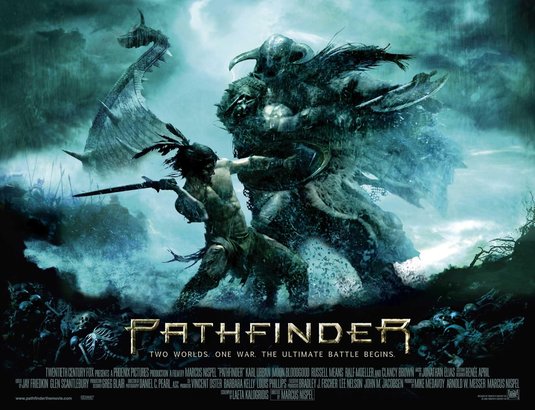
Pathfinder is a dismally bad film. This review contains spoilers but there isn't much to spoil.
Don't go and see it thinking the reviewers might just be a little pretentious and unwilling to enjoy an unashamedly fun film. Don't think, as I did, "surely a film with Vikings in it has to rock". It is truly bad. I am sufficiently open-minded to idiotic fun that I enjoyed Doom but found this an absolute chore.
It continues the Last of the Mohicans tradition of having the Native Americans win but only with the aid of a converted white guy. It is as if these films are trying to send the message "we don't think our culture is superior, but our bloodline clearly is". Rather politically incorrect which makes you wonder how Last of the Mohicans has become such an icon. I guess people missed the subtlety.
In the film Tomb Raider 2 Lara meets up with an African tribe who are going to help her. At that point I actually turned to the friend I was watching it with and said "we'll need a black guy to sacrifice in case anything goes wrong". Three seconds later they were all shot. Some films just seem to feel the need to address different races and cultures without the slightest idea of how to fit them into the story. It tends to end in hilariously unintentional breaches of political correctness. In this film it was a Native American army that managed to charge into a set of spikes their white guy (the hero) had set for the Vikings. Useless hippies.
The action is a bit lame preferring tepid setpieces to genuine trials of strength, cunning or valor. A particularly awful segment is the 'shield body-boarding' episode. What is strange is that the hero doesn't actually do anything but just sits there and gets lucky in not being planted into trees like the Vikings.
However, this film does have one redeeming quality. Its most absurd moment. The hero defeats the Viking chief by shouting "I Know Who I Am!" in Norse so loudly that he causes an avalanche which sweeps the poor Viking to his doom. Myself and a friend had driven to a cinema in another town to see this film and the entire ride back was spent shouting "I Know Who I Am!" at each other, the carpark and random strangers. Good times.
Thursday, April 26, 2007
Sometimes it isn't easy being green...
More and more councils are having waste collection take place every other week. The Conservatives I am campaigning for are likely to introduce fortnightly collection. The change is a response to a major increase, by the government, in landfill charges. Councils can either take drastic action to increase recycling or face heavy new charges and be forced to cut other services or increase taxes.
Fortnightly collection is not popular, it comes up on the doorstep and people really resent it enough to change their vote. There is a great variety of reasons why people are already throwing out enough to fill their bins each week; keeping chickens was an example I heard today. For many cutting that amount down through recycling isn't as easy as the measure requires it to be, as those designing the policy assumed it to be. That such a basic service as waste disposal cannot be delivered by a council strikes people as incompetent.
This unpopular measure is forced by the Labour government's changes to the landfill tax. It is implemented by councils running fortnightly collection. The Conservatives have lots of incumbent councillors who are being blamed for a Labour government measure. Getting the message across that this isn't the Conservatives councillors' fault is an uncertain process. I'm not sure if this was a conscious choice when formulating the policy but putting the measure in place this way, forcing councils to do the dirty work, is quite an effective means for Labour to make Conservatives pay the electoral price for this unpopular measure. Crafty.
The Conservatives aren't exactly blameless though. The best response to this measure would have been that increasing the amount of waste we recycle might be a good thing but it is hardly the most pressing priority. The increased landfill charges should have been opposed as an overly drastic measure people needed time to adjust to by changing their consumption habits and that might, otherwise, increase fly-tipping and create serious problems for those who can't easily recycle more. However, when you're trying to set yourself up as the new Green messiah you can't really oppose any measure which sounds as green and ambitious as a big increase in landfill charges designed to force councils to work harder at encouraging recycling.
There are plenty of benefits in terms of the 'dog whistle' effect and preventing Green Party protest votes but there are political costs to playing the environmentalist. In these council elections we might start to see these political costs to environmental sanctimony.
Wednesday, April 25, 2007
The Victorians
This video, via Gracchi, provides a wonderful view of the remarkable achievements of the late-nineteenth, early twentieth century. Seeing it reminded me of the film The Prestige which also deals with the Late-Victorian age. Both capture, in their own ways, the immense technological and social changes going on at the time. The Prestige provides a fictional depiction of the magical quality of the technologies of the time, particularly electrical engineering. The video above captures the extent that technologies and organisations built then have defined the modern experience.
I get the feeling that we underestimate the pre-war era. Perhaps I'm extrapolating too much from my own experience. When I first read George Dangerfield's The Strange Death of Liberal England I remember being struck by how little I knew of the society, economy and politics of Britain and the World before the First World War. During my economic history education the qualities of this era between the pioneering Industrial Revolution and the dramatic catastrophes of the Twentieth Century constantly stood out. For example, this was an era in which Britain invested more money abroad than any society before or since. We may be 'globalising' now but trade was freer before the First World War although many countries did have tariffs to generate income. Am I the only one who sees this era as a blindspot?
I can see two reasons this might be the case. First, the drama of the First World War obscures less dramatic goings on pre-war. The years prior to the war are thought of as its precursors rather than a period of history in themselves. Equally, the pre-war years are seen as a continuation of the novelty of the Industrial Revolution that largely took place earlier in the nineteenth century. Second, I wonder whether we assume that the relatively straight-laced morality of the Victorians, the high watermark of social taboo, must have made them less creative. It evidently did not.
The Green Peril
Are the UKIP on the march? Not really. 1% of the electorate (even that number may have been rounded up) and some absolutely tiny numbers in recent electoral tests suggests the party has had its moment. The party may experience a revival with the next set of European elections. However, it clearly has utterly failed so far to convince the electorate it is anything but a single-issue, fringe party.
Now, that a party only appeals to 1% of the electorate doesn't mean that it is electorally unimportant. If those votes are in the right places they could cost a mainstream party seats.
I've been doing some activist work for the Conservatives in the run up to the May 3rd elections in the heart of right-wing Middle England. If the UKIP were to succeed I would expect it to start here. While the blogosphere assumes that the greatest threat to the Conservatives is the UKIP everyone I speak to seems far more worried by the Greens of all people. The UKIP generally has no organisation and its support has been drifting in the last few years. The BNP's presence is in rough areas where the Tories have little to lose. The Greens are increasingly active and are far more likely to pick up a protest vote.
You can see this difference in the breakdown of the Communicate poll on ConservativeHome yesterday. Leaving aside the Celtic nationalist parties the largest 'Others' are the UKIP on 1%, the BNP on 2% and the Greens on 3%. Of course, all of these parties pale in comparison with even the Lib Dems on 22% who are still the recipient of most protest votes. If Cameron worries about voters who dislike Labour drifting to other parties this suggests he should continue his efforts to woo the rather confused right-wing Lib Dems, strengthen his environmentalism and then promise hard action on immigration. Attempting to appease the UKIP follows a weak fourth.
None of this has any bearing, of course, on the question of whether taking a tougher line on Europe is the right thing to do. I don't think more misjudged environmentalism would be a good idea despite the fact that it might gain us important votes from Lib Dems and Greens. However, it does mean that those who couch their case for a tougher Conservative line on Europe in terms of electoral pragmatism are rather misguided.
"It's Your Time You're Wasting" by Frank Chalk
It's Your Time You're Wasting isn't as entertaining as PC David Copperfield's Wasting Police Time. There are some very, very funny moments but there is a cynicism borne of the fact that Chalk, unlike Copperfield, leaves his profession at the end. While you will enjoy reading this book if you just want to read an amusing account of public sector bumbling read Copperfield's.
Equally, it doesn't have the profundity of Dalrymple's Our Culture, What's Left of It. I am unaware of any that can match that the depth of that book's account of the cultural problem facing modern Britain. This is no condemnation of Chalk's work but advice for those seeking a 'primer' in modern social conservatism. This isn't the place to look. Chalk's book functions, like Copperfield's, as further, first-hand primary evidence of the problems Dalrymple discusses.
This book is important because education is, and should be, so central to any policy programme which seriously wishes to combat a host of social problems. "Education, education, education" may have come to nothing but Blair said it for a reason. It highlights the problems with modern education. Many of these stem from an unwillingness to properly sanction troublemakers. Other problems emerge from the ability of troubled students to stop the progress of students who behave. The most touching parts of this book are when Chalk discusses bright and pleasant students from poor homes being entirely let down by the system.
If you can cope with the understandable cynicism this book is well worth reading.
Tuesday, April 24, 2007
Mike Denham compares Tesco to the NHS
This is brilliant. It frustrates me when people target Tesco for their anti-capitalist fervour. Supermarkets are held responsible for social trends they are the symptom of. The fall in the numbers of families including a non-working partner who has the time to visit a half-dozen shops is what kills small shops not some misbehaviour by Tesco. While there aren't a lot of different supermarket chains they appear to be competing fiercely.
Mike Denham makes very sensible points about the efficiency of private enterprise like Tesco. He compares this to the NHS. He refrains from arguing that NHS inefficiencies are caused by particular policy mistakes. Instead he identifies the fundamental problems with public services being provided by a centralised state accountable to politicians rather than consumers.
18 Doughty Street need to get better at enabling embedding. Then bloggers can more effectively spread their citizens journalist clips about.
On 18 Doughty Street...
Last Friday I took part in Vox Politix. It is now archived here. I think I did alright. Evidently, I could have used some more sleep and exercise but never mind. Some interesting points in there if I say so myself.
Monday, April 23, 2007
UK Government to Issue Islamic Bond
Ed Balls announced today that "the Treasury and Debt Management Office would look into the cost and benefits of the government issuing Islamic financial products in the sterling market, and publish the results of the study by the end of the year."
The new Islamic bond pays on the establishment of Britain as an Islamic Republic. When asked about a likely date a Treasury official answered "some time next century". This makes it a long-term investment expected to appeal to investors interested in other long-term and risky debt such as pre-revolution Cuban bonds.
It is thought the bond could also be attractive to firms likely to suffer in the event of Britain's becoming a part of the Dar al-Islam. Allied Pork Products, Diageo and Richard Desmond have all expressed an interest in using the new product to hedge against the business risk posed by the implementation of Sharia Law.
Happy St. George's Day
 Also, I think Andrew Rosindell's call to make St. George's Day a bank holiday, replacing May Day, is a fine idea. Might piss off the Socialists as an added bonus.
Sunday, April 22, 2007
The Miliband Heuristic
Miliband has announced he won't be running for the leadership of the Labour party.
Look at the prospects for Miliband if Labour loses the next election. He'll be the clear favourite and still reasonably young and untainted. He may have thought he could improve Labour's prospects but that the next Labour leader was sure to fail. Better to lead a recovering new Labour Party than be the bookend of the Blair government.
By contrast, if Labour wins they'll limp on for a parliament under Brown. After that, they could lose heavily and a Conservative government could last more than one parliament. Even if Labour keep on winning that just means more years serving under Brown. However it plays out Miliband would have to wait at least eight years for his chance at the leadership, probably longer. By then he would no longer be the fresh candidate. He might also have become more closely connected to an unpopular government or suffer some other calamity.
It could be Miliband's nerve failed him, it could be he really thinks Brown is a better candidate than himself for the Labour leadership. I suspect he thinks Labour are going to lose.
Saturday, April 21, 2007
Finally...
I have, at last, managed to move this blog to New Blogger. Very exciting.
Sorry there were no posts yesterday. A combination of being very tired and going on 18DoughtyStreet (combining the two is a bad idea). There probably won't be anything substantial today either as I'm off to the park, taking the train to Letchworth and then going drinking. Normal service should be resumed on Sunday.
Sorry there were no posts yesterday. A combination of being very tired and going on 18DoughtyStreet (combining the two is a bad idea). There probably won't be anything substantial today either as I'm off to the park, taking the train to Letchworth and then going drinking. Normal service should be resumed on Sunday.
Thursday, April 19, 2007
Gracchi's further thoughts on Labrador Conservatism
Gracchi responded again to my arguments for a 'Labrador conservatism'.
His first argument is that I have only confronted the soft judgement of pronouncing immoral someone who does not look after their children properly rather than someone who does but is unmarried. He is right that I cited the case of a man who serially abandoned his children which is an easier case. Now, of course marriage does not trump all other moral concerns. I know parents who have done a perfectly good job despite not being married. They are certainly morally superior to the married couple who beat their children or each other.
However, on balance marriage is a morally superior choice. Even if people can do a good job raising their children without being married that is a rejection of genuine commitment. Marriage isn't just one more way to reach the ideal of a stable family unit. It is inseparable from the taboos and standards that ensure commitment to family and children in our society. Rejecting a social commitment when children are involved is, all else equal, an immoral choice.
Of course, a single parent may be unmarried through no fault of their own thanks to avoiding some abuse, being abandoned or facing serious, irreconcilable, differences that makes marriage cause more harm than good. They clearly deserve little criticism. However, this doesn't invalidate the wider moral judgement. I can't be a philanthropist like Bill Gates but that doesn't mean his choice of philanthropy can't be a morally good thing.
He is right that I am supporting marriage to some end. However, this is as true for religious conservatives who see marriage as fulfilling God's design for human relations as for me believing it is a fine social arrangement. Very few people think of marriage as a good genuinely in itself.
Second, Gracchi sets up an absurd dichotomy on the idea of financial incentives to marriage. He argues I have to either believe that fiscal policy can make no difference to the marriage decision or that it will trap people into abuse. I've already set out my view on the true effects of fiscal incentives:
Apply Gracchi's dichotomy to the labour market. Does he believe that the salary someone is offered makes no difference to the job they take or that if offered a pound an hour more we'd all readily become human guinea pigs?
Gracchi's final argument is a mish-mash of returning to the question of whether I am willing to make a moral judgement about marriage and a consideration of the relationship between politics and policy. He has completely missed the point on the distinction between politics and policy. I'm not suggesting politicians should ignore the detailed impacts of policy. The debate we're having above is clearly crucial prior to putting in place fiscal incentives to marriage.
However, politics isn't just about policy. Politics should, and I'll quote myself again here, "embrace a broader debate over how our society should be ordered rather than treating every problem as a policy brain teaser." If David Cameron's talk of marriage results in no policy at all he will still have done the nation an enormous service if he can effectively make the case that we should not "treat criminals like victims, parents like children and moral judgement like some kind of plague." While good policies can make a difference changing social attitudes is the more crucial objective.
His first argument is that I have only confronted the soft judgement of pronouncing immoral someone who does not look after their children properly rather than someone who does but is unmarried. He is right that I cited the case of a man who serially abandoned his children which is an easier case. Now, of course marriage does not trump all other moral concerns. I know parents who have done a perfectly good job despite not being married. They are certainly morally superior to the married couple who beat their children or each other.
However, on balance marriage is a morally superior choice. Even if people can do a good job raising their children without being married that is a rejection of genuine commitment. Marriage isn't just one more way to reach the ideal of a stable family unit. It is inseparable from the taboos and standards that ensure commitment to family and children in our society. Rejecting a social commitment when children are involved is, all else equal, an immoral choice.
Of course, a single parent may be unmarried through no fault of their own thanks to avoiding some abuse, being abandoned or facing serious, irreconcilable, differences that makes marriage cause more harm than good. They clearly deserve little criticism. However, this doesn't invalidate the wider moral judgement. I can't be a philanthropist like Bill Gates but that doesn't mean his choice of philanthropy can't be a morally good thing.
He is right that I am supporting marriage to some end. However, this is as true for religious conservatives who see marriage as fulfilling God's design for human relations as for me believing it is a fine social arrangement. Very few people think of marriage as a good genuinely in itself.
Second, Gracchi sets up an absurd dichotomy on the idea of financial incentives to marriage. He argues I have to either believe that fiscal policy can make no difference to the marriage decision or that it will trap people into abuse. I've already set out my view on the true effects of fiscal incentives:
"I would argue that marginal financial incentives are unlikely to either 'create' marriages or sustain them through serious abuse. It will affect those marginal cases of marriages which have gone a little stale or are going through a rocky patch. In these cases the huge social costs of divorce suggest we should want people to err on the side of staying married. At the moment, with a tax system which will often leave people better off if they divorce, we do the opposite and incentivise divorce."
Apply Gracchi's dichotomy to the labour market. Does he believe that the salary someone is offered makes no difference to the job they take or that if offered a pound an hour more we'd all readily become human guinea pigs?
Gracchi's final argument is a mish-mash of returning to the question of whether I am willing to make a moral judgement about marriage and a consideration of the relationship between politics and policy. He has completely missed the point on the distinction between politics and policy. I'm not suggesting politicians should ignore the detailed impacts of policy. The debate we're having above is clearly crucial prior to putting in place fiscal incentives to marriage.
However, politics isn't just about policy. Politics should, and I'll quote myself again here, "embrace a broader debate over how our society should be ordered rather than treating every problem as a policy brain teaser." If David Cameron's talk of marriage results in no policy at all he will still have done the nation an enormous service if he can effectively make the case that we should not "treat criminals like victims, parents like children and moral judgement like some kind of plague." While good policies can make a difference changing social attitudes is the more crucial objective.
Obama should learn when to keep quiet
In trying to sound terribly profound Obama actually equates hearing the words of Don Imus and losing your job to outsourcing with being murdered in the Virginia Tech shootings:
"As you all know 33 people lost their lives today, this morning. Most of them were of the age of many of the young people in this audience, they were going to class, they had their lives in front of them, their parents were proud of them and looking forward to having them home for summer or visiting them on campus and their lives were cut short in a tragic and random fashion.
[...]
There's also another kind of violence though that we're gonna have to think about. It's not necessarily physical violence but that the violence that we perpetrate on each other in other ways. Last week, the big news, obviously, had to do with Imus and the verbal violence that was directed at young women who were role models for all of us, role models for my daughter. I spend, along with my wife, a lot of time making sure that my two young daughters, who are gorgeous and tall and I hope will get basketball scholarships, that they feel good about who they are and that they understand they can do whatever they can dream might be possible. And for them to be degraded, or to see someone who looks like them degraded, that's a form of violence - it may be quiet, it may not surface to the same level of the tragedy we read about today and we mourn, but it is violence nonethesame.
We [inaudible].... There's the violence of men and women who have worked all their lives and suddenly have the rug pulled out from under 'em because their job has moved to another country. They've lost their job, they've lost their pension benefits, and they've lost their health care and they're having to compete against their teenage children for jobs at the local fast food place paying $7 an hour."
Wednesday, April 18, 2007
Brown's Air Passenger Duty Rise Increases Emissions
The Sun is terribly impressed by "Stormin' Gordon" pointing out that "the Tories have NO plans to reinstate the pensions dividend he axed in 1997". Given that the Tories have made clear they plan to put alternate arrangements in place to reverse the damage (ending stamp duty on shares has been suggested) this is a pretty lame rebuttal.
Barely a day goes by when evidence doesn't come to light of some new Brown incompetence. Now this research by Mayor and Tol (who was cited by the BBC protesting at Stern's misrepresentation of his work) for the Economic and Social Research Unit in Dublin suggests that Brown's increase in Air Passenger Duty was a shoddy idea even without applying it retroactively like a crazy person:
That's right. He's doubled the tax on flights and succeeded in slightly increasing carbon dioxide emissions from air travel. Brilliant.
Apparently the Tory plans, which only tax flights beyond a certain number of miles per person, are better. The allowance for short range flights mitigates the Air Passenger Duty distortion. However, the Conservative proposal would have roughly the same effect as abolishing Air Passenger Duty. Why can't we just do that!
This is almost a textbook example of unintended consequences. A poorly worked out policy which will have the opposite effect to that intended. At the same time it places an increased burden on ordinary Britons taking well-earned holidays. Yet more evidence that Brown should be in mortal fear of losing his current job rather than expecting promotion.
Barely a day goes by when evidence doesn't come to light of some new Brown incompetence. Now this research by Mayor and Tol (who was cited by the BBC protesting at Stern's misrepresentation of his work) for the Economic and Social Research Unit in Dublin suggests that Brown's increase in Air Passenger Duty was a shoddy idea even without applying it retroactively like a crazy person:
"We use a model of domestic and international tourist numbers and flows to estimate the impact of the recent and proposed changes in the Air Passenger Duty (APD) of the United Kingdom. We find that the recent doubling of the APD has the perverse effect of increasing carbon dioxide emissions, albeit only slightly, because it reduces the relative price difference between near and far holidays."
That's right. He's doubled the tax on flights and succeeded in slightly increasing carbon dioxide emissions from air travel. Brilliant.
Apparently the Tory plans, which only tax flights beyond a certain number of miles per person, are better. The allowance for short range flights mitigates the Air Passenger Duty distortion. However, the Conservative proposal would have roughly the same effect as abolishing Air Passenger Duty. Why can't we just do that!
This is almost a textbook example of unintended consequences. A poorly worked out policy which will have the opposite effect to that intended. At the same time it places an increased burden on ordinary Britons taking well-earned holidays. Yet more evidence that Brown should be in mortal fear of losing his current job rather than expecting promotion.
Tuesday, April 17, 2007
Labour's attack on the SNP
I've been looking for this advert. Good old fashioned negative advertising.
The SNP attacked this ad on the grounds one of the 'ordinary people' talking about the impact the SNP could have on their lives used to be a senior Labour official. While I'm no fan of the Labour Party this argument doesn't hold much water. Former Labour officials will pay, just like everyone else, if the SNP is elected and the Labour party right about the consequences.
In the end, the families are there to illustrate how ordinary families will be affected. Even if they were all actors they could still convey that message. The advert is honest if it gives an accurate portrayal of how ordinary people's lives would be changed by an SNP victory. Whether those in front of the camera are actually 'ordinary' is unimportant.
Don't mention the war...
I almost feel dirty for rebutting this idiocy. Hillary Benn is trying to stop people using the term 'War on Terror'.
The whole concept of making a decision to remove a term from common usage disturbs me. First, it betrays a complete failure to prioritise properly. Call the war on terror what you like. The Labour party should be thinking about how we win it and the idea the name is in any way central to that is an admission of a lack of serious ideas. Second, it is very Orwellian. Worried that your popularity has been hurt by the poor conduct of a war. There's a simple solution. Stop talking about it, diminish its existence and you can pretend those failures are far less important.
Of course military force alone won't defeat Al Qaeda. How many wars have been won by military force alone?
Even those wars fought againt well defined enemies and with the objective of unconditional surrender, such as the World Wars, are not entirely military. Diplomacy is important. Rallying your population such that your country does not drop out is important. Industrial capacity is, historically, more important than military brilliance.
In most counter-insurgency wars such as Malaya the importance of non-military actions to winning the war increases. Hearts and minds, the broader political struggle, is often the crucial battlefield with military action focussed on enabling this process to take place.
The Cold War was an ideological struggle as much as anything. Does that mean the term 'war' was innapropriate in that case as well?
Of course, the modern usage of the term 'war' doesn't necessarily imply any military struggle at all. We have a 'war on poverty', 'war on drugs' and 'price wars'. The headline in the Telegraph article I cited the other day when discussing the Euro was "Super-euro may spark a currency war while French battle the ECB". Does this mean that the French are planning on sending special forces to assassinate Mr. Trichet? Does this mean we'll see an ECB militia fighting French troops in the streets of Brussels? Probably not.
There's little sign that 'terrorists' in general are uniting under one banner. The LTTE in Sri Lanka and Al Qaeda still have little to do with each other. Of course, we have seen the IRA and the FARC working together in Columbia but neither is traditionally labelled as a target of the War on Terror. If the problem were really that the 'War on Terror' united terrorists we would expect a general unity between terrorists which clearly isn't forming.
If our enemies do seek to unite why does Benn think they will rely upon our rhetoric? Al Qaeda has its own language of the Dar al-Islam and Dar al-Harb which is far more convenient to its objectives as it describes a united Islam against the rest. The War on Terror, by contrast, could only ever unite terrorists under one banner. It is a far less effective tool to recruit the greater body of the malcontented who you seek to turn into terrorists.
There is a good case that there does need to be a change in how the War on Terror is conducted but it is important to be rather careful about what you mean when you say "listening and finding common ground on values and ideas". Who are we finding common ground with? Do they want to find common ground with us? Benn is probably referring to non-terrorist Muslims but this can hardly act as a substitute for action against terrorists, can it? It would have to be a complement unless one wishes to just take whatever the terrorists throw at us.
Again, the idea that 'war' must mean a purely military project.
Any action taken by terrorists or against them will make them feel a part of something bigger. 9/11 must have made Al Qaeda members feel a part of something rather epic. Being hunted through Tora Bora by the coalition militaries might have given them a similar feeling although they might not have enjoyed it in that case. Terrorists are a part of something rather big when they kill scores of people. We're not going to convince them otherwise by controlling our language.
Hillary Benn's intervention is supposed to be a call for subtlety and nuance. Instead, it betrays a complete lack of serious thinking.
The whole concept of making a decision to remove a term from common usage disturbs me. First, it betrays a complete failure to prioritise properly. Call the war on terror what you like. The Labour party should be thinking about how we win it and the idea the name is in any way central to that is an admission of a lack of serious ideas. Second, it is very Orwellian. Worried that your popularity has been hurt by the poor conduct of a war. There's a simple solution. Stop talking about it, diminish its existence and you can pretend those failures are far less important.
"Downing Street distanced itself yesterday from an attack by Hilary Benn on theBush administration's strategy for the "war on terror", in which he claimed military force alone would not defeat al-Qa'ida."
Of course military force alone won't defeat Al Qaeda. How many wars have been won by military force alone?
Even those wars fought againt well defined enemies and with the objective of unconditional surrender, such as the World Wars, are not entirely military. Diplomacy is important. Rallying your population such that your country does not drop out is important. Industrial capacity is, historically, more important than military brilliance.
In most counter-insurgency wars such as Malaya the importance of non-military actions to winning the war increases. Hearts and minds, the broader political struggle, is often the crucial battlefield with military action focussed on enabling this process to take place.
The Cold War was an ideological struggle as much as anything. Does that mean the term 'war' was innapropriate in that case as well?
Of course, the modern usage of the term 'war' doesn't necessarily imply any military struggle at all. We have a 'war on poverty', 'war on drugs' and 'price wars'. The headline in the Telegraph article I cited the other day when discussing the Euro was "Super-euro may spark a currency war while French battle the ECB". Does this mean that the French are planning on sending special forces to assassinate Mr. Trichet? Does this mean we'll see an ECB militia fighting French troops in the streets of Brussels? Probably not.
"The International Development Secretary called, during a visit to New York, for the strategy to be redirected at winning the trust and support of communities where the terrorists prospered. He said he would not use the phrase "war on terror" - a favourite expression of President George Bush - because it helped to unite fragmented terrorist groups under one banner."
There's little sign that 'terrorists' in general are uniting under one banner. The LTTE in Sri Lanka and Al Qaeda still have little to do with each other. Of course, we have seen the IRA and the FARC working together in Columbia but neither is traditionally labelled as a target of the War on Terror. If the problem were really that the 'War on Terror' united terrorists we would expect a general unity between terrorists which clearly isn't forming.
If our enemies do seek to unite why does Benn think they will rely upon our rhetoric? Al Qaeda has its own language of the Dar al-Islam and Dar al-Harb which is far more convenient to its objectives as it describes a united Islam against the rest. The War on Terror, by contrast, could only ever unite terrorists under one banner. It is a far less effective tool to recruit the greater body of the malcontented who you seek to turn into terrorists.
"Mr Benn risked a diplomatic rift by lecturing the White House about the need to develop a more intelligent response to the challenges posed by terrorism. He said relying entirely on "hard power" - military force or economic measures - would not work. What was needed, he said, was "soft power" - listening and finding common ground on values and ideas."
There is a good case that there does need to be a change in how the War on Terror is conducted but it is important to be rather careful about what you mean when you say "listening and finding common ground on values and ideas". Who are we finding common ground with? Do they want to find common ground with us? Benn is probably referring to non-terrorist Muslims but this can hardly act as a substitute for action against terrorists, can it? It would have to be a complement unless one wishes to just take whatever the terrorists throw at us.
"Mr Benn said: "In the UK, we do not use the phrase 'war on terror' because we can't win by military means alone and because this isn't us against one organised enemy with a clear identity and a coherent set of objectives. It is the vast majority of the people in the world ... against a small number of loose, shifting and disparate groups who have relatively little in common apart from their identification with others who share their distorted view of the world. By letting them feel part of something bigger, we give them strength." He said later: "Words do count and that is why, since this is not something we can overcome by military means alone, we need to find other ways of describing what the challenge is.""
Again, the idea that 'war' must mean a purely military project.
Any action taken by terrorists or against them will make them feel a part of something bigger. 9/11 must have made Al Qaeda members feel a part of something rather epic. Being hunted through Tora Bora by the coalition militaries might have given them a similar feeling although they might not have enjoyed it in that case. Terrorists are a part of something rather big when they kill scores of people. We're not going to convince them otherwise by controlling our language.
Hillary Benn's intervention is supposed to be a call for subtlety and nuance. Instead, it betrays a complete lack of serious thinking.
Monday, April 16, 2007
Green Party Conference 2100
 This cartoon captures the absurdity at the heart of the really hair-shirt 'Contraction and Convergence', hippy brigade.
Sunday, April 15, 2007
Rogue Chancellor: 2.4 Nick Leesons

Nick Leeson collapsed the Barings Bank by losing £827 million. He lost his job, went to prison for four years in Singapore and won't be managing other people's money any time soon.
By contrast, Gordon Brown has lost over twice as much, £2 billion and he's going to be promoted to Prime Minister. Given more authority. The difference is that Leeson only had an old and important bank's capital to lose. He didn't have recourse to extorting ever money from the taxpayer to cover his losses.
Brown has destroyed one of the world's best funded pension systems and lost £2 billion going against advice from the Bank of England. He should be under pressure to resign. Why on Earth is he still entrusted with taxpayers' money? How is he still the favourite to be the next Prime Minister?
I'll be judgemental if I want to...
I disagree with a lot of Gracchi's response to my Labrador Conservatism piece. I've had to cut a fair bit as he had some very long paragraphs. Hopefully he'll correct me if I've lost any of the meaning:
I hope not. My argument was for separating social conservatism's moral judgement from a particular religious code. I think this is both a politically sensible move for social conservatives and is more persuasive to me because I'm not religious. However, to separate social conservatism from moral judgement altogether would be to kill it.
Take this section from Dalrymple's The Frivolity of Evil:
If being non-judgemental is really such a virtue, as Gracchi suggests and the British left enshrines, does that extend to this man's behaviour? Is he a victim of some tragic circumstance or irresponsibly, frivolously evil?
Gracchi, with a mind trained by academia into almost fractal subtlety, is far too attracted to any doctrine which promises to be calm, understanding and non-judgemental. However, in chasing the fools gold of being 'non-judgemental' we have created a culture unwilling to condemn the barbaric.
Gracchi may respond that he is quite willing to judge someone who repeatedly abandons his children. However, I think that when he judges even a call for social conservatism like my article through the prism of how 'judgemental' it is he has become a part of the problem. A subscriber to an intellectual perspective which regards moral judgement as passé. The result is social decay as the standards which civilisation depends upon are undermined.
Wrong Harriet Harman piece. This is what I was responding to (I'll respond to the Guardian article later as Gracchi seems to like it).
A little perspective will make it clear that that a fiscal incentive to marriage doesn't mean trapping people in abusive relationships. You can't have it both ways and argue that "few people will marry because of an extra hundred quid of benefit" but that, for the same benefit, they will take "domestic violence of all kinds, affairs and [...] emotional abuse".
I would argue that marginal financial incentives are unlikely to either 'create' marriages or sustain them through serious abuse. It will affect those marginal cases of marriages which have gone a little stale or are going through a rocky patch. In these cases the huge social costs of divorce suggest we should want people to err on the side of staying married. At the moment, with a tax system which will often leave people better off if they divorce, we do the opposite and incentivise divorce.
Gracchi then talks about a lot of possible counselling the state could offer. I'll respond to Harman's idea for divorce support in my response to her Guardian article but all this talk of other things we could do to help marriage seems largely tangential. I'll leave it out.
Actually, it isn't.
I've criticised Gracchi in another thread for treating politics as some kind of machine with policy as levers which you pull for certain effects. For neglecting the importance of the debate around values and ideals. Politics is bigger than policy and should be concerned with our collective values.
When we as a society treat criminals like victims, parents like children and moral judgement like some kind of plague the results are truly dismal. Changing the state's behaviour, new policy, matters. However, changing social attitudes is the most important function of a renewed social conservatism. Just as education board disciplinary procedures can't defend free inquiry the state can't save the family. Politics needs to embrace a broader debate over how our society should be ordered rather than treating every problem as a policy brain teaser.
"Matt's argument is much more non-judgemental than the traditional social conservative line."
I hope not. My argument was for separating social conservatism's moral judgement from a particular religious code. I think this is both a politically sensible move for social conservatives and is more persuasive to me because I'm not religious. However, to separate social conservatism from moral judgement altogether would be to kill it.
Take this section from Dalrymple's The Frivolity of Evil:
"The men in these situations also know perfectly well the meaning and consequences of what they are doing. The same day that I saw the patient I have just described, a man aged 25 came into our ward, in need of an operation to remove foil-wrapped packets of cocaine that he had swallowed in order to evade being caught by the police in possession of them. (Had a packet burst, he would have died immediately.) As it happened, he had just left his latest girlfriend—one week after she had given birth to their child. They weren't getting along, he said; he needed his space. Of the child, he thought not for an instant.
I asked him whether he had any other children.
"Four," he replied.
"How many mothers?"
"Three."
"Do you see any of your children?"
He shook his head. It is supposedly the duty of the doctor not to pass judgment on how his patients have elected to live, but I think I may have raised my eyebrows slightly. At any rate, the patient caught a whiff of my disapproval.
"I know," he said. "I know. Don't tell me."
These words were a complete confession of guilt. I have had hundreds of conversations with men who have abandoned their children in this fashion, and they all know perfectly well what the consequences are for the mother and, more important, for the children. They all know that they are condemning their children to lives of brutality, poverty, abuse, and hopelessness. They tell me so themselves. And yet they do it over and over again, to such an extent that I should guess that nearly a quarter of British children are now brought up this way."
If being non-judgemental is really such a virtue, as Gracchi suggests and the British left enshrines, does that extend to this man's behaviour? Is he a victim of some tragic circumstance or irresponsibly, frivolously evil?
Gracchi, with a mind trained by academia into almost fractal subtlety, is far too attracted to any doctrine which promises to be calm, understanding and non-judgemental. However, in chasing the fools gold of being 'non-judgemental' we have created a culture unwilling to condemn the barbaric.
Gracchi may respond that he is quite willing to judge someone who repeatedly abandons his children. However, I think that when he judges even a call for social conservatism like my article through the prism of how 'judgemental' it is he has become a part of the problem. A subscriber to an intellectual perspective which regards moral judgement as passé. The result is social decay as the standards which civilisation depends upon are undermined.
"Instinctively there is a lot of good in these attitudes- but there are problems too about Matt's article. He launches into what I think is an ill advised attack on Harriet Harman's recent critique of David Cameron's marriage policies in the Guardian."
Wrong Harriet Harman piece. This is what I was responding to (I'll respond to the Guardian article later as Gracchi seems to like it).
"By endeavouring to promote marriage by building up its fortifications- by say making it tax advantageous to be married or stiffening divorce law- you may make it difficult for people to escape from relationships that are harming them and harming their children (children who are brought up by parents that loathe each other are often damaged in the long term by that- their ideas of how you behave in a relationship can often be adversarial and manipulatory). Furthermore if Matt like me deems it more difficult to bring up a child on your own than with someone else- if we make it more difficult through tax breaks and like measures to do that then probably the kids who are left, through no fault of their own, with parents who may, for no fault of their own, be alone will be penalised even more than they already are."
A little perspective will make it clear that that a fiscal incentive to marriage doesn't mean trapping people in abusive relationships. You can't have it both ways and argue that "few people will marry because of an extra hundred quid of benefit" but that, for the same benefit, they will take "domestic violence of all kinds, affairs and [...] emotional abuse".
I would argue that marginal financial incentives are unlikely to either 'create' marriages or sustain them through serious abuse. It will affect those marginal cases of marriages which have gone a little stale or are going through a rocky patch. In these cases the huge social costs of divorce suggest we should want people to err on the side of staying married. At the moment, with a tax system which will often leave people better off if they divorce, we do the opposite and incentivise divorce.
Gracchi then talks about a lot of possible counselling the state could offer. I'll respond to Harman's idea for divorce support in my response to her Guardian article but all this talk of other things we could do to help marriage seems largely tangential. I'll leave it out.
"But it is upon the policies that we should judge labrador conservatism."
Actually, it isn't.
I've criticised Gracchi in another thread for treating politics as some kind of machine with policy as levers which you pull for certain effects. For neglecting the importance of the debate around values and ideals. Politics is bigger than policy and should be concerned with our collective values.
When we as a society treat criminals like victims, parents like children and moral judgement like some kind of plague the results are truly dismal. Changing the state's behaviour, new policy, matters. However, changing social attitudes is the most important function of a renewed social conservatism. Just as education board disciplinary procedures can't defend free inquiry the state can't save the family. Politics needs to embrace a broader debate over how our society should be ordered rather than treating every problem as a policy brain teaser.
Subscribe to:
Posts (Atom)


