Tuesday, March 27, 2007

Fixing Democracy?

Tom Paine has an expatriate's concern that our country has gone to the dogs in his absence. This post appears to capture "the country's going to the dogs" libertarianism quite well and so is deserving of a thorough response.

"These days we accept democracy, unthinkingly, as a good thing. I have not heard a serious word against it since University, when some young men of my acquaintance affected to think it “a brave experiment that failed.” I begin to wonder if they were right, at least as to its British incarnation.

Something is clearly very wrong with British democracy. Our low election turnouts prove that. Our voters do not face bombs and bullets on their way to the polling station, but they show less enthusiasm to vote than the Iraqis who do. Perhaps we should arrange to stain British voters’ fingers with purple ink and have men armed by Iran take pot-shots at them? I am sure President Ahmadinejad would oblige."


Isn't it a sign of how successful our political system has been that politics is usually not a matter of life or death?

It doesn't seem surprising or problematic to me that people have less interest in the political system when things are going relatively well. So long as the economy keeps chugging along in reasonable health and people feel fairly secure then the electorate can afford the luxury of apathy. If things get much worse and our electorate remains apathetic then I would be more concerned.

Britain faces very real and important issues which do need to be confronted but low turnout means that those not turning up to vote have decided to leave decision making to the middle class voters who still vote. I'm not convinced this is such a tragedy. If people don't want to cast a ballot that's entirely within their rights and doesn't stop them participating in future elections if things go wrong. The only real bias is towards the middle class at the expense of the poor; this is the Dude's objective and has been secured by the poor's own free will.

"One might expect the constant meddling, the authoritarianism, the sheer bloody priggishness of New Labour to drive people back to the polls. They were elected by a minority and they are imposing the views of part of that minority on the rest of us. Yet British non-voters I speak to are way beyond mere disinterest. They are militantly apathetic. They have enthusiastic contempt for the process."


It seems possible that they express their apathy in militant terms because it sounds a lot cooler than just admitting ignorance and assuming political decisions will turn out alright if left to others. There are plenty of avenues for active protest if one does not like our present political system. If someone chooses to be apathetic that is a revealed preference for leaving decisions to the rest of the electorate.

"Once every little boy and girl born into the world alive, was “either a little Liberal or else a little Conservative.” Yet now, we hear the fatal words, “they’re all the same.” So, indeed, they are. Perhaps it is not that our democracy is failing, but that it is working too well? Politicians have views as diverse as ever. There is no view too absurd to be represented in the House of Commons, as George Galloway sufficiently proves. To get and keep power, however, now involves concealing ones opinions. Men and women go into politics to pursue their agenda, but soon the peoples’ agenda is pursuing them."


The first sentence in this section hits on something important. Before when people voted they were probably just as ignorant and unthinking about their vote as those who do not vote now. They voted a certain way because that was what was expected by their family and community. Isn't not voting preferable to giving a party a mandate which is simply an expression of partisan loyalty? Now a mandate is weaker as the electorate has shrunk but at least it is honest.

"The only effective “check and balance” in our Parliamentary democracy was the way in which, for centuries, the British divided neatly, sportingly, into two roughly equal political "sides". Whigs vs. Tories, Conservatives vs. Liberals, Labour vs. Conservatives, etc. Our dangerous three word constitution (“Parliament is sovereign”) was not a problem. We could always rely on the swing of the political pendulum to keep government honest."


The Labour party appears to be suffering very significantly in the eyes of public opinion for its dishonesties and corruptions. Major's government was certainly weakened by scandal. It would appear that the system is still working to keep politics honest. At times the system falters and corruption occurs but that is more a testament to the imperfect nature of human beings and the corrupting effect of power than a fault with the British political system. It certainly exists under alternatives like the US system and is massively more prevalent in most dictatorships.

"We still have two major parties, but few feel any allegiance to them. Their memberships are derisory, smaller than a hotel loyalty scheme, larger than a decent-sized fishing club. Both are led by slimy, unprincipled populists. “I’ll tell you what I think” they seem to say, “as soon as I have worked out what I think you want me to think.” All of which means that we ourselves, dear readers, have become the problem. Constitutions protect people from each other, as much as they protect people from the State. In the shambles of our modern democracy, we are each other’s prey."


Again, why is party loyalty necessarily a good thing for democracy? Take a look at my numerous exchanges with DK on the UKIP and you'll see that I can probably be described as a Conservative loyalist. Despite this I always hope that my loyalty is based upon the Conservatives actually being the best path to getting policies I support implemented. Loyalty is a wonderful thing in personal relationships but can be toxic to democracy. Its decline could well be good news in the ongoing struggle to keep politics honest and accountable.

"Alexander Tytler (1747–1813) famously observed that:

A democracy cannot exist as a permanent form of government. It can only exist until the voters discover that they can vote themselves largesse from the public treasury. From that moment on, the majority always votes for the candidates promising the most benefits ... with the result that a democracy always collapses over loose fiscal policy followed by a dictatorship.


He had it almost right. In truth, the masses can accept occasional fiscal discipline, but only if first brought to beggary by their own idleness and greed."


Okay. This is an empirical claim and can be tested. Is our system producing fiscal irresponsibility? Martin Wolf had a great graph on this but it is now subscriber-only and I'm not a subscriber (if anyone reading this is and can retrieve it for me that would be great). Hence, here is my graph from EU data with the new entrants left out:
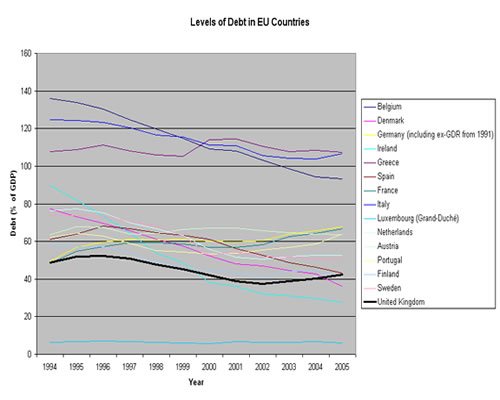


It's a little hard to read as a web graphic I'm afraid but you can take a look at the data yourself. We have among the lowest levels of government debt in the EU, the Americans aren't in this data set but have much higher levels of debt than we do.

Some developing countries and smaller nations have stronger positions but that is usually because they need to work harder to convince financial markets their debt is secure. Historically the British state has almost invariably been either the most or among the most fiscally conservative in the world. As a matter of economic history Paine's analysis, and Tytler's prediction, is just wrong.

A more detailed comparison would look for a relationship between age of democracy and level of debt to see if it fits Tytler's pattern:

"The average age of the worlds greatest civilizations from the beginning of history, has been about 200 years. During those 200 years, these nations always progressed through the following sequence:

From Bondage to spiritual faith;
From spiritual faith to great courage;
From courage to liberty;
From liberty to abundance;
From abundance to complacency;
From complacency to apathy;
From apathy to dependence;
From dependence back into bondage."


A cursory examination shows that the oldest democracies (Britain and Luxembourg I think) have low levels of debt. An inexorable democratic progression to decadence does not appear to be sustained by empirical examination.

"When Labour last wrecked the economy, the Tories under Thatcher won their reputation as “the Nasty Party". They made a sick nation take its bitter medicine. It had to be done, but no-one enjoyed it. Many who lived through it are bitter that our lives were thus blighted by the greed of previous generations who voted themselves unfunded benefits; so inflated the currency as to repay their debts in base coin and then left it to us to straighten things out. We are even more bitter now that New Labour has made all our efforts vain."


I think I've already dealt with this issue sufficiently. We do need to be careful about maintaining fiscal discipline in order to ensure interest rates and future taxation can remain low. However, there is no crisis.

"Our generation has paid for everything - twice - only to be told there is nothing for us. Our taxes, our pensions, have been diverted to bribe an army of Government “workers” and the mass of idlers on permanent benefits which now passes for “the working class”. Anyone who does work in Britain, if not for the State, is for much of the year in forced labour to feed the Government's hordes.

As has been sagely observed, “Labour always spends its way out of power eventually.” Cameron may pout, preen and posture now, but the Tories will be called into service as the Nasty Party again. "


The state has grown significantly over the last century and this can, perhaps, be seen as a result of the pressures of mass democracy. However, this is not likely to be something that constitutional reform can tackle. Even in the US there is no obvious constitutional limit to the size of the state. It is a political problem with a political solution.

"But enough of economics. What of politics? What, in particular, of liberty? Labour has opened our eyes to our constitutional danger. Though we were joyously ignorant of it, it seems that we were always at the mercy of an over-mighty State. All it took for habeas corpus to be repealed in Britain, was for the political balance to shift, so that one Party could do it without the other crying foul."


Before I move on to Paine's main analysis I should caution that it may be best to avoid fetishising old liberties like Habeas Corpus. While old liberties can remain essential sometimes things need to change. As Gracchi detailed some time ago it was increases in the strength of police power, themselves a response to new kinds of criminality, which led to the creation of many of our now old liberties. With new changes in criminality, particularly a rise in the number of crimes involving evidence and collaborators abroad, it seems plausible that our generation should be thinking about new liberties as much as old ones.

"Focus groups and opinion polls have had the same effect on political thinking, as wind tunnels and CAD had on car design. They are a more scientific, but also a more soulless, way to do the job. They have led to less choice as politicians adapt their offer to comply with the "scientific" data. Had Jefferson and Washington had focus groups, there would have been no American Revolution. Most colonists favoured the Crown. A majority moved to Canada to remain subjects of King George. But the founding fathers were not followers, but leaders. They built a democracy from undemocratic beginnings."


I'm not sure this is accurate. I read that the numbers were roughly a third in favour of independence, a third against and a third undecided. Boston was supposedly the turning point for the undecided group (before the war even started). Also, bear in mind that a lot of those who did not like independence left for Canada. Their opinion wasn't exactly led. Here's Wikipedia on the situation:

"Colonists were divided over which side to support. The Revolutionaries (known as "Americans", "Whigs," "Congress-Men" or "Patriots") had the active support of about 40 to 45 percent of the population. About 15 to 20 percent of the population supported the British Crown after 1775 and were known as Loyalists (or Tories). Loyalists fielded perhaps 50,000 men during the war years in support of the King. After the war, some 70,000 Loyalists departed the United States, most going to Britain, Nova Scotia or other British colonies."


"How safe is a parliamentary democracy to live in when most voters fail to understand that powers given to our rulers for one reason may be used for others? All civil liberties objections crumble today in the face of the word "suspect;" which means no more than someone thought, by a fallible someone else, to have done something bad."


This is an overexaggeration. There has been very real political, judicial and popular resistance to many of this government's impositions on civil liberties. Voters value security but that is contingent upon the current security/liberty balance. If civil liberties were infringed on to a larger extent that balance might change and liberty start to be prioritised over security.

Paine then spends some time going over awful policies that have been put in place democratically. I have no particular inclination to rebut this material as I do not think democracy is an infallible bar to atrocity. I agree with Paine on that point.

"Are there then then no limits to democracy? In Britain there are not. Our democracy is defective, because we have never clearly defined what power individuals have delegated to the State. Potentially, our lives, our freedoms and our worldly goods can be taken at any moment at the State's whim. That the State is under loose democratic control is of little comfort. Am I any less a serf if enslaved by a majority of my neighbours? Am I any less dead for being slain with their approval?

The State should enjoy only those powers delegated by individuals. Would any of us freely give the right of life and death? Would any of us freely give the right to tax us until we work most of the year for others, like indentured slaves? Democracy is a valuable, but not a sufficient component of a free society. We also need individual rights, which outrank those of the State, because it serves us, not vice versa. It is those rights that make us free, not the way in which members of the government are chosen."


Rights may, philosophically, exist in nature but they only affect real life if a large number of people believe in them. If we had a constitution dropped out of the sky and implemented when the Queen was drunk one day which said the government absolutely may not take more than 25% of the national income in tax would that rule be paid any heed at all?

If the population really want to they can do anything they want. Might may not be right but, in the end, it rules. Constitutions can be, and have been, broken and discarded as illegitimate by revolutionaries. They can be twisted to allow atrocity as happened with Hitler. They are not immutable. The defence of liberty cannot be left to rules but must rely upon the popular will. Under Paine's fatalistic account where the population just don't believe in liberty we are doomed and would do well to find a hole somewhere.

A constitution can be valuable if it is respected and acts as a rallying point for defenders of liberty. If people believe in liberty because they treat the constitution as somehow sacred then liberties are, indeed, more secure thanks to its existence. This appears to be what happens in the US.

There are costs to having a constitution. The final document will be imperfect and its interpretation can be even more so. I'm pro-choice but it seems infinitely preferable that this result has been obtained democratically in the UK instead of being imposed by the judiciary as in the US. Giving a small group of judges so much control over our affairs seems risky as they are fallible people and have huge, unaccountable power. It also creates resentment which could easily become generalised and threaten the liberties a constitution is designed to protect. Also, if our liberties do need to change with changing conditions a constitution could easily be a straitjacket.

That leaves us with a balance, a cost/benefit analysis for all states between the benefits of the British system and the 'rallying in the defence of liberty' benefit of a constitution.

Britain's unwritten constitution evolved slowly out stable earlier systems and, as such, could rely upon a certain measure of tolerance and respect for the conventions it reflects. We rely upon the fact that our institutions are respected without the imprimatur of an inflexible constitution. That means that we can avoid the costs of a constitution but still enjoy the robust defence of liberty other countries enjoy. Other nations do not have the same luxury as they are usually formed in violent revolution. This is why, despite never having a constitution, Britain has enjoyed a relatively liberal history (Hayek was one enthusiast).

This makes constitutional radicalism of the sort Labour has displayed dangerous but even Labour's degree of meddling is far from fatal. Our politics is still relatively healthy and our constitutional order shows no sign of imminent collapse. That changes to the Lords and devolution have been so mismanaged and there hasn't been a collapse (although further change will be needed) is a testament to our system's strength. A very British respect for tradition and incremental change has proven a reliable defence of liberty over the years. A great many nations with impeccable constitutions have fallen into madness and tyranny while we, despite our lack of a constitution, have remained free.

Paine ends with a call that democracy should not be above debate. I hope that my response is sufficiently measured that any fear of a hysterical answer to his reasoned article will be assuaged. He then argues that the Conservatives should embrace constitutional reform. There is some sign that they will, particularly with a new British Bill of Rights. However, I would hope that any such Bill will maintain the flexibility which Britain is afforded by a long and tolerant tradition.

Monday, March 26, 2007

If feminism is bad for your health...

A few days ago the Mail reported that feminism can be bad for a woman's health. Equality of income, management jobs and a 'pressured lifestyle' all hurt someone's expected health outcome. This research is from Sweden so it is reasonable to expect that this is feminism done 'properly' as far as is possible. There is state support for childcare and other measures to reduce the additional pressure on women that comes with equality.

This study's result is plausible as it fits with the other studies cited by those who want to reduce working hours or otherwise curb impositions on a leisure based lifestyle. It is not that feminism per se is bad for a person's health but that it exposes more women to pressures which always cause people health problems.

Would women trade their newfound equality for better health? I hope and expect not.

Doesn't this tell us a lot about how shallow our health and leisure obsessed, risk-averse political culture is?

When women say they're not feminists they mean crazy radical feminism. Those who still choose to bring up children instead of working are making a choice about what they want their work to be which is not an anti-feminist choice. Women are committed to a movement which will see them working longer hours and facing greater workplace pressure. They are committed because it is more important to someone's sense of wellbeing that they work and achieve all they can than that they avoid marginal harms to their health expectations. The feminists, on this, are right.

People are willing to trade their health for their work and to fight politically for the right to do so. It is illiberal and small-minded to stop any person, woman or not, working even if you think you are protecting them from themselves.

Flying Monkey Watch #3

Flying Monkey Watch was an early attempt at a regular fixture for this blog. However, since the Frankenbunny episode all has been pretty quiet on the flying monkey front but now it appears the project is back on.

If it is possible to make human-sheep hybrids surely a monkey-bird hybrid is equally plausible?

They are able to target specific organs according to the Mail on Sunday report which means that you wouldn't wind up with a beaked monkey or some other monstrosity. Continue the research...

Experts

Gracchi has a very thoughtful post up on the relevance of experts. The challenge is balancing the two concerns that these sections illustrate:

"To be uncharitable you might call it the Today program error. On the one side I have an eminent scientist who beleives in evolution, on the other a creationist who has never done any proper science who doesn't and I treat them equally. One though has done a huge ammount of experiments, rigorously tested out his theories and the other hasn't. Despite that the interviewer and the public adopt a posture somewhere in the middle.

[...]

I suppose to a certain extent what we see in society at the moment is too much respect for experts as magi, as mystical beings who divine truth in a mysterious way, and too little respect for the way that truth is manufactured."


This argument from Peter Frankln angered me when I first read it and might, by showing the other side of the coin, suggest the source of the 'experts' problem:

"Given Nigel Lawson’s record on economic stability, I’m pretty disinclined to accept his judgement on climate stability.

[...]

Twenty years ago Nigel Lawson decided that the best thing for Britain would be to shadow the Deutschmark. Twenty years later he is urging us to shadow the Chinese rate of carbon emissions. He is as wrong now as he was then."


"Some years ago Churchill decided that the best thing for Britain would be to return to the Gold Standard at the pre-war level. Now he is urging us to fight on against Nazi Germany. He is as wrong now as he was then". Plenty of politicians capable of sound judgement have fallen under the spell of fixed exchange rates and a strong pound. This is just lazy ad hominem.


The common problem is a perversion of accountability. People are being understood as black box 'truth machines' which have a certain efficiency. This efficiency is the likelihood than any particular statement they make will be correct. Such a method is lazy and the 'Today programme error' is a good term for it.

The only tonic is intelligence and regular fisking.

Thatcher saved us from this:

The Yellow Pages rebuts Layard

I saw this advert for the Yellow Pages over the weekend and was struck by what a powerful conservative, economically liberal message it has. A testament to the value of hard work not just for what it creates but for its spiritual value. Adverts are often keenly socially aware and if this speaks to a common feeling in Britain then that is very encouraging.

Mark Steyn makes baby Jesus cry

This article (via The London and New York Correspondence) is a fine example of why Steyn is just so infuriating. The subordinating of historical truth to modern day politics and bulldozing of subtlety in favour of a simple with or against us calculus makes me embarassed to be a conservative. Steyn regularly exhibits Coulteresque idiocy but seems to get away with it in a way she does not thanks to being a better writer.

I'll leave out the article's initial "when I was talking to the President the other day" spiel.

"You don't have to read far into Roberts' volume to appreciate why it resonates with this particular Commander-in-Chief. On page six, we find another head of government of a global superpower, the third Marquess of Salisbury. Speaking at the dawn of the 20th century, Britain's Prime Minister remarks:

England is, I believe, the only country in which, during a great war, eminent men write and speak as if they belonged to the enemy.


Indeed. And, as Roberts adds, "In fact, the phenomenon was to recur throughout the English-speaking peoples over the coming decades, and in some engagements - such as at Suez and in Vietnam - opposition from a vociferous domestic minority was to doom their enterprises far more than foreign opponents.""


Steyn leaves any conclusions from this implicit. However, the conclusions he wants to draw are pretty clear. Domestic opposition is dangerous. This is highly questionable, that opposition was only really successful in Vietnam thanks to the lack of military success. The US didn't leave Vietnam quickly and committed huge force. The enterprise was doomed thanks to a failure of this committment to secure victory and domestic opposition was more a symptom than a cause of military failure.

Even if it is true that minority opposition can, through their words alone, harm the war effort that may be best ignored. Would it have been worth the price of silencing political expression to secure victory in Vietnam? That is a big question and one Steyn, of course, does not feel it important to discuss. After all, if Salisbury was talking about domestic opposition to the Boer War then it is possible that opposition to his war was in the right, we were doing some seriously unpleasant things at the time. Perhaps it was better that domestic opposition doom Vietnam quickly rather than slow military attrition doom it more slowly. I won't presume to answer the question of which side was right in these debates but freedom for minority opposition is important because being a majority is no guarantee of being correct.

"He's certainly right about Vietnam, but my eyebrow arches skyward when it comes to Suez. It was surely neither domestic opposition nor Egyptian enemies that doomed the enterprise, but explicit and fierce American hostility to British action. Short-sighted hostility, one might argue, that led in part to the creation of the fetidly "stable" Middle East that plagues the world today. But that's one of the pleasures of Roberts' book: muscular polemical prose that cheerfully invites an argument about something or other on almost every page. It is, of course, a sequel - to Churchill's History Of The English-Speaking Peoples, whose four volumes concluded in the year 1900. Roberts feels, reasonably enough, that it's a shame to end the story without an account of the Anglosphere century."


Note that it wasn't only Britain who suffered from American hostility to Suez. France did as well. In France the political reaction was far stronger and analagous to the Australian response to Gallipoli with the United States playing the role of the British Empire. It killed French trust in American leadership.

Which raises the question of what he means by "the English-speaking peoples". I have both the London and New York editions of this book. The British jacket bears four flags - the Union Jack, the Stars and Stripes, the Southern Cross and the Maple Leaf (surely it should have been the Red Ensign). By contrast, the American jacket replaces that coalition of the willing with a scene of post-war jubilation in Times Square, and the only flag to be seen is that of Old Glory. Roberts' New York publishers would appear not to be entirely on board with his view of the great anglophone family and, at least for promotional purposes, prefer traditional notions of American exceptionalism. The author, on the other hand, subscribes to something closer to the Churchillian idea of a Britannic family with America as the prodigal son, but a son nevertheless and the greatest of all:

Just as we do not today differentiate between the Roman Republic and the imperial period of the Julio-Claudians when we think of the Roman Empire, so in the future no-one will bother to make a distinction between the British Empire-led and the American Republic-led periods of English-speaking dominance between the late-eighteenth and the twenty-first centuries. It will be recognised that in the majestic sweep of history they had so much in common - and enough that separated them from everyone else - that they ought to be regarded as a single historical entity, which only scholars and pedants will try to describe separately.


This section is interesting and plausible. There is a huge amount in common between the two great Anglophone powers and studying how the two compare and relate to one another would be an interesting project. Indeed, that comparison is a major focus of Niall Ferguson's, far more interesting, work. However, instead of trying to think through the implications Steyn prefers using it as a stick to beat the Continentals.

"If you step back, this seems obvious. Of the three great global conflicts of the 20th century - the First, Second and Cold Wars - who called it right every time? Germany: one out of three. Italy: two out of three. France: well, let's not even go there. For a perfect hat trick, there are only those nations on the front of Roberts' London edition."


Well, France did 'call it right every time'. It was defeated in the Second World War but the Wehrmacht were not a trifling enemy. It's commitment to the Cold War was limited by the fall out from Suez which the French took very seriously, a fair reaction. Its commitment to the First World War can hardly be questioned.

America may have called the First World War right but only right at the end and after the major costs of victory had already been paid. It warrants two and a half out of three at best. The real world just isn't as simple as Steyn would like it.

"There is a distinction between the "English-speaking peoples" and the rest of "the west", and at key moments in human history that distinction has proved critical. Europe has given us plenty of nice paintings and agreeable symphonies, French wine and Italian actresses and whatnot,"


If this were really nothing more than a harmless joke then I'd leave it alone but it isn't. It's a bizarre contempt for the cultural and scientific achievements of the rest of the West.

"but, for all our fetishization of multiculturalism, you can't help noticing that when it comes to the notion of a political west - a sustained commitment to individual liberty - the historical record looks a lot more unicultural and indeed (given that three of the four nations on that cover share the same head of state) uniregal. Roberts provides a good summation:

Although they are ancient states, many of the constitutions of European countries are very young indeed, far younger than those of Britain's constitutional monarchy (1688-9), America's democracy (1776), Canada's responsible government (1848) or even Australia's Federation (1900). By contrast, the French Constitution establishing its Fifth Republic was only promulgated in 1958, Germany's Basic Law was passed in 1949... Italy's was adopted in 1949... and Portugal's became law in 1976...


Or, as I like to say, the US Constitution is not only older than the French, German, Italian and Spanish constitutions, it's older than all of them put together. The entire political class of Portugal, Spain and Greece spent their childhoods living under dictatorships. So did Jacques Chirac and Angela Merkel. We forget how rare in this world is sustained peaceful constitutional evolution and, to be honest, it's kinda hard to remember when the principal political party of our own demented Dominion peddles non-stop Canada Day smiley-face banalities about how "we are such a young country" (Paul Martin) - which, aside from being obvious tripe, gives us the faintly creepy air of a professional virgin. "The English-speaking peoples did not invent the ideas that nonetheless made them great," concedes Roberts. "The Romans invented the concept of Law, the Greeks one-freeman-one-vote democracy, the Dutch modern capitalism..." But it is the English world that has managed to make these blessings seemingly permanent features of the landscape."


He spends a long time on this as if it has some significance but never spells it out. Perhaps it is a sign that the more liberal approach to state building that characterises the English-speaking world is inherently more stable. Perhaps it is a testament to the power of geographical security. Steyn seems to prefer leaving his analysis at a vague "we're better people". He doesn't even address the question of whether constitutional stability is a good thing. This is pure, brute rhetoric concealing the substituting of prejudice for genuine thinking.

"As Roberts sees it, the story of the 20th century is one of anglophone democracies defending the planet against what he calls four assaults: "The First Assault: Prussian Militarism 1914-17", "The Second Assault: Fascist Aggression 1931-39", "The Third Assault: Soviet Communism 1945-49" and "The Fourth Assault: Islamicist Terrorism and its De Facto Allies". In between come periods of complacency ("The Wasted Breathing Space: 1990-11 September 2001") and loss of faith ("The Long, Dismal, Drawling Tides: The 1970s"), but in the end the good guys always step up to the plate."


The French did far more to defeat Prussian Militarism than the Americans, the Soviet Union did most of the fighting against Fascist Aggression and Steyn acknowledged in his section on Suez that myopia may have led the Americans to make a mess of the Middle East and contribute to the Islamicist problem. Might the actual history of the twentieth century be a bit more subtle than 'anglosphere defends everyone against tyranny and oppression'?

"Our cousins across the ocean marked the dawn of the 9/11 era by selling off the Royal New Zealand Air Force. The whole lot, gone."


Okay, the New Zealand Air Force was never up to much. Running an airforce has huge fixed costs which would seem to make it a poor choice for a small country which does not need one for its own defence. It seems quite sensible that New Zealand focus on providing troops to a general Anzac alliance. This gives them far more capacity to project power and assist the Australians as a regional peacekeeper than spending on expensive but still sub-standard jets.

"Britain itself seems unable to rouse itself from a fatalistic three-legged danse macabre with Europe and its Islamifying cities that may yet mire it in the Continental pathologies it managed to avoid in the 20th century.

"Ah, the Anglosphere," Australia's Alexander Downer, my favourite foreign minister, said to me last year, when the subject of Canadian troops in Afghanistan came up. "There are really only five of us." But, in their present political sensibilities, Canada is semi-French, Britain is semi-European, and New Zealand is semi-bananas. The next volume of this story will be an interesting read."


One could extend this. Australia is a regional power (look at its tiny contribution in Afghanistan and Iraq despite having been such a supporter of both wars) in a region with a number of countries, India, China and a more forceful Japan, which seem likely to render it irrelevant pretty soon. The US has proven itself utterly incompetent in managing the results of its foreign policy interventions without European help. If it keeps making a hash of things it will soon choose a return to fearful isolation.

Of course, neither of these results is preordained but neither are the fates Steyn projects for the rest of the Anglosphere and Continental Europe. It is possible to write off any country you choose to with a touch of rhetorical overexaggeration of their problems. It is more interesting and more helpful to think seriously about how these countries might avoid this fate. They probably have a better chance if they work together rather than succumb to the temptation to snipe and bicker that has defined Steyn's career.

Unity, Disunity; the US, Europe

I've been thinking about the Western alliance recently. To be more precise I’ve been thinking about how few real defenders it has. People increasingly seem to choose a 'side' between Europe and America, usually on ideological lines. Those who don't, Tony Blair for example, seem to be more interested in avoiding a decision or an argument than making a genuine case for European and American ties.

Why should we care about the West? What is special about the European-US alliance? Why is Europe so much more important an ally to the US than, for example, India?

The answers to all these questions seem important to our future choices as a civilisation. There are probably a host of reasons why Europe and the US work so well together and it is clearly wrong to propose a monocausal explanation. Common cultural ties are the most commonly cited justification for strong links between Europe and America. However, I would like to advance a new explanation of why Europeans and Americans working together can be so successful which I think is of particular importance.

Europe's huge achievements over the ages have been built on its division. This is an argument which has been advanced in economic history by various authors such as Landes. When one nation's creative genius was spoiled by awful institutions or the devastation of war another would seize the torch. A classic example is the Inquisition which broke the collective mind of the Spanish in particular who had been leading lights in earlier periods. In another region, China for example, that could have ended intellectual progress and killed a chance at economic development but in Europe it just lead to Northern Europe taking over. Strategic competition between states meant that those left behind soon had to catch up and introduce successful innovations. At the same time European kingdoms were at least an approximation of modern states and could provide the modicum of security development required; economic gains would usually provide a strategic advantage rather than riches for others to plunder.

Don’t be fooled into thinking this is an article about the EU by the way. The idea the EU can rid Europe of its divisions is either alarmism or touching optimism depending on your perspective. If it started to do so I might get genuinely alarmed but there seems little sign of that as EU states continue to make different policy choices.

By contrast, American success came from its unity. Political unity meant that it possessed an unusually large market without tariff barriers to break it into sections. That market was also made up of relatively homogenous consumers. Britain, and the rest of Europe, didn't develop mass production because it didn't have the demand for large quantities of standardised consumer goods. As worldwide incomes rose the American, mass production model was more able to guarantee a general rise in living standards.

Now, if the source of Europe's strength has been its disunity and the source of America's has been its unity I think these qualities might hint at their contribution to an alliance as well. I'm afraid I'll have to stick to gross generalisations but I think that there is something to this idea. Of course, Europe can exhibit unity and the US is often deeply disunited as with the regularly cited ‘red states vs. blue states’ split. However, in general it seems sensible to believe that Europe has more disunity than the US.

Europe's disunity provides durability to the ideas, values and progress of the West. When one country drops the ball there is usually another making different choices. I think this makes Europe both the West's soul and its testing ground.

However much Europe loses its way it is a diverse place and there will always be states who remember what makes the West great. If the West was one nation, one culture that society might forget its values far more easily. For the purpose of this article I'm not going to claim a special knowledge about what ‘Western values’ might be. Whatever your view of what makes the West so successful that view is reflected somewhere in Europe and can be reasserted elsewhere from its existing foothold. Europe is a far more durable container for the intangible values that make up the Western soul thanks to its disunity.

Of course, sometimes it is important that the values or politics of the West change rather than be maintained. This is also easier with disunity. Disunity makes real dissent far more possible as different policies can actually be tried. While the states in the US can do this they are limited by the far greater strength of the Federal state and a common political culture (there is something of a common faultline in American politics even if different views predominate in different areas). The use of disunity to establish testing grounds can be seen with school vouchers in Sweden or the flat tax in Eastern Europe. It can also be seen with different forms of child support between France and Italy (cash) and Scandinavia (free childcare). All these are differences that have arisen since EU membership and new differences seem to be emerging at least as quickly as the EU standardises other, often narrow, areas of policy.

America's unity makes it strong. There is a reason why it was America that played a leading role in defeating the great threats, internal and external, to the West in the last century. While Europe has greater population and sometimes a larger economy in total there must always be a temptation to free-ride. As each small state is comparatively weak (although many are still titans compared to most non-Western states) they often cannot do what needs to be done alone. Cooperation is difficult to find because it is easier to hope that others will do the job of confronting common enemies. Without America Europe is endangered and weak. Without the power it used to possess thanks to Empire and technological dominance it is vulnerable to the great crises that afflicted the world in the last century and might do so this century as well. America's unity allows it to intervene more effectively than the Europeans even in Europe's backyard (the Balkans) but also to confront other enemies in the wider world.

Without Europe America cuts a sad figure. I have never been convinced that America should choose multilateralism because of some legal or moral duty. I doubt our enemies would respect international law if they were more powerful and if all international law can do is restrain the good it is not worth much. I see no principled reason why America's defence of its interests should be contingent on French, Chinese and Russian approval. However, I think perhaps it is not a coincidence that America's unilateral engagements have been managed so poorly. Europe brings a diversity of opinions which has to make the American approach to using its power more thoughtful and effective. America alone is not just more incompetent, though.

It is also fundamentally less impressive. As an Atlas America looks lonely and embittered. As leader of the 'free world' America is confident and proud. When Europe and America are working together as they were in the Cold War the universalist ideal America looks to for inspiration is much more tenable. Without Europe the question of why, of whether anyone actually has any interest in the shining city on the hill, is far harder for America to answer. Europe gives America purpose and keeps it from the temptation of small minded isolationism.

Neither those Americans, Mark Steyn is a prime example, who take satisfaction in the moral simplicity of America being alone or Europeans such as the French Gaullists who wish to set their country up in opposition to America have their country’s best interests at heart. The West is stronger than the sum of its parts and cutting it to pieces will make all weaker.

I’m a little worried that this article is a little messy and poorly argued. I must confess I’m still working these ideas out in my head but thought the comments of others might clarify my thinking. Let’s think about it in another way.

Disunity tends to lead to uncertainty whereas unity leads to certainty. In a unified body a decision can be made and stuck to whereas in a disunited body it will be subjected to further challenge by those who never agreed and were forced into line. Europe will generally be less unified and also less certain than the US.

Mencken on the advantages of uncertainty:

"Moral certainty is always a sign of cultural inferiority. The more uncivilized the man, the surer he is that he knows precisely what is right and what is wrong. All human progress, even in morals, has been the work of men who have doubted the current moral values, not of men who have whooped them up and tried to enforce them. The truly civilized man is always skeptical and tolerant, in this field as in all others. His culture is based on 'I am not too sure.'"


Dalrymple on the problems with uncertainty:

"This is not a strong position from which to fight people who, by their own admission, hate you and are bent upon your destruction, brought about preferably at your own expense. First, you can't take them seriously; second, you suspect they might in any case be right."


When Europe and America work together they can take the advantages of being both certain and uncertain.

Friday, March 23, 2007

Economics 101

Via the Economist, I doubt there is anyone with an economics training who, on trying to make an economics argument in a debate of some kind, has never been told that economics is just 'more complex than that'. Julian Sanchez is right that it can all get rather frustrating:

". . . a defense of (relatively unregulated) markets in this or that case is (profound sigh) so Economics 101. Because, you see, you learn about things like "supply and demand" in intro courses, so they must be terribly crude and misguided notions. Interestingly, people lacking even an Economics 101 background seem to feel few compunctions about deploying this trope.

Now, the perfectly accurate core idea here is that with greater theoretical sophistication, you find plenty of conditions under which the generalizations of the first-pass, stripped-down model don't hold. (In the pedagogical context, this is probably close to being a definitional truth: There would be little point to developing and teaching a more complex model unless whatever new wrinkles you added yielded some difference from the simpler one.) . . .

What's annoying about the "Economics 101" line isn't (just) that it's a noxiously condescending way of making such an argument. It's that quite a lot of the time, it's a substitute for such an argument. Instead of being a prelude to an elaboration of why the instant case constitutes such an exception, it's treated as a sufficient dismissal in itself—as though if a more sophisticated model incorporates more exceptions to general economic laws, the ne plus ultra of sophistication must be to assume everything is an exception. But the general rules remain general rules because they're still generally true, and indeed, are often predictive in circumstances far removed from the idealizations of blackboard models. Even when you really do have an econ 201 exemption to an econ 101 rule, it's still poor form to be too supercilious about advancing it. After all, your interlocutor might have an econ 301 riposte."


Hate world. Revenge soon. Take out on everyone.

Research and Development Spending

I think that Chris Dillow has missed a few plausible explanations of why research and development spending in the UK is lower than elsewhere.

1. Continuing weaknesses in British scientific education. These have been a problem for at least a century. While we continue to produce a healthy crop of scientists and sustain a superb contribution to high-level science there are serious flaws in basic, systematic scientific education in schools and not enough students choose to study science at university. This is hard to explain by institutional differences so is often put down to cultural factors. In particular, that university is often used to signal or change class and a scientific education is seen as 'grubby'.

2. British industry is 'too' competitive. Philippe Aghion set out how there might be a peak level of competition for research spending. Too little competition and a firm has no creative destruction pressure to innovate. Too much competition and following successful research spending firms quickly enter and swarm away the profits which might pay for the research. The ideal, if your objective is to encourage research, is firms with a strong market position which they seek to defend by outspending prospective rivals on research and development. Britain's is one of the most competitive world markets as it has little protection from takeover, the state has no real inclination to support champions and the country does not specialise in niche industries.

Combine this explanation with the third on the list of explanations Chris formulated, that there is generally a poor return to firms which spend on research and development. It looks like our competitive market encourages our firms to free ride off foreign oligarchy to all our benefit. Huzzah!

3. Service companies don't do much research and development. Britain's collective lifestyle is, to a remarkable extent, paid for by this share of global financial services exports:


Service companies always spend less on research and development. In particular, the spending that goes on developing new products and remaining at the leading edge of the industry which is accounted for as R&D in manufacturing companies is often less tangible in service companies. I won't address the "is deindustrialisation necessarily bad" debate here but, suffice to say, there isn't necessarily anything wrong with focussing on services. Particularly as that means you have to engage in a lot less competition with China.

Between us myself and Chris have come up with seven plausible explanations for low UK research and development spending. Of these only one, weak scientific education, really looks like a problem that the government should be trying to solve. A couple of the others could possibly be addressed but we are likely to cause more harm than good through other, unintended, consequences.

Perhaps low research spending is one of those issues that is best responded to with a dose of British benign neglect?

300

I really, really enjoyed this film but it has seriously divided critical and popular opinion. At the moment audience opinion on the BBC site is at 3* but divided almost entirely between 5* and 1* ratings and the reviews largely reflect a similar divide. I'll try to examine what other people are saying as well as giving my own two cents which will, I'm afraid, make this a long film review. I'll go through some of the stock criticisms first before moving on to the positive case for this film. There aren't many plot details in this review and I expect most people already know how Thermopylae ended so don't worry too much about spoilers.

Mr. Eugenides has already done a great job fisking the ignorant Comment is Free article accusing this film of preparing the ground for strikes on Iran but I think the charge this is 'about' Iran is more broadly weak. When films want to draw parallels to the present day they're rarely coy about it; V for Vendetta is an example of what happens when film makers want to draw parallels to the present day. While Persians are, ethnically speaking, Iranians that fact could hardly be avoided in a retelling of Thermopylae. For all the Iranian government's solipism this story isn't about them. In order to chart just how thoroughly the film differentiated its Persian horde from modern day Iranians I've drawn up, just for you my loyal readers, this special graphic illustrating the differences:


There's a lot of male flesh on display thanks to the Spartan habit of fighting sans clothes. However, it seems somewhat ironic that this leads supposedly liberal left-wing commentators to, in a rather schoolyard manner, call the film homo-erotic. If the film does excite the gays I'm not going to begrudge them their arousal but the nudity is an old fashioned design motif (as old as the Ancient Greeks themselves) designed to build up the idea of Spartan contempt for physical danger. Such great warriors of the classical age are likely to have stayed in good shape.

This film isn't anti-war. Left-wing reviewers have spotted this and are so proud they almost make it sound as if that isn't patently bloody obvious. Very few people are unconditional pacifists and most believe that war can be just and necessary. Why should films always take the anti-war side of the debate?

Particularly as the war portrayed in the film is a pretty just one by most standards. Even under modern international law I'm pretty certain the Spartans are in the right as they defend Greece from an invasion. The Spartans in the film are pretty close to the ideal that the "noblest fate that a man can endure is to place his own mortal body between his loved home and war's desolation". As a result the film does not, as any film of Alexander should for example, have to grapple with the morality of aggressive warfare.

The BBC review describes it as a "valentine to violence" and finds this disturbing. Calm down, that's what an action film looks like. Audiences have been enjoying them for years and society has not collapsed. While the body count and gore was spectacular it is hardly beyond the norm established from Rambo to the Matrix and Saw. While it got an 'R' rating in the US it has a 15 certificate here. The scale of violence is necessary to make the achievement of the Spartan warriors clear. It is only gratuitous if you don't get the point of the film and only scary if you think that it is actually talking about the US and Iran.

Now, on to the positive.

Visually the film was absolutely stunning. The cinematography and blue-screen CGI work was genuinely artistic and a far better use of the technology than Sin City. It was perfectly suited to embracing the mythical nature of the story. It is hard to pick out particular scenes as the whole thing was so constantly impressive. However, the scene where the Spartans are having some kind of explosive thrown at them was a particular favourite. The entire screen lights up as if the Spartans are surviving a trip to the centre of the sun.

It should be noted that I saw this film at the IMAX. If you're able to try and do the same as this film really justifies the big screen and powerful sound. It'll give you a much better sense of what IMAX is capable of than a documentary account of Kate Winslet's opinions on fish. Equally, it is the very best showcase of the sheer splendour of this film.

The action had a hi-octane power to it. Certainly, it was the first film I've ever seen which made a phalanx feel genuinely dangerous rather than merely cumbersome. Although the action does lose this character as it goes on and there are more individual skirmishes it retains its own character. The "Asian martial-arts vibe" which troubled Mr. Eugenides seemed muted enough that the film remained distinctive and the action wasn't formulaic. In particular, the relative focus upon co-operation felt appropriate.

The story device of having the film be a flashback as Dilios inspires the troops before the battle at Plataea is very appropriate. It focusses attention upon the real importance of the battle at Thermopylae as an inspiration to the other Greeks, and the West down the ages. It also offers a ready explanation for the fantastic elements of the story.

Finally, the politics. I disagree with those who argue for divorcing film criticism from politics. A lot of art does have political or philosophical implications and refusing to discuss them in favour of "was it fun" is demeaning. What was the political importance of 300?

I must first disagree with Marc Sidwell for the New Culture Forum and Masoud Golsorkhi (the article Mr. Eugenides is rebutting) who both argue that this film casts the West as the underdog but disagree over whether this is good or abominable. 300 ends on Plataea as a large Greek army, only outnumbered by three to one, charges in the confident expectation of inflicting a crushing defeat on the Persians. In 300, as in reality, while the West may be outnumbered it is rarely outgunned.

Thermopylae's true political importance is that, along with Salamis, it forms the heroic origin story of the West. Retelling this for modern audiences is vitally important. There is no longer the serious prospect of the West being militarily defeated as could plausibly have happened without the three hundred's heroism and our struggles are neither as heroic or as demanding. However, we do need to be prepared to sacrifice in defence of the rational, free and prosperous world that is the West. Sometimes compromise with our enemies is impossible or wrong. An obvious example of where most of us massively failed this test is in the response to recent threats to freedom of expression where we preferred cowardly appeasement to risky but vital defiance. To paraphrase the Team America cliché freedom really isn't free. It is genuinely inspiring to see a film unashamedly celebrating sacrifice in the name of the civilisation which is both our most precious inheritance from past generations and can be our greatest legacy to the future.

This kind of conservative political film is far rarer than it should be as the huge box office figures suggest that the audience are receptive. Instead of tapping what is obviously a huge appetite for films appreciative of the West and sacrifice in its name film makers prefer narrow, unimpressive critiques or ugly allegories on transient political issues. Zack Snyder may just have wanted to make a cool action film but he has, along with a few others, broken the consensus that Hollywood is a vehicle for a particular, left-wing view of the world. While there have always been films in which right-wingers can find their own meaning if they care to look this shows that conservative politics are nothing to be ashamed of. If the rest of Hollywood, perhaps even the British film industry, is paying attention we might see some amazing stories being brought to life.

300 is technically astounding, creatively groundbreaking, politically important and great fun. Watch it.

Thursday, March 22, 2007

McJobs

Dave's analysis here seems somewhat flawed:

"McDonalds is launching a campaign to change the dictionary definition of a McJob. The current definition is
"An unstimulating, low-paid job with few prospects, esp. one created by the expansion of the service sector"

according to the OED. McDonalds apparently had the slogan
"McProspects - over half of our executive team started in our restaurants. Not bad for a McJob."


How many of the people who work for McDonalds made it to the executive team?"


The proper test for whether McJobs should be characterised as having "few prospects" is whether they offer less chance of promotion than traditional unskilled professions. Otherwise the McJob term provides no new meaning beyond 'unskilled work'. My guess is that the rate of promotion from unskilled worker to executive has always been very low and that the McDonalds statistic that half their executives are ex-restaurant workers does denote impressive prospects relative to traditional unskilled labour.

While most McDonalds workers may never progress to more skilled work with the company all that really tells us is that being unskilled sucks. The dictionary definition of McJob is entirely innaccurate if they actually have good prospects relative to similar occupations.

The South Park Appreciation Society

If you want an example of someone taking their TV really, really seriously take a look at Cantor's piece from December analysing the Southpark Episode 'Gnomes'. The entire article is full of funny comparisons between South Park and philosophy from Aristophanes to Smith. My personal favourite section, though, is this one:

"But what about the gnomes, who, after all, give the episode its title? Where do they fit in? I never could understand how the subplot in “Gnomes” related to the main plot until I was lecturing on the episode at a summer institute and my colleague Michael Valdez Moses made a breakthrough that allowed us to put together the episode as a whole. In the subplot, Tweek complains to anybody who will listen that every night at 3:30 a.m. gnomes sneak into his bedroom and steal his underpants. But nobody else can see this remarkable phenomenon happening, not even when the other boys stay up late with Tweek to observe it, not even when the emboldened gnomes start robbing underpants in broad daylight in the mayor’s office. We know two things about these strange beings: they are gnomes and they are normally invisible. Both facts point in the direction of capitalism. As in the phrase “gnomes of Zurich,” which refers to bankers, gnomes are often associated with the world of finance. In the first opera of Wagner’s Ring Cycle, Das Rheingold, the gnome Alberich serves as a symbol of the capitalist exploiter – and he forges the Tarnhelm, a cap of invisibility. [10] The idea of invisibility calls to mind Adam Smith’s famous notion of the “invisible hand” that guides the free market. [11]"


This is brilliantly over earnest. Forgive me doing the same for a favourite of mine. To my mind the most important South Park is the double episode 'Cartoon Wars'. If you've never seen it this might be a comprehensive spoiler but won't stop you appreciating the episode's brilliance.

The double episode is itself a part of a sequence of episodes on modern obsessions and the culture of fear. Global warming was the target for two earlier episodes. 'Smug Alert' attacked the self-righteous attitudes of the glitterati, particularly in the entertainment community. Two Days Before the Day After Tomorrow mocked the hyperbole of the global warming movement. In both the South Park population went and hid in the community centre which became a metaphor for blind panic. The commitment to political content in South Park allows the show to build up these kinds of memes and make deeper points about a modern aversion to risk without needing to distract from the independent message of each particular show.

Throughout the show Fox is used as a metaphor for Comedy Central and Family Guy as a metaphor for South Park itself. This becomes particularly sophisticated as Cartman is the voice not only for the shows creators in his hatred of Family Guy's comedic style but also the evil voice of the terrorist threat of violence, actual terrorists giving video warnings fulfil the same dual purpose. This is a disarming display of humility and subtly sends the message that even when criticisms of certain artistic and media expression are correct it is still not right to limit freedom of speech.

The show's history is used as an argument against the idea some kind of double standard exists which dictates that it is not alright to mock Jews or other groups but free speech is invoked when people insult Muslims. When Cartman asks Kyle "how would you feel if there was a cartoon that made fun of Jews" the audience is well aware they are watching that cartoon. At the end of the show a fictional terrorist response to Family Guy's insult is shown which treads roughshod over every other fictional American taboo by literally shitting on the flag, Jesus and the President.

The show's message comes across loud and clear. Instead of sticking our heads in the sand, the episode's literal take on the American and British response to the Jyllands-Posten crisis, we need to challenge attempts to clamp down on freedom of expression. It is unacceptable and cowardly to allow a threat of violence to destroy our most important values. Such appeasement creates a vicious cycle as other groups seek to obtain a similar restriction that they not be offended.

There is so much more going on in these episodes and I’ve only covered a small portion of their range. At the same time it manages to stay really, really funny. However, despite the combination of subtle and brutally obvious messages in the show it was life rather than art which made the point most convincingly. At the climax the fictional Fox President decides to screen the image of Muhammad. By contrast, in reality Comedy Central censored South Park’s incredibly gentle portrayal of Muhammad. Just as Muhammad is about to be shown in the fictional Family Guy episode the actual programme cuts to a black screen with simple white text. The danger to our most cherished and important values was clear for all to see when "In this shot, Mohammed hands a football helmet to Family Guy; Comedy Central has refused to broadcast an image of Mohammed on their network" replaced such a moderate defiance of the violent threats of our enemies.

Wednesday, March 21, 2007

The FT on the Budget: Lex and Martin Wolf

Martin Wolf is always good value and if you want a detailed account of what the new budget means this article is well worth reading in full. This section seems particularly crucial:


"Overall, as was always expected, the Budget is close to neutral. How, then, has the chancellor been able to finance his two most exciting announcements: the reduction in the rate of corporation tax from 30 to 28 per cent, at a cost of £2.23bn from an indexed base in 2009-10, and the reduction in the base rate from 22p to 20p, at a cost of £9.64bn? The answers are simple: the former is financed by cutting capital allowances, worth £2.27bn in 2009-10; and the latter is largely financed by the elimination of the 10p starting rate of income tax, worth an additional £8.63bn in 2009-10."

An opinion that I've heard a lot from right-wing enthusiasts for this budget is that it is a lot like what we've been expecting from George Osborne, Lex argues the same although he cautions that even more strain is being put on the public finances.

This is clearly true to a certain extent. The change to the main rate of corporate tax, financed by cuts in capital allowances is a moderate version of exactly what the Shadow Chancellor proposed just a few days ago. However, there are two crucial differences:


  1. The reliance on the tax credit system to compensate poor families for the loss of the 10% rate. Given the weight of Tory criticism on their effectiveness it seems more likely that some kind of change to personal allowances would have been made. Relying on tax credits is problematic as they are neither simple (and once they are relied upon the benefits of simplification start to be lost) nor comprehensive (in particular the single poor will suffer).
  2. An anomalous hit to small businesses. This is hugely problematic particularly as the only compensation to them is an expansion in capital allowance which means the organisations least able to cope with increasing volumes of red tape will have an increase in complexity rather than simplification.

These two big differences are the most concrete departures from Tory policy. There is some suggestion in the response the Conservatives have released today that they are aware of this. By contrast, the rest of the Conservative official response is largely boilerplate: "we care about the NHS" and "borrowing is too high" without policy to address either.

It seems plausible that this budget might encourage the 'sharing the proceeds of growth' rhetoric from the Conservative Party to become adventurous. Instead of only talking about revenue neutral changes like the ones this budget is mostly composed of they now have cover, as this budget somewhat accepts the 'sharing the proceeds' logic, to start talking about what they might do if plausible growth gives them the opportunity to do some sharing. In the end this Budget was still a net tax raising budget, by hundreds of millions according to the Business, and the Conservatives could articulate that sharing the proceeds of growth will allow them to change this pattern.

Budget 2007

Recently I confidently predicted that we would see nothing interesting coming out of the Budget. I extrapolated from the pre-budget report which played safe and did little of substance. Now, we have headline cuts in the basic rate of income tax and the main rate of corporation tax. The TaxPayers Alliance blog, in their initial reaction, called for "three cheers for the Chancellor" although they noted that devil is always in the detail with Brown budgets. I was wrong and something big has happened, has something good happened?

The first thing to note is that this just can't be as good as it looks. He's been given something of a stay of execution in public finance terms but there just isn't room in the budget for big giveaways unless spending is properly controlled or the dynamic implications of tax cuts given proper prominence. Room for tax cuts combined with a continuing rise, though slowed, in public spending is limited. This has resulted in what Philip Stevens, writing for the FT, calls a "Budget worthy of the Kremlin".

The headline cut in income tax is balanced by the abolition of the 10% rate. While this sort of flattening of the tax code is a good idea in general it needs to be, and usually is in flat tax proposals, balanced by a significant increase in the personal allowance to prevent the poor taking a kicking. This does not appear to have been done and the poor will take a kicking. More will be reliant upon tax credits with all the problems that brings.

The corporation tax measures are broadly sensible insofar as they reduce allowances and cut the main rate. This is a cautious version of the plan Osborne recently announced (the Conservative plan was for a 3% rather than 2% cut) and a good idea as it simplifies the tax system. However, this is combined with a rise in the rate on small business which is unfortunate. Plenty of vulnerable businesses will be waking up this morning facing a rise in tax they will struggle to afford.

One final item to note at this early stage is the tax avoidance legislation. "A loss accruing to a company is not an allowable loss if it arises as part of arrangements which have a tax advantage as their main purpose, or one of their main purposes". This is the kind of language which makes it unclear what is illegal and what is not. It forces companies to up their compliance budgets to ensure that they minimise legal risk. This has large costs throughout the economy which can be hard to spot in accounting terms.

An interesting sign of how the politics might play out comes from Neill Harvey-Smith who asks why socialist MPs are cheering the changes in income tax:

"David Cameron was supposed to be embarrassed by the surprise income tax announcement. But he wasn't. Gordon Brown clearly doesn't understand the difference between tactics and strategy. The battle of ideas was conceded in that smug moment. If the government can cut taxes and increase spending, then Labour's biggest stick for beating the Conservatives is broken. If Labour MPs cheer tax cuts for the rich at the expense of the poor, what is the point of the Labour party?"


In particular, this would seem to create an opportunity for quite a cohesive approach for the Conservative party attacking a Brown led Labour government. If Labour are rebalancing the tax system in favour of bigger business and richer people the Conservatives can campaign as champions of the 'little guy'. It would fit absolutely beautifully with a number of other Conservative policy priorities:

Conservative support for the Third Sector allows for little people to do their work caring for people without the frustrations of control by big government regulation. Conservative opposition to too many centralised targets allows for the little guy working in the public services to get on with his job without the big state bureaucracy on his back. It would even fit with the dismal rhetoric a while back about the risks of Tesco ruining small shops; big business crushing the little guy.

I'm still trying to come up with a term to define this approach but "Shopkeeper Conservatism" might do the trick and appeals to an old understanding of Britain emerging from Napoleon's attempt at an insult. A friend suggests "Conservatism of Little Platoons" but Iain Duncan Smith may already have claimed that one. A couple of people I've discussed this approach with have suggested the term "populism" which hints at its electoral appeal.

Hygienic Party Drugs for the Noughties

"Popping animal worming tablets must rank as one of the more bizarre ways of getting high.

But the growing popularity of the pills, called BZP, among young people seeking a new form of stimulant led the UK's medicines regulator to warn yesterday that their sale was illegal.

[...]

[The] drug's active ingredient piperazine can cause problems including agitation, vomiting, seizures and allergic reactions, the MHRA said. The effects are similar to amphetamine and in extreme cases, may result in death, the agency said."


Oh my. Doesn't someone taking these things occassionally look in the mirror and think "what am I doing?"

When you're so attached to finding an artificial high you're willing to take a tablet that is so unpleasant it needs to be crushed into your dog's food or forced down its throat something has gone wrong. Take a long, hard look at your life.

The Extreme Life of J. S. Haldane


I can hardly claim to be impartial about my Uncle's book but it really does sound interesting. The story of a pioneering Scottish inventor who developed the use of canaries for mines and gas masks in the trenches of the First World War. In particular, the book is going to focus on the sacrifice of self-experimentation by this Victorian gentleman. It's out in a couple of months I believe.

Tuesday, March 20, 2007

Probably the best website in the world...

Set up by a collaboration of the Universities of Sheffield and Michigan Worldmapper.Org is truly brilliant. Over three hundred different cartograms displaying the world with the sizes of countries adjusted for various measures. Nice little descriptions next to them.

A thumbnail index of them all starts here.

Some highlights. Want to know why we're still able to afford imports despite the decline in manufacturing?


Where do most refugees go?


Don't take your dog to India:


Finally, compare military spending in 2002:


With war deaths in the same year:


Apparently if you want peace it really is best to prepare for war.

Will June 25th be the end of the Blair-era?

We've had these headlines before and this is somewhat qualified as it is an aide's plan rather than a set in stone date but the FT is a pretty reliable source:

"Senior Downing Street officials have drawn up a detailed draft timetable for Tony Blair's departure from Number 10 this summer, which will see him finally quit office in the last week of June.

[...]

Under the terms of the timetable Mr Blair will formally announce his intention to resign on either May 5 or May 8, one day after the first May bank holiday. His announcement on either day of his intention to leave office will trigger a seven-week contest for the Labour leadership.

This contest will culminate in the convening of a special Labour party conference at which the result of the leadership ballot will be formally declared. This conference will take place on June 23, immediately after Mr Blair returns from his final European Council meeting in Brussels."


After that happens the political phony war that has resulted from having a Prime Minister who has promised to leave before the next election may, finally, be over.

Monday, March 19, 2007

Right-wing success in Finland

Another Nordic success for the centre-right:

"The time for analysis of the results and why things went so well for the moderate conservatives of the NCP and so badly for the Social Democrats is still ahead, but one thing appears certain: as Finland shifts towards the right in what can only be described as an NCP landslide (in a country noted for small electoral swings), it is hard to envisage the new government being anything but a centre-right coalition."


According to a Finnish friend it is possible that new right-wing coalition will abolish the inheritance tax, cut income taxation significantly and take Finland into Nato. Eventually the Nordic countries will look across the North Sea and be baffled by the overbearing, high-tax economy in Britain.

BBC Report on Stern

This is an interesting BBC report on global warming (click in the top right to listen to the full report), which mirrors but expands upon some of Lawson's critiques of the assumptions in the Stern Review (via DK). Essentially, there are two key criticisms.

Firstly, Stern has chosen particularly strong assumptions, at the extreme end of the IPCC's predictions or beyond. He has double-counted costs and largely ignored the possibility of adaptation. Most of the differences are in economic prediction rather than the natural science analysis. This is the strategy of a report designed to justify a preconceived conclusion. Stern's defence of this is that the IPCC is "based on consensus" and he prefers his own analysis of the evidence but when he acknowledges that his report is only really qualified for economic analysis this is rather weak.

Secondly, the vast majority of the harms Stern identifies are predicted to occur after 2100. The BBC report mainly discusses this as a divergence from the popular understanding of the report and, in particular, the "5% now and forever" soundbite. More importantly it moves the predicted costs into a more uncertain time period. Predictions over a hundred years in the future should always be taken with a pinch of salt whether they are predictions of demographic apocalypse from Mark Steyn or global warming from the green movement.

There is a brilliant bit rebutting Chris Huhne, Liberal Democrat environment spokesman, who says we can see global warming in Britain in the Thames Barrier being raised so much more in the last five years than in the five years previous. The reporter actually goes to the Thames Barrier and finds that the truth is the opposite. However, truth has been made hostage to politics. Chris Huhne's over-confident ignorance encapsulates what makes much of the global warming debate so unimpressive.

Sunday, March 18, 2007

Gandhi, Churchill and Accountability

My post on Gandhi the other day was largely just a background for those who are tempted to make him a part of some kind of secular canon. It was a decidedly non-Thogger post. However, since I wrote it I've been thinking about the parallels to Churchill.

In much the same way as I did with Gandhi it is easy to find things wrong with the popular choice for Greatest Briton. He played a large part in Gallipoli, the decision to restore the Gold Standard at its pre-war parity after the First World War and then tried his luck at the 'soft underbelly' strategy again and got Allied troops bogged down in Italy. Churchill's record, if one were to count 'good' and 'bad' decisions, would be decidely poor.

The left once tried to get his election as the LSE Student Union's Vice-President (an honorary position often given to the dead) ruled unconstitutional on the basis of opinions he stated which are, by modern standards, racist and unpleasant. This is not necessarily an indictment of his character as he lived in a time of different norms and when racism meant something quite different. As such, I'm not convinced by such criticisms but for many they clearly will weigh into an assessment of his quality as well as the practical failings addressed above.

The reason that Churchill and Gandhi should still be considered great despite their failings is that they were right when at their most important. Churchill's failures of military decision making and economic analysis did not change history whereas his emphatic leadership in confronting one of history's greatest evils are as important as a single human's actions can be. Similarly, Gandhi's letters to the British people imploring them not to fight the Nazis made little impact and Indian economic policy was mostly set by successors such as Nehru. By contrast rendering the British exit from India peaceful (although the same could not be achieved for the partition) was a monumentally important achievement. Both Churchill and Gandhi were redeemed by a visionary conviction at the right place and time: Churchill's that the Nazi ideology was too aggressive and inhuman to be appeased. Gandhi's that Britain was losing its commitment to Empire and might be more vulnerable to the moral suasion of non-violent resistance than to the certainties of war.

Now, it is extremely difficult to tell which visionary, and often minority, understandings of the world will be correct after the fact. Mao's that untrained, ideologically driven effort could propel China towards great power status or Stalin's that Communism was being undermined by traitors who need to be purged may look less plausible now but managed to persuade the relevant political classes. Churchill's vision looked deeply aggressive and reactionary to those who wanted to avoid another world war. Gandhi's non-violent resistance must have sounded hopelessly naive and opportunistic to some at the time.

If one were to use accountability as the principle which underlies the modern choice of leaders to assess these different visionaries I'm not sure any would come out well. I think that with the catalogue of problems it would be tempting to avoid all of them. A conservative response, along Kieron O'Hara's lines, would be that this proves that radical visions are generally dangerous stuff and cautious, incrementalist leaders are to be preferred. However, clearly a radical break with old thinking can be necessary in order to make the right decisions, particularly in times of great stress. Those who responded conservatively to Hitler did not cover themselves in glory.

Without accountability what other method might we use to choose our leaders in hard times?

Sometimes we will be able to rely upon our own intellects and moral compass to assess their vision itself. However, during times of crisis or other great change the expected results of policies may be almost impossible to ascertain and circumstances rapidly changing. If this is the case we need to ask what sort of representative we should be looking for.

I would suggest that a key difference between Gandhi and Churchill and Mao and Stalin is that the former possessed tolerant personalities. Churchill could be catty during debates but this was always more the game of the debating chamber than a brutal intolerance of criticism. Gandhi was a barrister with the willingness to debate that entails. It would seem that the best lesson we can take from history is that the leaders best equipped to see us through hard times will be those who have the least tendency to see criticism as an assault. An open mind is the best defence against madness.

Friday, March 16, 2007

Kuntzel, Gracchi and the Western Defence of Freedom of Expression

At the time of the protests over the Pope's quoting of a Byzantine Emperor on the subject of Islam and the rational examination of faith Anne Applebaum urged unity in response to the threat to freedom of speech:

"But Western reactions to Muslim "days of anger" have followed a familiar pattern, too. Last winter, some Western newspapers defended their Danish colleagues, even going so far as to reprint the cartoons -- but others, including the Vatican, attacked the Danes for giving offense. Some leading Catholics have now defended the pope -- but others, no doubt including some Danes, have complained that his statement should have been better vetted, or never given at all. This isn't surprising: By definition, the West is not monolithic. Left-leaning journalists don't identify with right-leaning colleagues (or right-leaning Catholic colleagues), and vice versa. Not all Christians, let alone all Catholics -- even all German Catholics -- identify with the pope either, and certainly they don't want to defend his every scholarly quotation.

Unfortunately, these subtle distinctions are lost on the fanatics who torch embassies and churches. And they may also be preventing all of us from finding a useful response to the waves of anti-Western anger and violence that periodically engulf parts of the Muslim world. Clearly, a handful of apologies and some random public debate -- should the pope have said X, should the Danish prime minister have done Y -- are ineffective and irrelevant: None of the radical clerics accepts Western apologies, and none of their radical followers reads the Western press.
Instead, Western politicians, writers, thinkers and speakers should stop apologizing -- and start uniting.

By this, I don't mean that we all need to rush to defend or to analyze this particular sermon; I leave that to experts on Byzantine theology. But we can all unite in our support for freedom of speech -- surely the pope is allowed to quote from medieval texts -- and of the press."


Now a lecture by Kuntzel on the Nazi origins of Arab anti-semitism has been cancelled in response, according to the Leeds German department and Kuntzel himself, to a perceived threat of violence. Gracchi has addressed the debate in the scholarly manner which befits a careful and insightful mind by addressing the ideas in Kuntzel's work. His analysis is persuasive and it would appear that there are serious problems with Kuntzel's thinking. However, is that the point?

After all, Gracchi is equally emphatic that there is nothing racist or Islamophobic in Kuntzel's work and certainly nothing deserving of censorship. He just thinks Kuntzel is wrong. It would seem that he's making a similar mistake to those who rushed into a discussion of the merits of the Pope's words while his enemies were killing nuns. I don't think the crisis here is nearly as severe as no one has been hurt and it looks like the university may just have been overcautious. Nevertheless, it is still a case where critiques of Kuntzels work might be less important than rallying around his freedom of expression.

Essentially I think Gracchi is probably but right but that the subtlety of thinking that is his trademark may have caused him to get his priorities wrong in this instance.

Gandhi and the Global War on Terror

Gandhi's understanding of economics was less than impressive. Autarky was lunacy for pre-WW2 Nazi Germany as it lost the benefits of trade but, as they were expecting a major war, at least got them used to the isolation war would impose. However, India's one attempt to take on a country its own size, China, proved its army rather feeble. No one seriously expects Pakistan to cut India's trade links so that danger is not really a risk India faces. India effectively inflicted upon itself a mild version of what the Royal Navy imposed upon Germany in the First World War.

Fred Thompson, writing for the National Review, highlights just what it means to take Gandhi's approach in foreign policy:

"And that's a pretty good question. At what point is it okay to fight dictators like Saddam or the al Qaeda terrorists who want to take his place?

It turns out that the answer, according to Gandhi, is NEVER. During World War II, Gandhi penned an open letter to the British people, urging them to surrender to the Nazis. Later, when the extent of the holocaust was known, he criticized Jews who had tried to escape or fight for their lives as they did in Warsaw and Treblinka. "The Jews should have offered themselves to the butcher's knife," he said. "They should have thrown themselves into the sea from cliffs." "Collective suicide," he told his biographer, "would have been heroism."

The so-called peace movement certainly has the right to make Gandhi's way their way, but their efforts to make collective suicide American foreign policy just won't cut it in this country. When American's think of heroism, we think of the young American soldiers in Iraq and Afghanistan, risking their lives to prevent another Adolph Hitler or Saddam Hussein.

Gandhi probably wouldn't approve, but I can live with that."


A stopped clock is correct twice every day. It seems possible Gandhi was just lucky that the one time he had a position of leadership he was fighting a power unwilling to crush his non-violent resistance with military force. Or did he simply extrapolate from his moment of success to all manner of very different situations? Was his judgement that clouded by solipism?

Thursday, March 15, 2007

Blue-Corner Hollywood?

As I've discussed before Hollywood has never been entirely left wing and many films are complex enough to interpret in either direction or address a philosophical theme in a right-wing manner. However, what appears to be a new trend is the release of explicity right-wing political films. It is in the 'count on the fingers of one hand' stage but I think that South Park has demonstrated that politically charged and right-wing material can be successful. Thank You For Smoking followed in South Park: The Movie and Team America's wake.

Now, 300 is not a political movie in the same way but be under no doubt that if it closely follows the comic, which everyone says it does, it is very right-wing. It is based upon a comic by Frank Miller, creator of Sin City, which has a "Further Reading" section at the back including Victor Davis Hanson, author of "The Western Way of War" and well respected by a certain kind of conservative. Many left-wing reviewers in the US are getting worked up just because it's the first war movie in an age not to have an anti-war message. More than that it is a specific tale of war against and sacrifice to defeat an enemy trying to crush the nascent West.

Is it any good? There are loads of reviews out there and I'll add my own next Thursday once I've seen it at the BFI IMAX.

Wednesday, March 14, 2007

Fed-Ex Socialism

As I noted in a comment at his blog a little while ago Chris Dillow is an advocate of a rather rare form of socialism. Here's my comment:

""This presumption illuminates the distinction between mine and Labour's leftism. Much (not all) Labour policy does regard people as passive objects. Workers need minimum wage and health and safety laws because they're incapable of fighting for decent pay and conditions themselves. They need a nanny state as they can't choose correctly how to live their lives. And workers' control of firms and public sector bodies is not even considered, because workers aren't fit to run organizations.

By contrast, my leftism rests on a view that people are capable of running their own lives."


I'm surprised you didn't have more sympathy for "What's Left"'s prevailing sense of loneliness."


Essentially his vision of the left is rooted in the idea that democratic control of capital by workers will prove more efficient than capitalist control by owners. He sees private equity as an early attempt to grope towards a replacement for inefficient traditional forms of ownership.

Now, the essential question which any economist should be asking at this stage is, if it's more efficient why hasn't it happened already? I presumed that Chris, as a socialist, would answer that workers do not have access to capital and need redistribution to get it, however, this sentence from that post suggested that this wasn't his vision:

"Could it be that capitalism - like feudalism - will die a slow death as thousands of capitalistically-owned firms gradually mutate into ones owned in more efficient - and egalitarian - ways?"


In this new post he makes it clear that he agrees with Tyler Cowen that capital is not the main bar to the wider development of co-operatives and identifies other reasons. These are mostly cognitive biases such as the "myth of leadership", status quo bias or adaptive preferences. I don't think risk aversion is compatible with Dillow's case as if workers genuinely don't want risk and would prefer capitalists take it for them then capitalism may be optimal even if less productive.

There seems some reason to doubt his thesis, as he acknowledges there are already plenty of co-ops about, surely they should undermine the popular assumption that capitalism is the only way; the existence of which seems essential to much of his logic. If people can see Waitrose and law firms demonstrating the efficacy of worker control surely they would not adapt their preferences, for example.

However, if we accept that the current co-ops are too rare to undermine these irrationalities then there is an interesting implication. If co-ops are the central objective of a left-wing economic programme, as Dillow has suggested they should be, and if he expects them to rise to dominance through competition within the liberal economic system then surely politics is relatively unimportant to the advance of socialism? Dillow's logic would seem to be a case for intellectual socialism being more of a management doctrine than a political philosophy.

The right-wing in the US often aspire to Fed-Ex solutions. Their battle to reform the postal service repeatedly failed but, in the end, the results of their failure were overturned by the advance of Fed-Ex and other private carriers. If this is the best path for socialism as well doesn't this mean all the left-wingers who are currently heading off into NGOs, pressure groups and the Labour Party should instead be heading into practical occupations and then leading the charge for the left to outcompete capital? To quietly make obsolete the enemy it failed to destroy politically.

Tuesday, March 13, 2007

"I have no idea what I'm talking about but I figure I'll write about it in a national newspaper anyway"

Chris Dillow, hardly a bastion of the capitalist right, destroys, what he is right to describe as, a candidate for worst Comment is Free article ever. There is some fierce competition and I'm not sure it is in the top ten but it is certainly pretty dismal. I don't really have much to add to the analysis itself but it does seem important to note just what a collapse of editorial judgement at the Guardian this constitutes:

"But whatever is private equity? I've looked it up and I still can't quite make it out. It's in another language: angel investing, mezzanine capital, passive limited partners and hurdle rates. What? I asked my friend Rosemary and she couldn't even be fagged to think about it. "I don't know anything about all that," says she. "Just shut up and let me get on with my gardening." Luckily, my friend Fielding saw a programme on it, and he explained."


It almost sounds like a parody but I'm pretty sure it isn't.

She has just professed not just to her own ignorance but the ignorance of the few people she has spoken to on the subject. At least Hutton claims to have some kind of insight; this article doesn't even really aspire to any knowledge on the subject. The Guardian's audience should be appreciated by its editors as an enormous luxury, a chance to speak to so many people, but instead they show a kind of contempt by accepting this, presumably on the basis of it being ideologically satisfying.

I worry that, further, they might actually have liked its style, the unquestioning acceptance that this new capitalism is a fresh evil. The light-headed, self-satisfied lack of the drive to question ideological received wisdom is being sold as a lifestyle choice. The parroting of opinions obtained casually through friends is described as a preferable alternative to the hard, ungratifying and vaguely nerdy work of trying to "make it out" on your own. Instead of trying to inform their readers they are trying to instill in them the idea that to close your mind is to prove that you are urbane and fun.

C4: The Great Global Warming Swindle

If you watch one video this year...

The great global warming swindle focusses not on the material I've always found more convincing; the policy analysis of emissions curbs. Instead, it takes the science on directly with great verve and makes a case I haven't really heard all in one place before.


Update: This is the best response I've heard to the points the programme raises. Make up your own mind on the science, I'm inclined to believe that the truth is that there is good evidence for something close to the IPCC convention view of what is going on but that it is far less extreme and certain than the green movement is pretending to boost its political case. This is the kind of view that Lawson's speech and most of my own writing on the subject is based upon and is not overly dependent on a particular side of the scientific debate.

Monday, March 12, 2007

The Death Penalty and Gun Control

It might seem strange but it occurred to me today that it is interesting to consider the debates over gun control and the death penalty together rather than separately. After all, opinions on the two subjects usually move together; I think most people who support gun control oppose the death penalty and vice versa. Although neither debate is particularly active in the UK they are still interesting particularly because they are non-economic issues on which libertarians often take the right-wing side and I do not. I'll quickly describe my views on each issue and then go on to discuss why the death penalty and gun control cases face problems when combined.

I'm not opposed to the death penalty because of the possibility of error. We cannot give someone twenty years back any more than we can resuscitate someone we've executed. The difference in terms of what we take from someone when we make a mistake scales just as with most punishments of greater severity. Also, I'm not opposed to the state killing of itself. I believe that the state can need to kill people in wars with external enemies and that the police will need to shoot to kill when facing internal enemies with little injunction about slaughtering their fellow citizens.

I think the evidence on the death penalty as a deterrent is mixed and I'm not sure one can form an opinion on the basis of such a practical consideration alone. My opposition to the death penalty stems from my belief that it makes a coward of the state. While a murderer may have been a fearsome beast at one point when they are executed they are strapped down with a shaved leg and wearing incontinence underwear. They aren't any more dangerous than a newborn and are utterly unable to defend themselves. When people, on being told that you don't want your state killing people, argue that to be consistent you must be an absolute pacifist I always think they do more to smear war than strengthen the death penalty. "The noblest fate that a man can endure is to place his own mortal body between his loved home and war's desolation"; by contrast, the death penalty is an ugly, cowardly practice and one I would not support even in return for quite significant changes in crime figures.

I support gun control as I can see it working in Britain. Apart from tiny pockets with exceptional social problems, even there gun crime is far lower than in equivalent areas of the US, guns are not a part of British life. The case right-wingers make against gun control in the US, that it only restricts the law abiding, just doesn't work in reality; a comprehensive gun control can make obtaining them far more difficult. This works particularly as it is combined with a police force which is composed of unarmed beat officers and armed response units which prevents an arms race as the only armed officers cannot be outgunned as US cops can be.

With guns the bar to murder is so much lower. Killing a person, or yourself, without a gun is, barring an accident, usually a rather slow and physically demanding process which often fails and which one has time to reconsider; the passion required for a crime of passion murder often isn't sustained. Equally, when burglaries go wrong, for example if someone is surprised in the act, the chances of someone being killed are much lower.

I think that the libertarian case against gun control is, perhaps, overstated. All but the hardcore anarcho-capitalists accepts that the state should defend property rights and that relies upon a state monopoly on the use of force. Surely prohibiting devices which give one such significant potential for using force could make that task massively harder and undermine the legitimate function of the state?

Neither my view on the death penalty nor my opinion of gun control is necessarily universalist. I am prepared to be quite understanding towards developing country states which have trouble establishing a credible deterrent and need the death penalty's strength to keep order. Equally, in states which cannot keep order an armed citizenry might be a force for stability as the state cannot do nearly enough to protect property rights itself; mass ownership of guns might be a least bad option compared to rule by the unscrupulous. This would seem to explain why the 'only stopping the law abiding have guns - you'll get more crime' argument seems to have been accurate in Jamaica. However, neither of these conditions appear, to me, to obtain in any Western country.

Now, here's this article's punchline. The US has a lot more homicide than the UK despite hardly being a more lawless place these days. This difference has to be largely explained by differences in the number of guns about, particularly as many of these homicides are carried out with guns. It also has the death penalty. If we assume that the pro-death penalty case is right and it is a credible deterrent then guns have to cause enough murder to obscure both the effect of the death penalty and the actual disparity in murder numbers. This means that either the death penalty isn't proving an effective deterrent or guns are causing a truly vast increase in the number of murders; most likely a combination of the two. Considering the case for the death penalty and the case against gun control together demonstrates just how weak both cases are.

LSE Open 2007

Well, I survived.

The tournament was a huge success. Everyone had great fun, the organisation was sharp and I saw some good debates. In particular, the debate on selling citizenship brought out interesting questions such as the price/value distinction which rarely emerge in debating.

The winners were Sam Block and Diairmuid Early. The best speaker on tab and in the final was Sam Block. The best team on the tab were "The Half-Chinese Construction Barrister Lobby Group" composed of Alex Wright and Shannon Eastwood.

The motions were:

Round 1: This house would Directly Elect the British Prime Minister.
Round 2: This house would Admit Taiwan to NATO.
Round 3: This house would provide tax breaks to couples with children.
Round 4: This house would crimininalise smoking and drinking while pregnant.
Round 5: This house would allow individual British people to sell their citizenship.
Quarter-final: This house would introduce a 28% flat rate of tax on any income above £9000 per year.
Semi-final: This house believes those suspected of crimes against humanity should be tried in British courts regardless of where the crime took place.
Final: This house would leave the European Union.

Two trends I noticed. Firstly, debating is becoming very, very law oriented, almost to the exclusion of all other disciplines. Only international relations is still permitted to muddy the water. At the mere notion of financial or, particularly, tax implications in a motion there is a widespread sense of resentment and a chorus of "boring". This hasn't always been the case, when I started out, not so long ago, it was non-political legal theory motions that got such a reaction but they are now the vogue.

That debating might come to be dominated by lawyers is entirely understandable, although possibly a shame, as it is such a vital training for the bar; trainee barristers who haven't debated during their undergraduate years are a sad sight. However, with an economics training I find it pretty alarming that the legal minds of the future find economics so alien for a couple of reasons:

Firstly, legal thinking has been radically affected by the ideas coming out of economics. The Coase Theorem is the classic example but there is an entire journal devoted to the 'law and economics' genre. Secondly, many of the consequences of all the cases that these future barristers go on to argue will play out through the economic system and, often, through the tax system which they find so boring. Having an interest in these issues seems vital to any lawyer who wants to understand the world the law operates in and the interests of their clients.

The second trend was that the anti-French meme had been taken to bizarre levels. In almost every round the debate was somehow related, by at least one speaker in each round, back to the shortcomings of the Gauls. Myself and Neill Harvey-Smith (there is a funny account of just how tenuous some of the critiques of France were on his blog) were discussing this before the final and joking that things weren't likely to improve with a motion about the European Union. That proved alarmingly prescient as an American team defined the final into a joke (which was good fun but something of a shame) about how awful the French were and that they should leave the EU.

I am hardly a great apologist for the French political system and the country is far from perfect but at what stage does a funny, ironic old rivalry become ugly and closed-minded? Voltaire, Montaigne, Bastiat, Rousseau; most nations would be proud of just one of them. That is but a tiny sample of the French contribution in one field and the French can boast a similarly impressive achievement in almost any important human activity you care to mention. Jokes about the shortcomings of France are funny but if we use them too often might we internalise the joke and actually blind ourselves to the breadth and depth of the French contribution to the best things in life? Or am I taking things too seriously?