

Wednesday, March 19, 2008


Tuesday, March 18, 2008
I'm not anti-American...
...but if I was this article from the peerless alt-magazine for expats in Moscow - the Exile - would explain why. Hysterical.
Obama
Chris Pope, a friend working at the AEI, provides a fine example of why I seriously dislike Obama:
On the same subject, Andrew Ferguson has an absolutely brilliant, must-read dissection of Obama's speeches. My favourite section, although the article should be read in full:
"Like all Obama's stuff, it is very eloquent, at times beautifully emotive, but where it verges on policy it dives into nonsense:"Just as black anger often proved counterproductive, so have these white resentments distracted attention from the real culprits of the middle class squeeze – a corporate culture rife with inside dealing, questionable accounting practices, and short-term greed; a Washington dominated by lobbyists and special interests; economic policies that favor the few over the many."
Well, actually, the unfolding chaos is caused by a housing market bubble.
Any fool who has been paying attention to the news over the past year knows this. Obama knows this. we all know this. Trying to scapegoat corporations, accountants, lobbyists and "the few" is demagogy that is as deliberate as it is mendacious, and as dangerous as it is unserious."
On the same subject, Andrew Ferguson has an absolutely brilliant, must-read dissection of Obama's speeches. My favourite section, although the article should be read in full:
"That's a clue, anyway. The sentence may not have any positive content, Walker seems to be saying, but it does have an indirect meaning, an implication, as a kind of self-referential gesture for the people who claim it. When Obama's supporters say "We are the ones we've been waiting for," what they mean is that in the long roll call of history, from Aristotle and Heraclitus down through Augustine and Maimonides and Immanuel Kant and the fellows who wrote the Federalist Papers, we're number one! We're the smartest yet! Everybody--Mom, Dad, Gramps and Grandma, Great Grandpa and Great Grandma, maybe even the Tribal Elders--they've all been waiting for people as clued-in as us!
Is this what Obama means too? No one who's wandered through an Obama rally and heard the war whoops and seen the cheerful, vacant gazes would come away thinking, "These are the smartest people ever." I'm sorry, they just aren't. What is unmistakable is the creepy kind of solipsism and the air of self-congratulation that clings to his campaign. "There is something happening," he says in stump speeches. And what's happening? "Change is happening." How so? "The reason our campaign has been different is about what you, the people who love this country, can do to change it." And the way to change it is to join the campaign, which, once you join it, will change America. Because this is our moment. The time is now. Now is the time. Yes, we can. We bring change to the campaign because the campaign is about change. We are the ones we've been waiting for. Obama and his followers are perfecting postmodern reflexivity. It's a campaign that's about itself. The point of the campaign is the campaign."
Monday, March 17, 2008
Quasi-revenue-neutral tax reform
Polls suggest that voters increasingly want lower taxes, even if that means lower spending. Tax cuts are popular. This poses quite a conundrum for politicians who aren't willing to take serious measures to control spending and have no room to borrow.
Revenue-neutral changes to the tax system seemed like the way out for a while but they are a political nightmare because the losers will hate you for it and the winners will prove fickle and ungrateful.
The new solution politicians appear to have hit upon is the quasi-revenue-neutral change. The most politically successful example was the Conservative increasing of the Inheritance Tax threshold 'paid for' by a new flat rate charge to non-doms. The secret is to find a change that is revenue neutral from the Treasury's point of view but a tax cut from the perspective of ordinary people.
There is a problem with all this. It's quite hard to get large sums of money out of the rich 'other'. There aren't very many of them, they leave or use the advantages that made them rich to hide their money from you. Charges on non-doms, of whatever political colour, appear unlikely to raise money. Attempts to crack down on tax avoidance drive ordinary people to bankruptcy but don't yield much by way of revenue. In order to finance their plans Menzies Campbell's Liberal Democrats had to define "rich" down to £35,000 each, in a two-earner household.
With his Vehicle Excise Duty proposals Alistair Darling must have thought he was onto a winner. He could raise revenue from "gas-guzzlers" and give it to the working poor. Unfortunately, there aren't that many Hummers out there and they're already heavily taxed. In order to get substantial amounts of revenue he had to increase VED on the kind of cars ordinary people drive. We crunched the numbers and once it started to be reported that cars as humble as a Nissan Micra would be paying more tax the political logic of the changes looked a lot more suspect. To find out how much your car tax will go up visit www.taxpayersalliance.com/whatsmycartax/
Darling's plan failed and the Budget became a disaster. As the News of the World reported: “for the first time since Labour came to power in 1997, support for the government has SLUMPED after a Budget”. This is another example of quasi-revenue-neutral tax changes failing to deliver the political goods.
Cross-posted from CentreRight.Com
Sunday, March 16, 2008
Universalist conservatism
While I am no apologist for the BBC I think that Conor Burns is being a little too aggresive in his attack on them for calling the victors of Iran's election "conservatives". Conservatism can be understood as a passion for institutional stability - a wish to preserve something in an established order. In that sense, a conservative in one country could favour free-markets and democratic governance and, in another, theocratic tyranny. There is no universal conservatism and a conservative could be a man of good sense in England but not in Iran.
Hayek's critique of conservatism is rooted in this problem. If your passion is for preserving then you concede the future to your enemies; if the fight is between conservatives and socialists you will move slowly to socialism. That is why I think that conservatism needs liberalism (in the European sense of the word).
I think that the Iranian "conservatives", clearly defending an established order we would not want to defend, highlight a dilemma for all conservatives. At what stage is there too little worth conserving? At what stage do we concede that conservatism needs to be set to one side in favour of the more radical medicine of liberalism?
I set out the ideas in this post, in more detail, a while back on TCS Daily.
P.S. All this doesn't mean that the BBC's article isn't sloppy. Whether or not the Iranian election victors were 'conservative' or 'reformist' doesn't get at the crucial distinction among Iranian hardliners - clerics or soldiers? The BBC's analysis is weak because they don't draw that distinction so can't properly analyse what the change means for Ahmadinejad. That leads to false enigmas like this one: "However, many of the conservative winners are critics of hard-line President Mahmoud Ahmadinejad."
Cross-posted from CentreRight.Com
The politics of the Budget - the results are in!
Apologies for the lack of posts. Still, it appears that I got the politics of the Budget just about right.
Thursday, March 13, 2008
The politics of the Budget
I think Mike Smithson is overstating the case for Balls' heckle being a monumental cock-up a bit here. I think it is unlikely Balls has just cost the Labour Party the next election. It seems more likely that, and his other silly heckling, has ruled him out as a potential Chancellor. That's important. There aren't many other candidates who could succeed Darling and it might mean he is more likely to remain in post. Given how thoroughly Darling's reputation for competence is being trashed that could be very significant.
Now, the bigger issues in yesterday's Budget:
1) A hike in taxes on alcohol and cigarettes
I really can't improve on the magisterial treatment of this subject by the Daily Mash (particularly the second post). Their graphic sums it up:

More than anything this will start to create for Labour the same kind of problem the Tories used to have. They risk being thought of as a nasty, no fun, party.
2) More complexity in the benefits system
The announcements yesterday had all the problems of Labour's benefits policy over the last decade. Plenty of money and good intentions. Unfortunately, far too little thought is given to incentives and there is every indication this Budget will trap a lot more people in dependency on the State. This is more of the same and, while it appeals to parts of the Labour base, isn't going to persuade anyone.
3) Punishing tax increases on motorists
The delay in the Fuel Duty rise is good news. With petrol prices rising so sharply and petrol so heavily taxed already any breathing room for motorists is good news.
However, the VED changes are absolutely hideous. A majority of Britons already think that when politicians call for green taxes they are really after revenue and not really out to save the planet. Darling will, rightly, not get the benefit of the doubt. Now he introduces VED changes that will see quite ordinary little cars paying significantly more excise duty, and new quasi-Showroom Taxes, and tries to pass that off as an attack on "gas guzzlers".
To see just how bad this is, or how your car will be affected, go and take a look at the database I created for the TaxPayers' Alliance.
This could well be a political catastrophe. Unlike taxes that are concealed in a product price, like Fuel Duty or the Renewables Obligation, people have to pay Vehicle Excise Duty directly themselves. People of modest means with old Mondeos, for example (any car registered since 2001 will face the new duties), will find themselves facing demands for hundreds of pounds in excise duty where they had paid significantly less before.
Living in London it is easy to forget that outside the city the vast majority of people drive to work and rely on their cars. They don't want to cram their family into too tiny a space to go away for the weekend and the new bills will be about as welcome as a kick in the nuts. When they pay those bills they will hate the Government. Brown has to hope that hatred fades before the election.
Now, the bigger issues in yesterday's Budget:
1) A hike in taxes on alcohol and cigarettes
I really can't improve on the magisterial treatment of this subject by the Daily Mash (particularly the second post). Their graphic sums it up:
More than anything this will start to create for Labour the same kind of problem the Tories used to have. They risk being thought of as a nasty, no fun, party.
2) More complexity in the benefits system
The announcements yesterday had all the problems of Labour's benefits policy over the last decade. Plenty of money and good intentions. Unfortunately, far too little thought is given to incentives and there is every indication this Budget will trap a lot more people in dependency on the State. This is more of the same and, while it appeals to parts of the Labour base, isn't going to persuade anyone.
3) Punishing tax increases on motorists
The delay in the Fuel Duty rise is good news. With petrol prices rising so sharply and petrol so heavily taxed already any breathing room for motorists is good news.
However, the VED changes are absolutely hideous. A majority of Britons already think that when politicians call for green taxes they are really after revenue and not really out to save the planet. Darling will, rightly, not get the benefit of the doubt. Now he introduces VED changes that will see quite ordinary little cars paying significantly more excise duty, and new quasi-Showroom Taxes, and tries to pass that off as an attack on "gas guzzlers".
To see just how bad this is, or how your car will be affected, go and take a look at the database I created for the TaxPayers' Alliance.
This could well be a political catastrophe. Unlike taxes that are concealed in a product price, like Fuel Duty or the Renewables Obligation, people have to pay Vehicle Excise Duty directly themselves. People of modest means with old Mondeos, for example (any car registered since 2001 will face the new duties), will find themselves facing demands for hundreds of pounds in excise duty where they had paid significantly less before.
Living in London it is easy to forget that outside the city the vast majority of people drive to work and rely on their cars. They don't want to cram their family into too tiny a space to go away for the weekend and the new bills will be about as welcome as a kick in the nuts. When they pay those bills they will hate the Government. Brown has to hope that hatred fades before the election.
Wednesday, March 12, 2008
Back from New York
Well, I'm back. I returned from New York on Sunday but have been really busy the last few days and slowly recovering from my jet lag (always worse after travelling East). Spent today responding to the Vehicle Excise Duty con on Sky News. There'll be interesting posts again soon!
Saturday, March 01, 2008
Off to New York

First, the story of my last forty-eight hours. Late last night I suddenly decided that I was going to find my passport. I'd need it on Sunday when I flew out to the States, after all. On finding it I discovered it expired in December. Calmed down. Rang the passport service. They had no appointments till Monday. After another panic, which I hope didn't sound too pathetic down the phone, I asked if they had any appointments in offices elsewhere in the country. They had one, at 9.00am on Saturday - in Wales!
Given that there are no trains from London that get you in to Newport by nine on a Sunday I would have to drive or make it a two day stint. After a train ride back to Letchworth to get the car, six hours driving and four hours waiting for it to be produced in Newport I am now the proud owner of a brand new passport.
All those heroics mean that I will be travelling to New York tomorrow. Blogging will be light but hopefully, when I can find a bit of time, interesting next week as I'll be at this conference till Tuesday and then taking a bit of a holiday to explore New York. Normal service will be resumed the following Monday. I'll still keep an eye on the comments and my e-mail when I can - if anyone has any New York-related recommendations please post them in the comments to this thread.
Friday, February 29, 2008
London losing its edge

A huge share of Britain's GDP, tax revenues and exports are dependent upon financial services and the continuing ability of London to attract investment in this vital industry. It is one sector where we are a world leader. Take a look at the WorldMapper map with countries' sizes adjusted to their share of the international finance and insurance market. 99% of world profits from this huge industry flow to Switzerland, Germany, Luxembourg and the UK - we are the leaders:

This is a highly mobile industry as it operates globally and can communicate effortlessly across the world. If London ceases to be competitive we could lose our lead in this vital sector really quickly. If that happens we will struggle to make up for the loss of most of the around £15 billion of tax revenues that London exports to the rest of the country every year rather than spending itself. That's just tax revenues - our long-term prosperity would also seriously suffer.
With all that in mind the news, from the Financial Times, that our competitive position relative to New York and other financial centres is eroding should be extremely worrying:
"London is losing its status as the world’s leading financial centre and being overtaken by New York, according to a global survey of finance professionals.
The collapse of Northern Rock and the proposed tax crackdown on non-domiciled residents are making the UK less attractive to overseas businesses, according to the City of London Corporation, which commissioned the survey.
A separate survey, also commissioned by the City, said the UK tax system had lost its competitive edge over other financial centres. The UK had become increasingly unpredictable and uncertain, complex and unnecessarily aggressive in its approach to taxpayers, it found."
Cross-posted from the TaxPayers' Alliance blog.
Wednesday, February 27, 2008
Live-blogging E-Day
I just checked BBC News and found out about E-Day. In the face of criticism for bias and politicisation and with poor audience figures for Live Earth the BBC pulled the plug on 'Planet Relief'. One part of Planet Relief was to be twenty-four hours in which everyone tried to save energy. This part was kept in business by the determination of Matt Prescott - campaigner for low energy light bulbs among other things - who dreamed up the scheme.
As a result E-Day started at six this evening. It has a glowing write-up on BBC News Online, the support of the Bishop of London - of all people, energy companies and various environmental pressure groups. Power use will be monitored by the National Grid and compared to their business as usual predictions (which should be very good, if they get them too wrong we get blackouts).
Things aren't exactly going well:
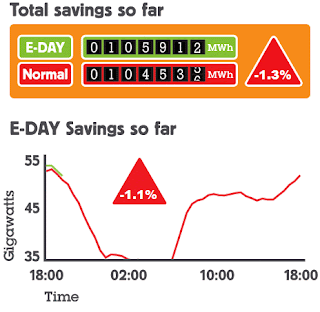
They've actually managed to increase energy usage. Ouch!
We'll check back later.
9.40pm: Total "savings" so far are at -1.2%. E-Day is still making things worse! What will we do?
It's about as important as it would have been if things had gone well, i.e. not very. UK electricity generation is a tiny percentage of global emissions.
9.50pm: Bishop Hill has some background on the BBC's support for this farce.
10.58pm: 1.8% total increase in electricity use! Also, apparently this is a 'moral issue'. The Church of England continues its drive to become the religious wing of the BBC.
Midnight: We're a quarter of the way through and so far E-Day has seen 2% higher energy use than expected under 'business as usual'. This is proving about as successful as when anti-capitalists stage one of their periodical 'don't buy things' days.
9.00am: Over half way now and energy use is still 1.3% up on business as usual. It is running 4.4% above business as usual use right now so things are only going to get worse. How long before Dr. Prescott holds an angry, expletive-laden press conference?
2.30pm: Only 0.8% up now. Maybe they'll break even?
4.30pm: Still up 0.7%. They don't have long now. A correspondent from an American think-tank has a suggestion:


9.35pm: Freeborn John smells a rat. I agree with him that the dissapearance of the early excess consumption is very suspicious. It is hard to explain why the pattern in the early hours would look so different at the end compared to when it was actually happening. Also - in terms of anecdotal evidence from watching the meter - the live usage bar always seemed to be running an excess higher than the average, which shouldn't happen. Still, surely they wouldn't rig it that brazenly?
00:30: They've updated the site with this message:
A few points:
1 - If the temperature had been unexpectedly mild would they have updated the prediction?
2 - How exactly do you define "worked well"?
3 - "Next time"? You've got to be shitting me.
Still, I'm impressed he managed to avoid the term "climate criminals" or call for us to be sent to Climate Camp.
As a result E-Day started at six this evening. It has a glowing write-up on BBC News Online, the support of the Bishop of London - of all people, energy companies and various environmental pressure groups. Power use will be monitored by the National Grid and compared to their business as usual predictions (which should be very good, if they get them too wrong we get blackouts).
Things aren't exactly going well:
They've actually managed to increase energy usage. Ouch!
We'll check back later.
9.40pm: Total "savings" so far are at -1.2%. E-Day is still making things worse! What will we do?
It's about as important as it would have been if things had gone well, i.e. not very. UK electricity generation is a tiny percentage of global emissions.
9.50pm: Bishop Hill has some background on the BBC's support for this farce.
10.58pm: 1.8% total increase in electricity use! Also, apparently this is a 'moral issue'. The Church of England continues its drive to become the religious wing of the BBC.
Midnight: We're a quarter of the way through and so far E-Day has seen 2% higher energy use than expected under 'business as usual'. This is proving about as successful as when anti-capitalists stage one of their periodical 'don't buy things' days.
9.00am: Over half way now and energy use is still 1.3% up on business as usual. It is running 4.4% above business as usual use right now so things are only going to get worse. How long before Dr. Prescott holds an angry, expletive-laden press conference?
2.30pm: Only 0.8% up now. Maybe they'll break even?
4.30pm: Still up 0.7%. They don't have long now. A correspondent from an American think-tank has a suggestion:
"Wouldn’t it be more effective to encourage people to turn on everything they can? The surge in demand could cause a massive blackout, which would force people to use a lot less power for awhile."
Sensible policies for a happier Britain.
9.30pm: I'm back - missed the big moment but checked it on my mobile. Sure enough, they've increased electricity consumption.
What can I say? Except:
9.35pm: Freeborn John smells a rat. I agree with him that the dissapearance of the early excess consumption is very suspicious. It is hard to explain why the pattern in the early hours would look so different at the end compared to when it was actually happening. Also - in terms of anecdotal evidence from watching the meter - the live usage bar always seemed to be running an excess higher than the average, which shouldn't happen. Still, surely they wouldn't rig it that brazenly?
00:30: They've updated the site with this message:
"E-Day did not succeed in cutting the UK's electricity demand. The drop in temperature between Wed 27 Feb and Thurs 28 Feb days probably caused this, as a result of more lights and heating being left on than were originally predicted. The National Grid refined their assessments, based on actual weather data, during Thursday afternoon but I am afraid that E-Day did not achieve the scale of public awareness or participation needed to have a measurable effect. I will do my best to learn the relevant lessons for next time. Thank you to everyone who helped me or left something off specially as their contribution to E-Day, and this Leave It Off experiment. Please enjoy E-Day's solution, video and science sections which all worked well. Warmest regards, Matt"
A few points:
1 - If the temperature had been unexpectedly mild would they have updated the prediction?
2 - How exactly do you define "worked well"?
3 - "Next time"? You've got to be shitting me.
Still, I'm impressed he managed to avoid the term "climate criminals" or call for us to be sent to Climate Camp.
Monday, February 25, 2008
Rambo
 You know what struck me most about the new Rambo? It's very pagan.
A few reasons why:
- Middle Earth was Tolkein's Christian critique of Europe's pagan spirit. In the Lord of the Rings victory belongs not to martial valour, which is hopeless, but to faith and hope. In Rambo the Christian aid workers are the hobbits. Their illusions are shattered and they are saved by pagan military heroics, which are effective. It rebuts Middle Earth.
- It is brutally violent.
- The real heroes are overwhelmingly amoral in outlook and attitude but effective and on our side.
I'm not saying it was intended that way. I think that it is entirely possible that the film was intended to send a Christian message. However, the pagan attitude creeps in and has a certain plausibility to it. I sometimes wonder if we don't do enough to understand our Northern European/Germanic roots and how they influence our outlook.
Update: I've set this out in rather more detail on CentreRight.Com
Sunday, February 24, 2008
Indur Goklany on What to Do about Climate Change
Indur Goklany's paper (PDF) for Cato's Policy Analysis is excellent. He goes through, using the Stern Review and DEFRA's Fast Track Assessment as his sources, why even pessimistic accounts of the costs of climate change cannot find more than marginal harms within the foreseeable future. This builds into a case that humanity will actually be better off in the warmer but richer scenarios that were purported to be the worst-case scenarios by Stern and DEFRA's researchers than in a cooler but poorer world.
Goklany argues that adaptation to the specific problems that might be worsened by climate change, such as malaria, is the way forward. His study provides yet more support for the now reasonably well established three-pronged response to climate change; that such an approach is a better idea than aggresive attempts to curb emissions. Technological development, adaptation and resilient free-market institutions can all contribute to an effective response to global warming.
Goklany argues that adaptation to the specific problems that might be worsened by climate change, such as malaria, is the way forward. His study provides yet more support for the now reasonably well established three-pronged response to climate change; that such an approach is a better idea than aggresive attempts to curb emissions. Technological development, adaptation and resilient free-market institutions can all contribute to an effective response to global warming.
Friday, February 22, 2008
Leaving the country

It is often better to look at revealed preferences; how people actually behave when faced with actual decisions in real life rather than hypotheticals in a survey.
Some dramatic new evidence of this kind emerged yesterday. High staff turnover often suggests that an organisation is not a pleasant place to work. High numbers of asylum seekers from Venezuela suggest that Hugo Chavez's rule is not very pleasant. The Army's recruitment and retention difficulties suggest that the poor management of the Armed Forces is making them an increasingly unpleasant place to work. In that light, the evidence yesterday that Britain is facing the biggest brain drain in 50 years, that those most able to leave are doing so, is an alarming suggestion that things are going very wrong in Britain today:
"There are now 3.247 million British-born people living abroad, of whom more than 1.1 million are highly-skilled university graduates, say the researchers.
More than three quarters of these professionals have settled abroad for more than 10 years, according to the study by the Organisation of Economic Co-operation and Development (OECD).
No other nation is losing so many qualified people, it points out. Britain has now lost more than one in 10 of its most skilled citizens, while overall only Mexico has had more people emigrate."
Why are people leaving? One suggestion:
"Prof David Coleman, of St John's, Oxford, said the brain drain was "to do with quality of life, laws and bureaucracy, tax and all the rest of it"."
Ever higher levels of tax; little to show by way of public service results for that huge drain on private incomes; an overly meddlesome state that leaves people bereft of control over their own lives. Yesterday's emigration numbers should be a wake-up call for a nation whose government is attempting to do too much and doing a very poor job of it. If things don't change Britain will continue to lose far too many of its best and brightest.
Cross-posted from the TaxPayers' Alliance blog.
Wednesday, February 20, 2008
The Government's Northern Rock agenda
Vince Cable, in yesterday's debate on the bill to nationalise Northern Rock, framed the essential question that the Government are not openly addressing but that is of paramount importance to the question of where Northern Rock goes from here over the next few years:
"May I return to the central question of what kind of bank will now operate? Will it be built up or run down? The hon. Member for Newcastle upon Tyne, Central (Jim Cousins), with whom I have had several exchanges in the past few weeks, put it rather well yesterday when he asked whether this is the end of the beginning or the beginning of the end of this bank. That question is crucial. It is at the heart of the argument about the business model, on which Ron Sandler will presumably be asked to decide. It is not clear to me which of the two approaches is the better. A wide range of options exists, so one can envisage a kind of continuum, at one extreme of which the bank would be run off and would have no new business. The other extreme might involve a highly expansionary strategy—a kind of publicly owned Virgin or “the people’s bank”, as somebody called it yesterday. Alternatively, something between the two might happen." - Hansard, 19 Feb 2008 : Column 193
The agenda that the Government are trying to slip under the radar is something closer to the latter that the former; a highly expansionary strategy. Jim Cousins provided an illustration of the political pressure that the Government are under to deliver such a solution to the problems of Northern Rock:
"Let us be fair about this. Northern Rock was trying to be a big bank based in the north-east that could take on the big boys of the banking sector. That prospect, from the north-east’s point of view, must be retained. It may not ultimately work out that way, but it must be retained." - Hansard, 19 Feb 2008 : Column 198
Cousins is supporting nationalisation because he believes that it is a vehicle for taxpayers' support to be used in an attempt to revive the busted Northern Rock. Why does he believe this?
Such a strategy wasn't mentioned in Alistair Darling's speech and is hardly the impression given by his rather humble talk of "temporary public ownership". John Redwood asked whether the Government had told Cousins that they were going to attempt to run into reality his vision of nationalisation reviving Northern Rock as a big bank:
"Mr. Redwood: As a local Member for the business, has the hon. Gentleman been given any assurances by the Chancellor that he is going for the growth model and not the wind-down model?
Jim Cousins: No, I have had no such assurance; nor, at this stage, would I necessarily look for one. We have had from Mr. Sandler clear comments that he sees the business as a going concern and is preserving the option of growing it on." - Hansard, 19 Feb 2008 : Columns 197-198
If Cousins is representative then Labour MPs share our conclusion that Ron Sandler's unguarded statement on Monday (quoted in the Financial Times) offers the best clue we have yet to the objectives that will inform the business plan for a nationalised Northern Rock.
"The aim is to reinvent Northern rock as a 'profitable, vibrant and sustainable business'"
This is the agenda that the Government won't yet discuss openly but that seems to be underlying their policy on Northern Rock. Taxpayer support is to be enlisted in an attempt to revive the bank. There are a number of issues with this:
1. It ups the ante by committing taxpayers money to the risky venture of trying to revive Northern Rock instead of taking the more cautious approach of trying to get value from the assets as they stand. As Stephen Dorrell put it: "The state would be used as a sort of turn-around venture capitalist" (Hansard, 19 Feb 2008 : Column 200). The ill-fated Phoenix Consortium attempt to turn around Rover as a mass-market car manufacturer shows the risks of a hubristic failure to accept that a company has had its day and might need to be wound down.
2. Regardless of Ron Sandler's abilities he will be operating a nationalised industry and subject to the political pressures that make the lives of many brilliant private-sector executives' lives hell when they switch to the public sector. Jack Lemley, the project manager brought in to run construction of the London Olympics venues, told the Idaho Statesman:
"Well, I’ve never walked away from a project ever until I retired from the London 2012 programme, and it was so political that I think there is going to be a huge difficulty in the completion both in terms of time and money and it’s much more difficult because there’s so much time being lost now. [...] I don’t want my reputation ruined being able to deliver projects on time and on budget."
3. This will be a massive market distortion. There will be one player in the mortgage market with a guarantee from the taxpayer behind them. This will allow the bank to offer more generous interest rates than its competitors. Potential competitors with a revived Northern Rock are rightly furious.
The Government are deliberately keeping the plans for what happens next with Northern Rock obscure. However, their plan to make taxpayers play venture capitalist trying to revive a busted bank with a wrecked brand is becoming clear anyway. It is a political agenda that puts taxpayers' money at huge risk and could create damaging distortions in the British economy.
Cross-posted from the TaxPayers' Alliance blog.
Tuesday, February 19, 2008
What the opposition should say in the Northern Rock nationalisation debate
The Government offered every inducement to private sector bidders for Northern Rock. It offered a heads you win, tails we lose deal whereby the taxpayer would foot the bill if things went wrong at the bank but a new owner could walk away with big profits if things turned around for the better. They still couldn't find a private sector bidder able to offer good value to taxpayers.
That the Government could not find a bidder despite lowering the bar so drastically suggests that the private sector didn't expect to be able to get much value out of Northern Rock. We are now expected to believe that the Government can do a better job - can deliver taxpayer value where the private sector couldn't. Taxpayers are understandably cynical.
There are several unanswered questions. Just how strong is Northern Rock's loan book? How well prepared is it to weather weaknesses in the housing market and still pay off massive loans to the taxpayer?
What will we have to pay shareholders? Is there any chance that the outrageous demands for £4 per share being made by hedge funds, who have bought into Northern Rock since the crisis, will be sated?
Bigger questions are raised by the form that this nationalisation is beginning to take. While this is, in theory, a debate on whether or not to nationalise Northern Rock that is less a decision than a resignation that there is little other alternative. By contrast, the form of nationalisation is a decision firmly within the Government's grasp and one that could have vast financial consequences.
We can understand how that decision has been made by listening to Ron Sandler, the new boss at Northern Rock, who was quoted in the Financial Times as saying "the aim is to reinvent Northern Rock as a 'profitable, vibrant and sustainable business'". The Government have chosen not to take the option of running down the mortgage book and steadily putting the bank out of its misery. Instead, taxpayers are being asked to support an attempt to resurrect the bank. There are many parallels to the Phoenix Consortium's promise to make Rover a world-beater again.
Such an endeavour is necessarily more risky and involves a greater exposure of taxpayers' money than running the bank down. The Government is upping the ante on taxpayers' behalf. While there has been an attempt to spin this 'temporary' settlement as a very short-term arrangement Ron Sandler has acknowledged that it is likely to be years before a resurrected Northern Rock is likely to be ready to return to the private sector.
Throughout that period each British taxpayer will, effectively, have £3,500 staked on the future of a mortgage bank with a busted brand. Beyond that, they will have to hope that this bank is really run on commercial, and not political, terms. While Ron Sandler may be impeccably qualified he will be employed by, and answerable to, politicians. If they see some short-term political advantage in delaying, for example, important decisions on downsizing Northern Rock will the chances of taxpayer value being delivered be further imperilled?
There are other costs to a nationalisation that aims to reinvent Northern Rock. It will mean facing other mortgage lenders with a rival able to call on a guarantee from Her Majesty's Government. That is quite a luxury and, in a time when banks are struggling to raise finance, will make it hard for other banks to compete. For that reason European authorities are likely to take a dim view of overly ambitious proposals to revive Northern Rock.
It is a betrayal of basic economic principle and the interests of every taxpayer for the Government to use Northern Rock as, perhaps, the most expensive job creation scheme in history.
Cross-posted from the TaxPayers' Alliance blog.
Monday, February 18, 2008
Obama and the Precautionary Principle
Tim links to some rather... enthusiastic statements from Obama supporters:
"He empowers us with words... People are rushing into the tent to drink that Magic Water."
"He is not the Word made flesh, but the triumph of word over flesh."
"I felt this thrill going up my leg"
All from the excellent Is Barack Obama the Messiah? blog. So on the one hand we have the possibility that Obama is some kind of saviour who will reward a vote for him with all kinds of miracles.
Unfortunately, there is another possibility. Kevin Henry suggests that electing Obama could lead to the destruction of the human race thanks to a giant meteorite.
So, should we take the possibility that God is a racist and will punish Americans with extinction for electing a black man seriously? Or, should we vote Obama so that he can end terrorism, global warming and man's inhumanity to man?
We should probably ignore both but, then, we should probably ignore a few degrees of climate change here or there after 2800 (PDF, Box 1.3). Imagine if someone proposed going to war with Iran in case they nuked us in even two hundred years time. Stern and those who believe his "authoritative" report are allowed to get away with that kind of breach of common sense.
Cross-posted from CentreRight.com.
Sunday, February 17, 2008
Defence spending
As I noted following the CSR in October defence spending as a share of GDP is set to continue to fall. It is even set to fall absolutely in real terms over the next few years. Massive commitments in Iraq, Afghanistan and now in Kosovo just can't be combined with steady cuts in the military's resources. Particularly given the ongoing scandal of MoD inefficiency.
The Government's standard defence - that military spending fell under the last government is very weak. The last government both started from a high, Cold War, base and never faced the military with the massive commitments that the present Government has.
The Armed Forces are being massively let down. Good personnel are leaving thanks to the conditions created by such an overstretch. The consequences will last for decades. Soldiers are dying thanks to the Government's failure to properly resource the Army.
The Government's standard defence - that military spending fell under the last government is very weak. The last government both started from a high, Cold War, base and never faced the military with the massive commitments that the present Government has.
The Armed Forces are being massively let down. Good personnel are leaving thanks to the conditions created by such an overstretch. The consequences will last for decades. Soldiers are dying thanks to the Government's failure to properly resource the Army.
Saturday, February 16, 2008
What is socialism?
Sorry if that title sounds a little presumptious. However, there is an interesting clash between DK's understanding of socialism and Chris Dillow's.
All serious political movements contain within them a great amount of variety. Almost everyone is, at some point, embarassed by others within their ideological camp. I wouldn't like to be associated with every position held by every conservative and I'm sure DK sometimes cringes at things said by fellow libertarians.
However, Dillow's position is more uncomfortable than ours. I can reasonably claim that the majority of conservatives, and libertarians, have positions on contemporary issues that I have a lot of sympathy for. That we are broadly on the same side in wanting a range of things: a small state, a strong nation, robust families and a host of other positions. Chris, despite his claim to possess a stronger connection to the early Left, seems to be on the wrong side of most of the movement on a range of issues. From the size of the state to the merits of a host of lifestyle paternalisms.
I think the problem can actually be traced back all the way to Marx. Even a rightwinger such as myself can acknowledge that Marx had a fierce, if misguided, account of what was wrong with the world - a problem he wanted to see ended. He also had a promise - that history was on the Left's side. He didn't really have a programme. That part was always fuzzy and I've never been convinced that either Stalinism or Dillow's liberal left programme can really claim to possess a greater grasp of true "Marxism".
By contrast, American conservatism has the vision of the Founders. British Conservatism Burke's steady defence of the robust British nation. Libertarians have Nozick, Rothbard, Hayek and innumerable other others. All of whom had a vision of the society they were defending or seeking to see put in place. By contrast, the Left started from Marx's rage. That left them very vulnerable to all manner of poorly thought through or outright evil philosophies that would claim to be the proper way to give their rage practical vent. Considered positions like Dillow's struggled within that discourse.
All serious political movements contain within them a great amount of variety. Almost everyone is, at some point, embarassed by others within their ideological camp. I wouldn't like to be associated with every position held by every conservative and I'm sure DK sometimes cringes at things said by fellow libertarians.
However, Dillow's position is more uncomfortable than ours. I can reasonably claim that the majority of conservatives, and libertarians, have positions on contemporary issues that I have a lot of sympathy for. That we are broadly on the same side in wanting a range of things: a small state, a strong nation, robust families and a host of other positions. Chris, despite his claim to possess a stronger connection to the early Left, seems to be on the wrong side of most of the movement on a range of issues. From the size of the state to the merits of a host of lifestyle paternalisms.
I think the problem can actually be traced back all the way to Marx. Even a rightwinger such as myself can acknowledge that Marx had a fierce, if misguided, account of what was wrong with the world - a problem he wanted to see ended. He also had a promise - that history was on the Left's side. He didn't really have a programme. That part was always fuzzy and I've never been convinced that either Stalinism or Dillow's liberal left programme can really claim to possess a greater grasp of true "Marxism".
By contrast, American conservatism has the vision of the Founders. British Conservatism Burke's steady defence of the robust British nation. Libertarians have Nozick, Rothbard, Hayek and innumerable other others. All of whom had a vision of the society they were defending or seeking to see put in place. By contrast, the Left started from Marx's rage. That left them very vulnerable to all manner of poorly thought through or outright evil philosophies that would claim to be the proper way to give their rage practical vent. Considered positions like Dillow's struggled within that discourse.
Wednesday, February 13, 2008
Matt Wardman accuses the BBC of stirring
Matt Wardman accuses the BBC, in fairly strident terms, of encouraging an unnecessary storm over the Archbishop of Canterbury's words.
His evidence for this is pretty weak. Essentially, he has two points. First, that by publishing the story on their website before the interview they pre-empted his interview and thereby prevented people getting the balanced and nuanced account of his opinions that the interview provided. Second, that the website article was distorting.
I don't know Wardman's background. If he hasn't worked in journalism or politics his mistake in assuming that an article published before the actual interview runs is exceptional is quite understandable. It is quite common to trail an interview a little. A couple of examples off the top of my head that were definitely trailed by news stories in the media before the actual speech: Patricia Hewitt's speech on the next ten years of the NHS and the Dispatches programme investigating the Olympics. In fact, the process is so common that if I read an account of the contents of a speech in the newspapers I will usually expect that it is still possible to go and see it.
What has happened here isn't so different. The Archbishop made the statements cited in the BBC article in a pre-recorded interview. They will probably have put the website story up first on the assumption that people hearing the interview would go to look it up on the website and, if the story weren't in place, it would leave them dissapointed. That is the same reason TPA research reports generally go online late the night before they hit the papers, shortly after the first editions have hit central London. There's nothing sinister about it - just good planning.
So, is the website article itself misleading? I don't think so. Wardman's main accusation is this one (which he repeats endlessly):
The Archbishop did say "it seems unavoidable". The website's account of that, crucial, statement isn't in any way misleading. It was followed, very near the top of the article, with: "For example, Muslims could choose to have marital disputes or financial matters dealt with in a Sharia court." I don't see anything that is missed here. I don't see anything misleading in the website's account of the interview at all. Wardman is being completely disingenuous and I get the impression he is only able to convince himself because he is working from the assumption that people must have been misled, must be behaving irrationally.
There is a real arrogance to Wardman's unstated assumption that the public are just useful idiots for the media - charging at a red flag. He doesn't take the time to understand why people are angry. He should.
His evidence for this is pretty weak. Essentially, he has two points. First, that by publishing the story on their website before the interview they pre-empted his interview and thereby prevented people getting the balanced and nuanced account of his opinions that the interview provided. Second, that the website article was distorting.
I don't know Wardman's background. If he hasn't worked in journalism or politics his mistake in assuming that an article published before the actual interview runs is exceptional is quite understandable. It is quite common to trail an interview a little. A couple of examples off the top of my head that were definitely trailed by news stories in the media before the actual speech: Patricia Hewitt's speech on the next ten years of the NHS and the Dispatches programme investigating the Olympics. In fact, the process is so common that if I read an account of the contents of a speech in the newspapers I will usually expect that it is still possible to go and see it.
What has happened here isn't so different. The Archbishop made the statements cited in the BBC article in a pre-recorded interview. They will probably have put the website story up first on the assumption that people hearing the interview would go to look it up on the website and, if the story weren't in place, it would leave them dissapointed. That is the same reason TPA research reports generally go online late the night before they hit the papers, shortly after the first editions have hit central London. There's nothing sinister about it - just good planning.
So, is the website article itself misleading? I don't think so. Wardman's main accusation is this one (which he repeats endlessly):
"The story was trailed at the top of the news programme with the headline: The Archbishop of Canterbury has said that the adoption of Sharia Law in some parts of Britain is inevitable. (No he didn’t, or not in the way that your headline was inevitably going to make people think.)"
The Archbishop did say "it seems unavoidable". The website's account of that, crucial, statement isn't in any way misleading. It was followed, very near the top of the article, with: "For example, Muslims could choose to have marital disputes or financial matters dealt with in a Sharia court." I don't see anything that is missed here. I don't see anything misleading in the website's account of the interview at all. Wardman is being completely disingenuous and I get the impression he is only able to convince himself because he is working from the assumption that people must have been misled, must be behaving irrationally.
There is a real arrogance to Wardman's unstated assumption that the public are just useful idiots for the media - charging at a red flag. He doesn't take the time to understand why people are angry. He should.
Subscribe to:
Posts (Atom)


