Monday, April 14, 2008

Institutional Decadence

In today's Guardian we have yet more evidence that the Commons has, with a few honourable exceptions, become utterly emasculated and decadent.


Douglas Carswell, MP and contributor to this site, wrote, in the Mail on Sunday, that "speaker [Michael] Martin must go". This isn't, outside SW1, very controversial at all. Michael Martin is the speaker who has spent thousands of pounds of taxpayers' money in a vain attempt to prevent the public seeing the bills they've been paying for MPs' expenses. He is trying to keep MPs' expenses secret while there are serious concerns about his own use of the taxpayer's pound to pay taxi fares when his wife goes shopping. His spokesman resigned for giving "an inaccurate account" of these trips.


While some might disagree with Carswell's call for Martin to resign he has only echoed similar calls from groups outside parliament - including the TaxPayers' Alliance and former independent MP and war reporter Martin Bell. The call should hardly be a surprise or a shock.


However, the response today suggests that the Commons is trying to close ranks.

"[Denis] MacShane said yesterday that the public attack on Martin was part of a plot to discredit the government and parliamentary institutions. "David Cameron must take steps to rein in this campaign and he should discipline Mr Carswell," he said."

An MP should be disciplined for representing the views of his constituents and the public at large? MacShane has a nerve.


It gets worse:

"Tory whips were said to be likely to have "a quiet word" with Carswell, mainly to warn him such a public attack would be counterproductive and end up with him not being called to speak during debates."

A "quiet word" to warn that saying sensible things on an issue of great public concern is "counterproductive". What kind of pseudo-oligarcy do these people think they are running?


If they're worried about not being called during debates there are two options for the Conservatives:


  1. If they all speak out then the Speaker can hardly refuse to call the entire opposition.


  2. Grow a spine and stop being so pathetically easy to intimidate.


What will really be "counterproductive" is this new, shameful attempt to silence criticism of the Speaker. When the public rightly think that the Speaker is attempting a cover-up of the details of MPs' expenses the idea that a new cover-up is being launched to protect the Speaker himself will strike most as utterly contemptuous of the public that MPs are supposed to serve.

Cross-posted from CentreRight.Com

Saturday, April 12, 2008

Judicial Aristocracy

Tim argues that British democracy is being undermined by judicial activism. Supreme Court Justice Antonin Scalia made a similar argument to the Times last year using the more poetic and, perhaps, informative term 'judicial aristocracy'. Tim is going to write to Dominic Grieve requesting clarification of the Conservative Party position on this issue. Unfortunately, this article by Fraser Nelson suggests that Grieve might take a different position.


There are a number of problems with British judicial activism:


1) An unnecessary sacrifice of democracy


Many nations have needed written constitutions and judicial power to curb majority tyranny. They're an imperfect tool, though. Constitutions can be circumvented and such 'safeguards' imply sacrificing the principle of rule by the demos to a significant degree. It is to our nations eternal credit that we haven't needed to make that sacrifice. We've done as well as any, and far better than most, without it. I see no need to sacrifice that great tradition now. The great threats to our liberty come not from an angry majority but unnacountable minorities whether in Europe or our own bureaucracy and political class.


2) Lawyers don't think like 'normal' people


Every profession comes with its own set of cognitive biases. A tendency among its practitioners to a particular way of understanding the world around them. These biases can affect the way people approach important debates. One example is that lawyers tend to be sceptical of deterrence.


A couple of generalisations: Every economist, if they're honest and believe in their discipline, believes in deterrence. We understand the world in terms of incentives and expect that setting up a powerful disincentive to being a criminal will, ceteris paribus, reduce the amount of criminality. We have very good empirical evidence that this is the case. By contrast, every lawyer, in their heart of hearts, thinks that the very idea of deterrence is unhelpful and, most of the time, pretty specious. They spend their entire career thinking in terms of individual cases. That's usually how they learn law and how they practice - one case at a time. The big picture isn't something they have any serious reason to look at and sentencing one person harshly just to affect the attitudes of others seems unjust.


These two disciplines sit at opposite ends of this crucial debate. Worse, we can't even talk to each other. Economists sound brutal and unrealistic to the lawyers, lawyers sound wooly-minded and sappy to the economists.


There is no infallible way of getting to the truth of the matter, which side is right. It is a decision that is rightly left to the people in a democracy as I set out in point one. Further, if the lawyers are given a priviliged position to change policy, beyond their ability to convince people, it can mean a massive bias against the right-wing position.


3) Weakening the defence of liberalism


Constitutions and the judges who enforce them cannot, themselves, defend liberalism. The populace can always ignore, change or pervert constitutional rules and disregard or replace judges. A constitution only has value if it has legitimacy. The American Constitution, and the power of judges to enforce it, isn't contested. People believe that free speech, for example, does deserve particular protection as a constitutional right. There is no such source of legitimacy for the British judiciary and they appeal to foreign documents such as the ECHR. This means that the judicial aristocracy actually weakens, by association, liberalism itself by association. The concept of "human rights" itself becomes thought of, by the population at large, as a foreign charter defending awful men on spurious grounds.


I've put these arguments to lawyers many times. The last is usually the most successful.

Cross-posted from CentreRight.Com

Tuesday, April 08, 2008

Tax evasion vs. tax avoidance

Tax evasion is rightly a crime and honest taxpayers should not have to subsidise a criminal minority. Equally, there are sensible measures - such as simplifying the tax system - that can be taken to reduce the extent to which people can plan their way around tax (and reduce the advantages accorded to those with expensive accountants).

However, we don't think that trying to blur the line between tax evasion (breaking the law in order to avoid paying tax) and tax avoidance (arranging your affairs, within the law, in a way that minimises your tax burden) is a good idea at all. There are a number of reasons why, in practice and economic theory, such schemes turn out poorly whether you attempt to clamp down on anti-avoidance through a grand General Anti-Avoidance Principle or by encouraging the HMRC to become extremely aggresive (as has happened in recent years).


However, the basic problem is that the people who pay the highest price are never the rich foreigners that many on the left like to set up as bogeymen. It is ordinary people. Ex-cabbies starting up a business who haven't done anything wrong but are bankrupted for 88p, for example. This morning we found this 1909 election poster from the excellent collection at the Bodleian library which illustrates the basic problem pretty beautifully:


Cross-posted from the TaxPayers' Alliance blog.

Sunday, April 06, 2008

Does a politician's private life matter?

Tim sets out six factors that can help us to understand the relevance of a politicians' private life to his actions.


To my mind the crucial thing to remember is that we are in a representative democracy.  We can't judge politicians entirely on their policies because we are not just electing a manifesto but a set of oligarchs to rule for four to five years.  Politicians can ignore what they have promised in their manifesto.  Beyond that, they may be faced with conditions that policy could not be formed for before hand.  Trusting someone with that kind of power is a big deal, advocates of mixing in some purer democracy might argue it is too much, and it is quite understandable that people should want to know the character of the person they are giving so much authority.


I think that actually presents something of an argument for ideology in politics.  While ideology might be seen to corrupt people's decision making by introducing concerns other than a simple balancing of evidence and expectations it does at least make politicians predictable.  Even if you don't completely embrace a politicians ideology if they take it seriously you do at least know where you stand.


Finally, I have to quickly respond to Tim's particular dislike of indifference (he laments that people are less infuriated by that than by hypocrisy).  I actually think he is wrong on this.  It would be a real shame if the Right were to replicate the Left's weakness for unserious 'caring'.  The idea that, for example, even if someone's prescriptions for responding to climate change are lunatic it is, at least, good that they care cannot be something the Right accepts.


Cross-posted from CentreRight.Com

Wednesday, April 02, 2008

Apologies for my absence

Sorry for the lack of posts. I'm afraid I've been both very busy and short of the little ideas of which posts are made. The blog will recover soon enough, hopefully over the weekend.

Wednesday, March 26, 2008

Eco-towns

EcotownA few months ago Mike Denham wondered, on the Burning Our Money blog, whether the new eco-towns would be "The Crap Towns Of Tomorrow". After all, the last generation of government sponsored new towns hardly matched up to the initial, idealistic visions. Even the relatively successful schemes like Harlow are now themselves candidates for "regeneration". The less successful new towns have become bywords for urban blight.


Classic mistakes are already beginning to be made. On Monday the BBC reported that those living in or entering the new eco-towns will be kept to a 15mph speed limit. Caroline Flint says that she will "make no apology for setting the bar as high as possible" because there is "a unique opportunity to deliver a programme which will genuinely revolutionise the way people live".


This attempt to use housing policy not to deliver the kind of lifestyle people want but the kind that Ministers think they should want is not just unpleasant and dictatorial, it is almost invariably a dismal failure. Harlow's town centre is in need of regeneration after 60 years, while older centres have been well maintained over centuries, because it couldn't attract the shoppers and other ordinary people whose patronage provides the economic incentive to keep a place looking pleasant. Similarly, the eco-towns will only be a success if ordinary people want to live there.


Outside of major cities a heavy majority of people drive to work. As there is no way for the government to make the eco-towns immune to the impracticalities of public transport and only a limited range of jobs will exist in towns with populations of 5-20,000 residents of eco-towns will drive to work as well. A 15mph speed limit - not just in the centre of town but also on approach roads - will be a endless source of frustration and make eco-towns an undesirable place to live.


While shortages of housing supply will mean that someone will live in the eco-towns, if it is only those with no other choice - who leave when they can - the new towns will quickly fall into unloved neglect. Most of those who profess to care so much about the environment will stay in market towns built millenia ago. It is easy for Flint to 'set the bar high' if she isn't going to be the one facing the frustration of trundling along at half the national urban centre speed limit.


Eco-towns are likely to prove expensive - both financially and in terms of destruction of the natural environment they are built on top of. Unless they are stopped or seriously rethought that cost might be paid just in order to create new urban planning disasters and, as Mike predicted, "The Crap Towns Of Tomorrow". Politicians much prefer the noisy idealism of forcing people to walk to work and 'eco-towns' to carefully thinking through the possible unintended consequences of their actions. Housing policy needs to be brought closer to ordinary people or we will keep seeing the same mistakes being made, decade after decade.

Cross-posted from the TaxPayers' Alliance blog.

Wednesday, March 19, 2008

Tuesday, March 18, 2008

I'm not anti-American...

...but if I was this article from the peerless alt-magazine for expats in Moscow - the Exile - would explain why. Hysterical.

Obama

Chris Pope, a friend working at the AEI, provides a fine example of why I seriously dislike Obama:

"Like all Obama's stuff, it is very eloquent, at times beautifully emotive, but where it verges on policy it dives into nonsense:

"Just as black anger often proved counterproductive, so have these white resentments distracted attention from the real culprits of the middle class squeeze – a corporate culture rife with inside dealing, questionable accounting practices, and short-term greed; a Washington dominated by lobbyists and special interests; economic policies that favor the few over the many."

Well, actually, the unfolding chaos is caused by a housing market bubble.

Any fool who has been paying attention to the news over the past year knows this. Obama knows this. we all know this. Trying to scapegoat corporations, accountants, lobbyists and "the few" is demagogy that is as deliberate as it is mendacious, and as dangerous as it is unserious."


On the same subject, Andrew Ferguson has an absolutely brilliant, must-read dissection of Obama's speeches. My favourite section, although the article should be read in full:

"That's a clue, anyway. The sentence may not have any positive content, Walker seems to be saying, but it does have an indirect meaning, an implication, as a kind of self-referential gesture for the people who claim it. When Obama's supporters say "We are the ones we've been waiting for," what they mean is that in the long roll call of history, from Aristotle and Heraclitus down through Augustine and Maimonides and Immanuel Kant and the fellows who wrote the Federalist Papers, we're number one! We're the smartest yet! Everybody--Mom, Dad, Gramps and Grandma, Great Grandpa and Great Grandma, maybe even the Tribal Elders--they've all been waiting for people as clued-in as us!

Is this what Obama means too? No one who's wandered through an Obama rally and heard the war whoops and seen the cheerful, vacant gazes would come away thinking, "These are the smartest people ever." I'm sorry, they just aren't. What is unmistakable is the creepy kind of solipsism and the air of self-congratulation that clings to his campaign. "There is something happening," he says in stump speeches. And what's happening? "Change is happening." How so? "The reason our campaign has been different is about what you, the people who love this country, can do to change it." And the way to change it is to join the campaign, which, once you join it, will change America. Because this is our moment. The time is now. Now is the time. Yes, we can. We bring change to the campaign because the campaign is about change. We are the ones we've been waiting for. Obama and his followers are perfecting postmodern reflexivity. It's a campaign that's about itself. The point of the campaign is the campaign."

Monday, March 17, 2008

Quasi-revenue-neutral tax reform

Polls suggest that voters increasingly want lower taxes, even if that means lower spending. Tax cuts are popular. This poses quite a conundrum for politicians who aren't willing to take serious measures to control spending and have no room to borrow.


Revenue-neutral changes to the tax system seemed like the way out for a while but they are a political nightmare because the losers will hate you for it and the winners will prove fickle and ungrateful.


The new solution politicians appear to have hit upon is the quasi-revenue-neutral change. The most politically successful example was the Conservative increasing of the Inheritance Tax threshold 'paid for' by a new flat rate charge to non-doms. The secret is to find a change that is revenue neutral from the Treasury's point of view but a tax cut from the perspective of ordinary people.


There is a problem with all this. It's quite hard to get large sums of money out of the rich 'other'. There aren't very many of them, they leave or use the advantages that made them rich to hide their money from you. Charges on non-doms, of whatever political colour, appear unlikely to raise money. Attempts to crack down on tax avoidance drive ordinary people to bankruptcy but don't yield much by way of revenue. In order to finance their plans Menzies Campbell's Liberal Democrats had to define "rich" down to £35,000 each, in a two-earner household.


With his Vehicle Excise Duty proposals Alistair Darling must have thought he was onto a winner. He could raise revenue from "gas-guzzlers" and give it to the working poor. Unfortunately, there aren't that many Hummers out there and they're already heavily taxed. In order to get substantial amounts of revenue he had to increase VED on the kind of cars ordinary people drive. We crunched the numbers and once it started to be reported that cars as humble as a Nissan Micra would be paying more tax the political logic of the changes looked a lot more suspect. To find out how much your car tax will go up visit www.taxpayersalliance.com/whatsmycartax/


Darling's plan failed and the Budget became a disaster. As the News of the World reported: “for the first time since Labour came to power in 1997, support for the government has SLUMPED after a Budget”. This is another example of quasi-revenue-neutral tax changes failing to deliver the political goods.

Cross-posted from CentreRight.Com

Sunday, March 16, 2008

Universalist conservatism

While I am no apologist for the BBC I think that Conor Burns is being a little too aggresive in his attack on them for calling the victors of Iran's election "conservatives". Conservatism can be understood as a passion for institutional stability - a wish to preserve something in an established order. In that sense, a conservative in one country could favour free-markets and democratic governance and, in another, theocratic tyranny. There is no universal conservatism and a conservative could be a man of good sense in England but not in Iran.


Hayek's critique of conservatism is rooted in this problem. If your passion is for preserving then you concede the future to your enemies; if the fight is between conservatives and socialists you will move slowly to socialism. That is why I think that conservatism needs liberalism (in the European sense of the word).


I think that the Iranian "conservatives", clearly defending an established order we would not want to defend, highlight a dilemma for all conservatives. At what stage is there too little worth conserving? At what stage do we concede that conservatism needs to be set to one side in favour of the more radical medicine of liberalism?


I set out the ideas in this post, in more detail, a while back on TCS Daily.

P.S. All this doesn't mean that the BBC's article isn't sloppy. Whether or not the Iranian election victors were 'conservative' or 'reformist' doesn't get at the crucial distinction among Iranian hardliners - clerics or soldiers? The BBC's analysis is weak because they don't draw that distinction so can't properly analyse what the change means for Ahmadinejad. That leads to false enigmas like this one: "However, many of the conservative winners are critics of hard-line President Mahmoud Ahmadinejad."

Cross-posted from CentreRight.Com

The politics of the Budget - the results are in!

Apologies for the lack of posts. Still, it appears that I got the politics of the Budget just about right.

Thursday, March 13, 2008

The politics of the Budget

I think Mike Smithson is overstating the case for Balls' heckle being a monumental cock-up a bit here. I think it is unlikely Balls has just cost the Labour Party the next election. It seems more likely that, and his other silly heckling, has ruled him out as a potential Chancellor. That's important. There aren't many other candidates who could succeed Darling and it might mean he is more likely to remain in post. Given how thoroughly Darling's reputation for competence is being trashed that could be very significant.

Now, the bigger issues in yesterday's Budget:

1) A hike in taxes on alcohol and cigarettes


I really can't improve on the magisterial treatment of this subject by the Daily Mash (particularly the second post). Their graphic sums it up:


More than anything this will start to create for Labour the same kind of problem the Tories used to have. They risk being thought of as a nasty, no fun, party.

2) More complexity in the benefits system


The announcements yesterday had all the problems of Labour's benefits policy over the last decade. Plenty of money and good intentions. Unfortunately, far too little thought is given to incentives and there is every indication this Budget will trap a lot more people in dependency on the State. This is more of the same and, while it appeals to parts of the Labour base, isn't going to persuade anyone.

3) Punishing tax increases on motorists

The delay in the Fuel Duty rise is good news. With petrol prices rising so sharply and petrol so heavily taxed already any breathing room for motorists is good news.

However, the VED changes are absolutely hideous. A majority of Britons already think that when politicians call for green taxes they are really after revenue and not really out to save the planet. Darling will, rightly, not get the benefit of the doubt. Now he introduces VED changes that will see quite ordinary little cars paying significantly more excise duty, and new quasi-Showroom Taxes, and tries to pass that off as an attack on "gas guzzlers".

To see just how bad this is, or how your car will be affected, go and take a look at the database I created for the TaxPayers' Alliance.

This could well be a political catastrophe. Unlike taxes that are concealed in a product price, like Fuel Duty or the Renewables Obligation, people have to pay Vehicle Excise Duty directly themselves. People of modest means with old Mondeos, for example (any car registered since 2001 will face the new duties), will find themselves facing demands for hundreds of pounds in excise duty where they had paid significantly less before.

Living in London it is easy to forget that outside the city the vast majority of people drive to work and rely on their cars. They don't want to cram their family into too tiny a space to go away for the weekend and the new bills will be about as welcome as a kick in the nuts. When they pay those bills they will hate the Government. Brown has to hope that hatred fades before the election.

Wednesday, March 12, 2008

Back from New York

Well, I'm back. I returned from New York on Sunday but have been really busy the last few days and slowly recovering from my jet lag (always worse after travelling East). Spent today responding to the Vehicle Excise Duty con on Sky News. There'll be interesting posts again soon!

Saturday, March 01, 2008

Off to New York


First, the story of my last forty-eight hours. Late last night I suddenly decided that I was going to find my passport. I'd need it on Sunday when I flew out to the States, after all. On finding it I discovered it expired in December. Calmed down. Rang the passport service. They had no appointments till Monday. After another panic, which I hope didn't sound too pathetic down the phone, I asked if they had any appointments in offices elsewhere in the country. They had one, at 9.00am on Saturday - in Wales!

Given that there are no trains from London that get you in to Newport by nine on a Sunday I would have to drive or make it a two day stint. After a train ride back to Letchworth to get the car, six hours driving and four hours waiting for it to be produced in Newport I am now the proud owner of a brand new passport.

All those heroics mean that I will be travelling to New York tomorrow. Blogging will be light but hopefully, when I can find a bit of time, interesting next week as I'll be at this conference till Tuesday and then taking a bit of a holiday to explore New York. Normal service will be resumed the following Monday. I'll still keep an eye on the comments and my e-mail when I can - if anyone has any New York-related recommendations please post them in the comments to this thread.

Friday, February 29, 2008

London losing its edge

London


A huge share of Britain's GDP, tax revenues and exports are dependent upon financial services and the continuing ability of London to attract investment in this vital industry. It is one sector where we are a world leader. Take a look at the WorldMapper map with countries' sizes adjusted to their share of the international finance and insurance market. 99% of world profits from this huge industry flow to Switzerland, Germany, Luxembourg and the UK - we are the leaders:


97


This is a highly mobile industry as it operates globally and can communicate effortlessly across the world. If London ceases to be competitive we could lose our lead in this vital sector really quickly. If that happens we will struggle to make up for the loss of most of the around £15 billion of tax revenues that London exports to the rest of the country every year rather than spending itself. That's just tax revenues - our long-term prosperity would also seriously suffer.


With all that in mind the news, from the Financial Times, that our competitive position relative to New York and other financial centres is eroding should be extremely worrying:

"London is losing its status as the world’s leading financial centre and being overtaken by New York, according to a global survey of finance professionals.


The collapse of Northern Rock and the proposed tax crackdown on non-domiciled residents are making the UK less attractive to overseas businesses, according to the City of London Corporation, which commissioned the survey.


A separate survey, also commissioned by the City, said the UK tax system had lost its competitive edge over other financial centres. The UK had become increasingly unpredictable and uncertain, complex and unnecessarily aggressive in its approach to taxpayers, it found."

Cross-posted from the TaxPayers' Alliance blog.

Wednesday, February 27, 2008

Live-blogging E-Day

I just checked BBC News and found out about E-Day. In the face of criticism for bias and politicisation and with poor audience figures for Live Earth the BBC pulled the plug on 'Planet Relief'. One part of Planet Relief was to be twenty-four hours in which everyone tried to save energy. This part was kept in business by the determination of Matt Prescott - campaigner for low energy light bulbs among other things - who dreamed up the scheme.

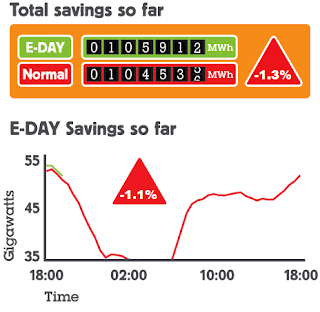
As a result E-Day started at six this evening. It has a glowing write-up on BBC News Online, the support of the Bishop of London - of all people, energy companies and various environmental pressure groups. Power use will be monitored by the National Grid and compared to their business as usual predictions (which should be very good, if they get them too wrong we get blackouts).

Things aren't exactly going well:


They've actually managed to increase energy usage. Ouch!


We'll check back later.

9.40pm: Total "savings" so far are at -1.2%. E-Day is still making things worse! What will we do?

It's about as important as it would have been if things had gone well, i.e. not very. UK electricity generation is a tiny percentage of global emissions.

9.50pm: Bishop Hill has some background on the BBC's support for this farce.

10.58pm: 1.8% total increase in electricity use! Also, apparently this is a 'moral issue'. The Church of England continues its drive to become the religious wing of the BBC.

Midnight: We're a quarter of the way through and so far E-Day has seen 2% higher energy use than expected under 'business as usual'. This is proving about as successful as when anti-capitalists stage one of their periodical 'don't buy things' days.

9.00am: Over half way now and energy use is still 1.3% up on business as usual. It is running 4.4% above business as usual use right now so things are only going to get worse. How long before Dr. Prescott holds an angry, expletive-laden press conference?

2.30pm: Only 0.8% up now. Maybe they'll break even?

4.30pm: Still up 0.7%. They don't have long now. A correspondent from an American think-tank has a suggestion:


"Wouldn’t it be more effective to encourage people to turn on everything they can? The surge in demand could cause a massive blackout, which would force people to use a lot less power for awhile."


Sensible policies for a happier Britain.


9.30pm: I'm back - missed the big moment but checked it on my mobile. Sure enough, they've increased electricity consumption.


What can I say? Except:


9.35pm: Freeborn John smells a rat. I agree with him that the dissapearance of the early excess consumption is very suspicious. It is hard to explain why the pattern in the early hours would look so different at the end compared to when it was actually happening. Also - in terms of anecdotal evidence from watching the meter - the live usage bar always seemed to be running an excess higher than the average, which shouldn't happen. Still, surely they wouldn't rig it that brazenly?

00:30: They've updated the site with this message:

"E-Day did not succeed in cutting the UK's electricity demand. The drop in temperature between Wed 27 Feb and Thurs 28 Feb days probably caused this, as a result of more lights and heating being left on than were originally predicted. The National Grid refined their assessments, based on actual weather data, during Thursday afternoon but I am afraid that E-Day did not achieve the scale of public awareness or participation needed to have a measurable effect. I will do my best to learn the relevant lessons for next time. Thank you to everyone who helped me or left something off specially as their contribution to E-Day, and this Leave It Off experiment. Please enjoy E-Day's solution, video and science sections which all worked well. Warmest regards, Matt"

A few points:

1 - If the temperature had been unexpectedly mild would they have updated the prediction?

2 - How exactly do you define "worked well"?

3 - "Next time"? You've got to be shitting me.

Still, I'm impressed he managed to avoid the term "climate criminals" or call for us to be sent to Climate Camp.

Monday, February 25, 2008

Rambo

You know what struck me most about the new Rambo? It's very pagan.


A few reasons why:

  • Middle Earth was Tolkein's Christian critique of Europe's pagan spirit. In the Lord of the Rings victory belongs not to martial valour, which is hopeless, but to faith and hope. In Rambo the Christian aid workers are the hobbits. Their illusions are shattered and they are saved by pagan military heroics, which are effective. It rebuts Middle Earth.
  • It is brutally violent.
  • The real heroes are overwhelmingly amoral in outlook and attitude but effective and on our side.

I'm not saying it was intended that way. I think that it is entirely possible that the film was intended to send a Christian message. However, the pagan attitude creeps in and has a certain plausibility to it. I sometimes wonder if we don't do enough to understand our Northern European/Germanic roots and how they influence our outlook.

Update: I've set this out in rather more detail on CentreRight.Com

Sunday, February 24, 2008

Indur Goklany on What to Do about Climate Change

Indur Goklany's paper (PDF) for Cato's Policy Analysis is excellent. He goes through, using the Stern Review and DEFRA's Fast Track Assessment as his sources, why even pessimistic accounts of the costs of climate change cannot find more than marginal harms within the foreseeable future. This builds into a case that humanity will actually be better off in the warmer but richer scenarios that were purported to be the worst-case scenarios by Stern and DEFRA's researchers than in a cooler but poorer world.

Goklany argues that adaptation to the specific problems that might be worsened by climate change, such as malaria, is the way forward. His study provides yet more support for the now reasonably well established three-pronged response to climate change; that such an approach is a better idea than aggresive attempts to curb emissions. Technological development, adaptation and resilient free-market institutions can all contribute to an effective response to global warming.

Friday, February 22, 2008

Leaving the country

ChairsWhen economists want to know what people think they try to avoid relying upon asking them. Surveys, opinion polls, personal anecdote and other ways in which people express their opinion can often be misleading or distorted. When and how a question is asked and how it is phrased can seriously affect the outcome of a poll. More importantly, people may express a certain preference in a poll but make quite different choices when asked to make real decisions with real consequences.


It is often better to look at revealed preferences; how people actually behave when faced with actual decisions in real life rather than hypotheticals in a survey.


Some dramatic new evidence of this kind emerged yesterday. High staff turnover often suggests that an organisation is not a pleasant place to work. High numbers of asylum seekers from Venezuela suggest that Hugo Chavez's rule is not very pleasant. The Army's recruitment and retention difficulties suggest that the poor management of the Armed Forces is making them an increasingly unpleasant place to work. In that light, the evidence yesterday that Britain is facing the biggest brain drain in 50 years, that those most able to leave are doing so, is an alarming suggestion that things are going very wrong in Britain today:

"There are now 3.247 million British-born people living abroad, of whom more than 1.1 million are highly-skilled university graduates, say the researchers.

More than three quarters of these professionals have settled abroad for more than 10 years, according to the study by the Organisation of Economic Co-operation and Development (OECD).

No other nation is losing so many qualified people, it points out. Britain has now lost more than one in 10 of its most skilled citizens, while overall only Mexico has had more people emigrate."

Why are people leaving? One suggestion:

"Prof David Coleman, of St John's, Oxford, said the brain drain was "to do with quality of life, laws and bureaucracy, tax and all the rest of it"."

Ever higher levels of tax; little to show by way of public service results for that huge drain on private incomes; an overly meddlesome state that leaves people bereft of control over their own lives. Yesterday's emigration numbers should be a wake-up call for a nation whose government is attempting to do too much and doing a very poor job of it. If things don't change Britain will continue to lose far too many of its best and brightest.

Cross-posted from the TaxPayers' Alliance blog.